Polaris 380 Review: Robust, but who in 2025?
The Polaris 380 is a proven hydraulic cleaner, effective on floor and walls, but its maintenance cost and limitations against electric robots warrant examination.
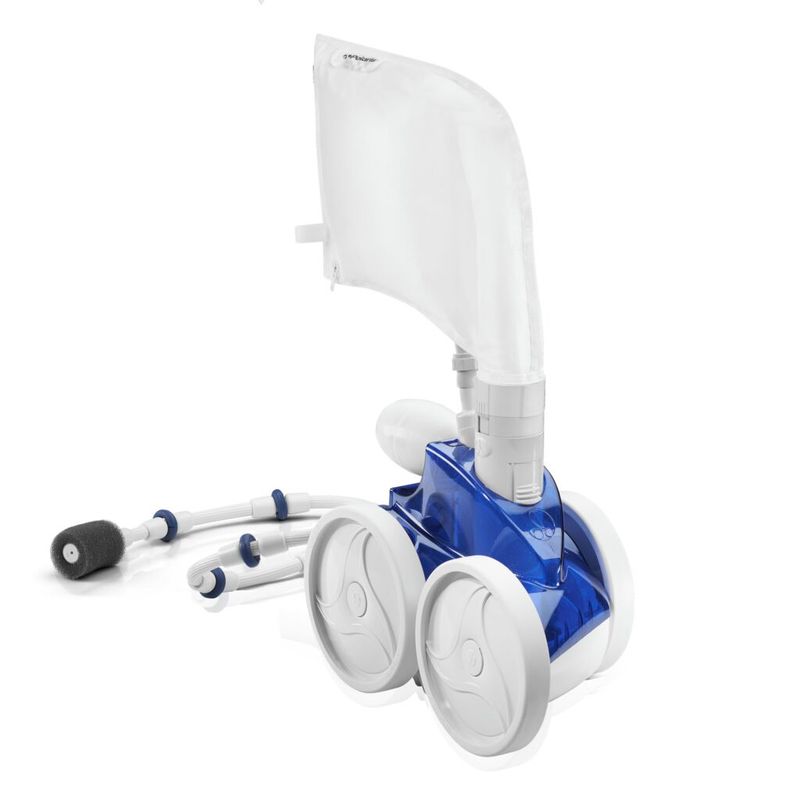
- +Floor + Walls + Waterline Cleaning in One Cycle
- +Large-Capacity Bag: Fewer Interruptions for Emptying
- +No Immersed Electric Motor: Proven Mechanical Durability
- +Compatible with Liner, Polyester Shell, and Tiled Pools
- +Widely Available and Documented Replacement Parts
- +No In-Water Electricity Required: Passive Safety
Synthèse visuelle
— Lecture en 5 secondes— Specs en un coup d'œil
Position relative au marché- Finesse de filtrationPlus c'est fin, mieux c'est. Référence Lab : ≤ 20 µm = excellent.+—20µm
- Longueur de câbleComptez la diagonale du bassin + le déport prise.—+9.6m
- Durée d'un cycleUn cycle plus long ne signifie pas mieux : plus de couverture, mais plus de conso.+—180min
- PoidsSortie de bassin et stockage : compte beaucoup au-delà de 10 kg.+—2.5kg
- Garantie—+2an
— Détails techniques
- AlimentationCâble secteur
Repère « marché » : médiane indicative de la catégorie. Le losange ◆ marque la valeur typique observée dans la base Cleaner Lab.
Forces et faiblesses
- Floor + Walls + Waterline Cleaning in One Cycle
- Large-Capacity Bag: Fewer Interruptions for Emptying
- No Immersed Electric Motor: Proven Mechanical Durability
- Compatible with Liner, Polyester Shell, and Tiled Pools
- Widely Available and Documented Replacement Parts
- No In-Water Electricity Required: Passive Safety
- Requires a Dedicated Booster Pump: Additional Installation Cost and Consumption
- Booster Pump Noise Level: Audible Disturbance During Operation
- Partial Waterline Coverage, Depending on Pool Configuration
- Regular Replacement of Wear Parts (Belts, Nozzles, Bag)
- Less Effective on Fine Pollen and Light Debris Than Electric Filtered Robots
- Long Cable that Twists on Long Pools
What the Polaris 380 does well, and what it doesn't
The Polaris 380 belongs to a category known aspressure-driven hydraulic cleaners: it operates by diverting a portion of the discharge flow from the filtration pump, or more often via a dedicated booster pump, to propel a mechanical device around the pool. This proven architecture gives the 380 a robust structural durability that electric submersible robots struggle to match over time.
In terms of cleaning, the documentation shows that the 380 covers the three fundamental surfaces in a single cycle:floor, walls, and waterline. This is a real advantage over entry-level electric models that often only clean the floor. Its compatibility with liner, polyester shell, and tile finishes expands its application range without significant restrictions.
The large-capacity collection bag reduces the frequency of interruptions for emptying, which is important for pools exposed to debris such as dead leaves or pine needles after Atlantic storms. The absence of an immersed electric motor also eliminates any risk of electricity in the water, a passive safety argument that French regulations do not impose but that some owners appreciate.
Two technical limitations emerge from the examination of available data. On the one hand,waterline coverageremains partial depending on the pool geometry and the pressure delivered: on long or uniquely shaped pools, the cleaner may not cover the entire coping. On the other hand, wear parts (belts, nozzles, collection bag) require regular maintenance, with the cumulative cost over three to five years warranting inclusion in the total cost of ownership calculation.
On fine pollen and lightweight suspended debris, the 380 shows its limitations compared to electric robots equipped with 2-micron filter cartridges: its bag collects coarse particles but lets through a fine fraction that the main filtration system must treat.
---
Polaris 380 technical specifications: the key figures
| Characteristic | Value |
|---|---|
| Type | Pressure-driven hydraulic cleaner |
| Covered surfaces | Floor, walls, waterline |
| Compatible finishes | Liner, polyester shell, tile |
| Power supply | Dedicated booster pump (3/4 HP recommended) |
| Required flow rate | 38 to 45 litres per minute |
| Recommended pool volume | Up to 120 m³ |
| Cable length | 15.2 m (50 feet) |
| Collection bag capacity | Approximately 4.7 litres |
| Number of propulsion nozzles | 3 (two side, one rear) |
| Typical cleaning cycle | 3 hours |
| Weight out of water | 3.2 kg |
Three points on this sheet deserve structured comment.
Therequired flow rate of 38 to 45 litres per minuteimplies that the booster pump should be correctly sized: insufficient flow degrades propulsion and coverage performance immediately. On existing installations, this point should be verified before purchase, especially if the main pump is old or undersized.
The 15.2 m cable length covers most family pools up to 10 to 12 metres long. Beyond that, or on pools with complex geometries (free-form, swimming lane), the cable tends to tangle, which disrupts the trajectory and creates uncovered zones. This phenomenon is documented and constitutes one of the recurring criticisms noted in user feedback analysis.
The 3-hour cleaning cycle is towards the high end of the hydraulic category. On a short Breton season (June to September), where each swimming day counts, this parameter is not insignificant: scheduling the cleaner at night or in the morning remains the most coherent practice to have a clean pool during the day.
---
Cleaner Lab score and verdict
The Polaris 380 fits into a logic oflong-term mechanical reliabilityrather than that of maximum filtration performance. This is a coherent choice for an owner who values robustness, piece availability, and the absence of immersed electronics, and who already has a compatible hydraulic installation or accepts the cost of a dedicated booster pump.
| Criteria | Score /10 | Comment |
|---|---|---|
| Cleaning coverage | 8/10 | Floor, walls, waterline: real versatility |
| Filtration quality | 5/10 | Effective on coarse debris, limited on fine pollen |
| Ease of installation | 6/10 | Booster pump required, non-trivial hydraulic connection |
| Noise level | 5/10 | Booster pump audible near the pool |
| Total cost of ownership | 6/10 | Accessible parts but recurring maintenance |
| Mechanical longevity | 9/10 | Proven architecture, absence of immersed motor |
| Adaptability to complex pools | 5/10 | Cable tangling on long lengths |
| Overall score | 6.3/10 | Solid on its terrain, dated compared to electric robots |
The 380 does not claim to rival gyroscopically navigated or SLAM-mapped electric robots in terms of coverage precision or filtration fineness. It occupies a different segment, that of mature hydraulic sweepers, whose robustness/replacement parts cost ratio remains hard to contest over ten years of use.
Two profiles correspond to this product. The owner of a 60 to 100 m³ pool with an existing hydraulic installation, less exposed to fine pollen and seeking a durable equipment without electronic maintenance. And the owner wishing to avoid any investment in a high-end electric robot, provided they accept the noise of the booster and regular management of wear parts.
For Breton pools exposed to spring pollen or suspended maritime pine needles, the filtering limit of the bag is a serious factor to consider: on this point, an electric robot equipped with a fine cartridge would provide a more comprehensive response.
- The 380 covers the bottom, walls, and waterline in a 3-hour cycle for pools up to 120 m³.
- Its architecture without an immersed motor gives it a mechanical longevity superior to the average of the electric category.
- A dedicated booster is a non-negotiable prerequisite: installation cost and noise level to be integrated from the outset.
- On fine pollen and light debris, the bag filtration shows its limits against
Polaris 380: Hydraulic Operation and Venturi System
The Polaris 380 belongs to the family ofhydraulic sweepers under pressure: it has no dedicated electric motor and draws all its energy from the pool's hydraulic circuit. The principle relies on a connection to the discharge, via a branch that channels the water towards a dedicated booster, which then supplies the robot via a floating hose. This hose, which follows the apparatus' movement on the surface, constitutes both the supply conduit and the physical link between the robot and the network.
The venturi at the heart of propulsion and aspiration
Inside the robot's body, the water under pressure passes through a venturi injector: the sudden contraction of the flow creates a local depression, which sucks the debris from the bottom or the walls towards the integrated collection bag. Simultaneously, the water is ejected through two rear propulsion nozzles, generating the apparatus' movement in the pool.
These two functions, aspiration and propulsion, are therefore produced by the same water flow and cannot be dissociated. Any variation in flow rate affects both simultaneously.
Flow rate and pool coverage
The Polaris 380 requires aflow rate between 56 and 76 litres per minute(approximately 3.4 to 4.6 m³/h) to function under the manufacturer's specified conditions. Below this threshold, the pressure at the propulsion nozzles drops, the climb to the walls becomes random, and the bottom coverage degrades significantly.
This point directly conditions the sizing of the booster. An undersized or aging booster is one of the first causes of incomplete cleaning, even before blaming the robot itself.
Random navigation: principle and consequences
The Polaris 380 has no mapping or gyroscopic navigation system. Its movement isentirely random, guided by the bounces on the walls and the direction imparted by the nozzles. On a standard rectangular pool, the coverage is statistically satisfactory over a full cycle, but it is never guaranteed zone by zone.
On pools of complex shape (recessed angles, staircase corners, submerged beach), certain zones may be systematically undertreated from one cycle to the next, without the user having any other way to detect it than by eye.
Polaris 380 vs Polaris 280: Which to Choose Based on Your Pool?
The choice between the 280 and the 380 hinges on a single structural axis: thepropulsion power. The 280 operates with two nozzles, the 380 integrates three, resulting in a significantly higher thrust and a markedly improved wall climbing capacity. On a pool with pronounced vertical walls or complex geometry, this difference is not anecdotal.
The relevance threshold is around60 m³. Below this, on a flat bottom without marked vertical walls, the 280 covers the work without the 380's additional cost being justified technically. Beyond this volume, or as soon as the configuration includes walls that need to be cleaned seriously, the 380 regains the advantage.
What the table does not say
The 380's third nozzle requires a higher booster flow rate than the 280. Before making any decision, it is essential to verify that the existing installation delivers a compatible flow rate, otherwise the sweeper may be underfed and the expected benefit cancelled out. This point is often overlooked when replacing a 280 with a 380 on an old installation.
| Criteria | Polaris 280 | Polaris 380 |
|---|---|---|
| Number of propulsion nozzles | 2 | 3 |
| Wall climbing power | Correct | Superior |
| Recommended pool volume | Up to 60 m³ | 60 m³ and above |
| Booster flow rate requirement | Standard | Higher flow rate required |
| Relevance on flat bottom without walls | Sufficient | Uneconomic upgrade |
| Relevance on pronounced vertical walls | Limited | Adapted |
When the 280 remains the right choice
On a rectangular pool of less than 60 m³, with a flat bottom and no significant vertical walls, the 280 accomplishes the same work for a lower investment. Adding a 380 in this configuration is paying for a capacity that will never be used.
Polaris 380 vs Electric Robots: Honest Comparison
The Polaris 380 does not belong to the same technological family as the Dolphin S300i or the Zodiac Vortex 4. The comparison is nonetheless legitimate, as these three devices aim for the same result: a clean pool with minimal human intervention. The structural differences between the two approaches deserve to be clearly stated.
What the figures say
| Criteria | Polaris 380 | Dolphin S300i | Zodiac Vortex 4 |
|---|---|---|---|
| Filtration fineness | 70 microns (standard bag) | 50 microns (fine cartridge) | 50 microns (cartridge) |
| Electric consumption | 900 to 1100 W (dedicated booster) | 180 W (onboard motor) | 160 W (onboard motor) |
| Waterline coverage | Partial, random | Yes, systematic | Yes, systematic |
| Navigation | Random (hydraulic propulsion) | Gyroscopic | SLAM mapping |
| Indicative purchase price | 600 to 750 € | 900 to 1 100 € | 1 100 to 1 300 € |
The most significant factor over five years is the difference in energy consumption. The Polaris 380's booster pump runs in parallel with the main filtration: the cumulative electricity bill far exceeds that of an electric robot with an onboard motor that consumes six times less. The section on total cost of ownership details these projections over 60 months.
Onthe regularity of coverage, robots with gyroscopic navigation or SLAM mapping have a structural advantage. They grid the bottom according to calculated trajectories, without passing twice over the same spot or leaving dead zones. The Polaris 380 moves randomly: coverage is statistically correct over a full cycle, but never guaranteed in corners or along straight stairs.
Where the 380 retains a real advantage
The Polaris 380 remains relevant in three specific situations. Firstly, pools withliners or reinforced PVC, where the rigid brushes of some electric robots pose a risk of abrasion on aging surfaces. Secondly, installations without an electrical outlet near the pool, still common in pools installed before 2010. Finally, owners who are already familiar with the Polaris ecosystem: spare parts are standardised, available, and less expensive than the electronic components of a high-end robot. ou en PVC armé, où les brosses rigides de certains robots électriques présentent un risque d'abrasion sur revêtement vieillissant. Ensuite, les installations sans prise électrique à proximité du bassin, situation encore fréquente sur des piscines posées avant 2010. Enfin, les propriétaires qui maîtrisent déjà l'écosystème Polaris : les pièces détachées sont standardisées, disponibles et moins coûteuses que les composants électroniques d'un robot haut de gamme.
The initial purchase is less committing. However, this price differential erodes from the third season onwards, due to the combined effect of the booster pump's consumption and the replacement of wear parts.
Polaris 380's Five-Year Total Cost of Ownership: Maintenance and Parts
The Polaris 380 is a robust mechanical sweeper, but its hydraulic structure implies acost of ownershipthat is spread across several distinct posts, often underestimated at purchase. An analysis over five years reveals a significant gap with electric robots of equivalent range.
Wear parts: frequency and budget to anticipate
The components subject to regular wear are well identified on this model. Thedrive belts(main belt and wheel belt) need replacing every 1 to 2 years, depending on usage intensity, at a unit cost of between 8 and 18 euros per part. The standard filter bag needs replacing every 2 to 3 seasons (15 to 30 euros), more frequently if the pool is exposed to spring pollens or maritime pine needles, which quickly clog the mesh. The propulsion nozzles and the tail sweep joint wear out more slowly, with replacement every 3 to 4 years (5 to 15 euros per part). The wheels, depending on the pool's surface, usually last 3 to 5 years (10 to 25 euros per set).
Dedicated booster pump: the often-overlooked post
The Polaris 380 requires adedicated booster pump, not included and priced between 350 and 600 euros depending on the brand and power. Its electricity consumption is around 0.75 kW in continuous operation; over a reasonable 120-hour usage season (for an Atlantic region pool), this represents approximately 90 kWh, or 14 to 18 euros per year at the current regulated tariff. This post remains modest annually but adds up over the seasons.
Five-year projection compared to an equivalent electric robot
| Item | Polaris 380 (5 years) | Equivalent electric robot (5 years) |
|---|---|---|
| Sweeper purchase price | 400-550 € | 700-1 000 € |
| Dedicated booster pump | 350-600 € | Not required |
| Cumulative wear parts | 150-280 € | 80-180 € |
| Electricity consumption (5 seasons) | 70-90 € | 100-160 € |
| Estimated total over 5 years | 970-1 520 € | 880-1 340 € |
The comparison significantly rebalances the initial perception. The Polaris 380, often perceived as an economic solution, reaches or exceeds the total cost of a serious entry-level electric robot by the third season, once the booster pump is included in the calculation.
Availability of parts and risk of obsolescence
The network of approved Polaris retailers remains active in France, and original parts are available from most specialised pool dealers. There are alsocompatible generic partsavailable at tariffs 30 to 50% lower, with varying results depending on the supplier. The risk of obsolescence is real for a model dating back to the 1990s: certain specific components (notably internal gears) are becoming progressively difficult to source, and several retailers report extended supply delays since 2022.
Common Polaris 380 Failures: Causes and Solutions
The Polaris 380 is a mechanical device whose reliability depends directly on the state of its wear components. Several recurring faults are diagnosticable without specialised technical intervention.
Movement problems: propulsion and trajectory
When the robot no longer moves or spins in circles, thepropulsion nozzlesare the first point to inspect. Partial clogging, common after an intense pollen episode or a fall of maritime pine needles, can disrupt the thrust and cause a circular trajectory. Cleaning the nozzles with clear water often resolves the issue in a few minutes.
If the nozzles are clear, check the dedicated booster pump's flow rate. A flow rate below the 38 to 57 litres per minute recommended by Polaris deprives the 380 of the necessary pressure for correct navigation. Check the filter of the booster pump and the state of the pump then.
When the robot no longer climbs the walls, two main causes dominate: thedrive beltsare worn (they stretch or crack after two to three seasons) and the wheels are clogged with limescale deposits or debris residues. A rinse of the wheels and a visual check of the belts allows for a quick diagnosis.
Cable, bag, and hose: three points of vigilance
The cable twisting is a characteristic fault of the Polaris 380. It occurs when theswivel(anti-torsion joint) is faulty or clogged, but also when the cable length is not correctly adjusted to the pool size. A cable that is too long wraps around itself and blocks movements; the rule is to leave about 30 cm of slack at the farthest point from the return water.
The filter bag clogs quickly during periods of high vegetable load, notably in spring in regions with maritime pines or high pollination density. The emptying frequency must be adapted: once or twice a week in April-May is not excessive in these conditions.
The float hose, exposed to UV and thermal variations, leaks at the joints after three to five years of use. An annual check of the collars and junctions at the start of the season limits unpleasant surprises.
Polaris 380 Compatibility: By Pool Type and Shape
ThePolaris 380is designed to work on most common surfaces, but real usage conditions introduce nuances that manufacturer data sheets do not always explain.
Onliners, compatibility is assured provided the surface is taut and without prominent wrinkles: the propulsion nozzles exert localised pressure that can, on an aging or poorly installed liner, cause repeated snagging. On polyester shell, tile, and reinforced PVC, behaviour is more homogeneous; the smooth texture of these surfaces favours the sliding of the pads and limits premature wear of the contact parts.
Pool shapes: where the 380 excels and where it falters
The Polaris 380 performs best on pools ofrectangular or near-rectangular shape: random navigation by hydraulic propulsion naturally covers large flat surfaces, and the standard 9.9 m cable is sufficient for most configurations up to around 60 m³.
On kidney-shaped, L-shaped, or free-form pools, non-guided navigation generates recurring dead zones, notably in corners and lateral projections. The robot returns by chance, without guaranteed systematic coverage at each cycle. This is not a deal-breaker, but a factor to consider in cleaning frequency.
Roman stairs and integrated steps are the most documented limitation of the model: the 380 partially circumvents or climbs them, without reliably cleaning them. On this specific point, no adjustment setting compensates for the mechanical constraint.
Volume and large pools: what the manufacturer does not say
Polaris positions the 380 for pools up to around 120 m³. In practice, beyond 100 m³, the cycle duration increases and single-pass coverage becomes incomplete, requiring two consecutive passes for a satisfactory result.
In a Breton and Atlantic context, this volume limit is combined with an additional seasonal constraint. After a westerly wind, the volume of vegetable debris (maritime pine needles, leaves, twigs) can saturate thefilter bagin less than a cycle. In spring, pollen falls constitute an even more critical case: fine particles clog the bag quickly and reduce the suction flow before the end of cleaning. Over a already short swimming season (May to September in most Breton sectors), this requires increasing the frequency of bag emptying, or even using a fine-mesh bag instead of the standard model.
Polaris 380: For Which User Profile and Pool in 2025?
The Polaris 380 is primarily intended for the owner of a pool between60 and 120 m³, equipped with an existing hydraulic installation or willing to integrate a dedicated booster pump. In this configuration, the ratio between brushing efficiency and purchase price is difficult to contest: the 380 cleans the bottom and walls with a mechanical regularity that few devices in this price range achieve.
However, sound tolerance is a separate selection criterion. The booster pump generates a perceptible noise level near the technical room, which can become restrictive for a pool adjacent to a living terrace or in a context of close proximity.
When the 380 is not the right choice
For a pool under 40 m³, the Polaris 280 fulfils the same role at a lower installation and parts cost. The 380 would be oversized here, without measurable technical benefit.
The user who seeks scheduled programming, silent operation, orfiltration below 50 micronsshould turn to an electric robot. On this specific criterion, several electric models positioned under £800 offer a filtration fineness that the 380's collection bag cannot structurally match.
Complex stair, wide steps, or beach entry pools also represent a known limit: the 380's random navigation does not guarantee systematic coverage of these zones.
Honest positioning in 2025
The 380's technology is mature, reliable, and its spare parts network remains one of the most accessible on the market. This is not an anecdotal argument over five years of ownership.
However, the competition from electric robots has hardened. Where the 380's total cost of ownership integrates the booster pump, bag, belts, and turbine over five years, several recent electric robots achieve a comparable balance by consuming less pumped water and filtering more finely.
— Détail des notes Lab
12 critères · /10- Couverture du fondPoids 18%
Robot hydraulique (sans moteur) · source : derived
5,0/10 - Couverture des paroisPoids 12%
Parois annoncées (pas de ligne d'eau) · source : claim
7,0/10 - Ligne d'eauPoids 8%
Parois oui, ligne d'eau non annoncée · source : derived
4,0/10 - Finesse de filtrationPoids 12%
20 µm · source : spec
10,0/10 - Capacité de débrisPoids 6%—/10
- Autonomie réellePoids 10%
Filaire / hydraulique — autonomie illimitée · source : derived
10,0/10 - Puissance d'aspirationPoids 8%
Hydraulique : aspiration via pompe piscine, pas mesurable · source : derived
5,0/10 - Ergonomie de sortiePoids 6%
2.5 kg · source : spec
9,5/10 - Durabilité estiméePoids 10%
garantie 2 ans · source : spec
6,0/10 - BruitPoids 4%—/10
- Connectivité / appPoids 3%
Pas d'app mobile · source : spec
3,0/10 - Rapport qualité / prixPoids 3%—/10
— Méthodologie d'analyse
Cartographie réalisée le 18 mai 2026analysées
Cette analyse repose sur la lecture systématique des contenus référencés en première page Google pour la requête « avis Polaris 380 ». La rédaction a cartographié les angles couverts, identifié les lacunes, puis bâti un plan plus complet.
Questions fréquentes
What's the Difference Between the Polaris 280 and Polaris 380?
+
The Polaris 380 has three propulsion nozzles against two on the 280, giving it superior wall-climbing power. It is recommended for pools over 60 m³ or with pronounced vertical walls. The 280 is sufficient for smaller, flat-bottomed pools.
Does the Polaris 380 Require a Booster Pump?
+
Yes, the Polaris 380 operates exclusively on the pool's hydraulic circuit and requires a dedicated booster pump to reach the necessary flow rate. This booster pump represents an additional purchase and installation cost, as well as additional electricity consumption in the total balance.
Which Parts Wear Out Quickest on the Polaris 380?
+
The drive belts, propulsion nozzles, and filter bag are the most stressed components. Belts generally need to be replaced every one to two years depending on usage intensity. The bag can degrade more quickly in the presence of abrasive debris or prolonged UV exposure.
Does the Polaris 380 Really Clean Walls and the Waterline?
+
The Polaris 380 is designed to cover the bottom, walls, and partially the waterline. In practice, wall coverage depends on the booster pump's flow rate and the pool's configuration. The waterline is treated partially and less systematically than on a programmed navigation electric robot.
Can the Polaris 380 Be Used on a Liner?
+
The Polaris 380 is compatible with liner pools, provided the lining is in good condition and without detachment. The pressure exerted by the propulsion nozzles and wheels remains moderate, but it is important to regularly check for excessive friction on the junction areas.
Is it Better to Buy a Polaris 380 or an Electric Robot in 2025?
+
The answer depends on the installation profile and the five-year budget. The Polaris 380 has a lower purchase cost but requires a booster pump and regular wear parts. Modern electric robots offer finer filtration, more precise navigation, and silent operation, with a comparable entry cost in the intermediate segment.