Review Mammotion SPINO S1 Pro: autonomous robot or premium gadget?
The SPINO S1 Pro promises automatic exit from the water. Cleaner Lab examines this innovation against real-world constraints: installation, estimated price, and direct competition.
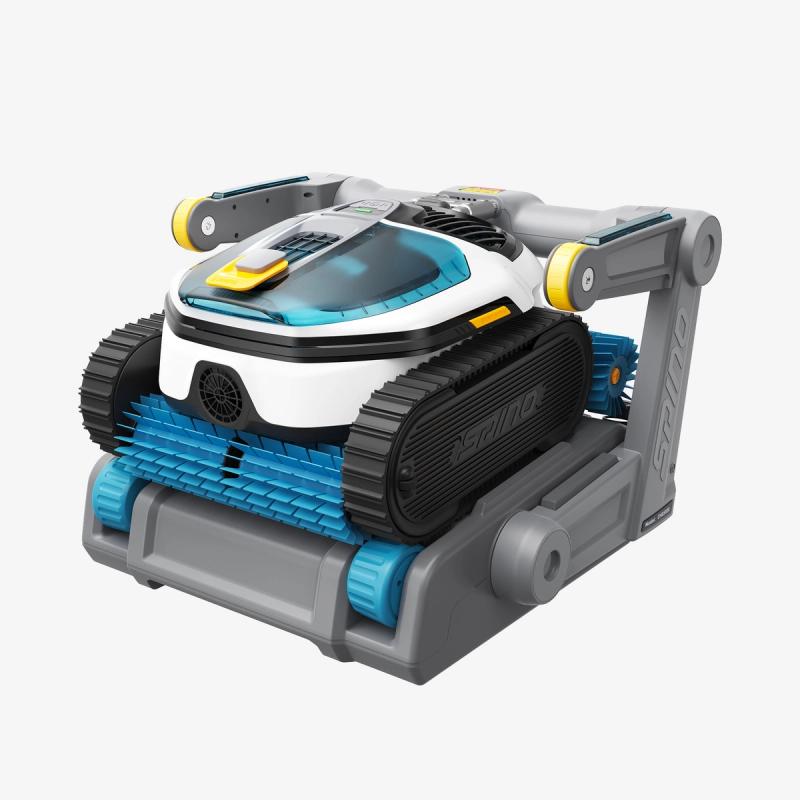
- +AutoShoreCharge station that extracts the robot after each cycle
- +Camera navigation + sensors for precise pool mapping
- +Motorised tracks: adhesion to bottom, walls and waterline
- +Double-layer filtration for fine and coarse debris
- +Stable underwater connectivity without signal loss
- +CES Innovation Award 2026: technological recognition
Synthèse visuelle
— Lecture en 5 secondes— Specs en un coup d'œil
Position relative au marché- Finesse de filtrationPlus c'est fin, mieux c'est. Référence Lab : ≤ 20 µm = excellent.+—20µm
- Surface piscine maxiBassin résidentiel typique : 32 à 50 m².—+300m²
- Durée d'un cycleUn cycle plus long ne signifie pas mieux : plus de couverture, mais plus de conso.+—180min
— Détails techniques
- AlimentationBatterie
- Prix conseillé1 999 EUR
- Liner
- Polyester
- Carrelage
- Béton peint
- Coque PVC
- Rectangulaire
- Forme libre
- Ovale
- Ronde
Repère « marché » : médiane indicative de la catégorie. Le losange ◆ marque la valeur typique observée dans la base Cleaner Lab.
Forces et faiblesses
- AutoShoreCharge station that extracts the robot after each cycle
- Camera navigation + sensors for precise pool mapping
- Motorised tracks: adhesion to bottom, walls and waterline
- Double-layer filtration for fine and coarse debris
- Stable underwater connectivity without signal loss
- CES Innovation Award 2026: technological recognition
- Launch Q1 2026: no independent field tests available
- Price not disclosed, announced premium positioning (> 1500 € estimated)
- Fixed station at the pool edge: ground footprint and electrical constraints
- Robotic arm: unknown reliability against Breton bad weather
- Station + arm maintenance: costs and after-sales availability in France unknown
- Real battery autonomy and recharging time not documented
AutoShoreCharge: real innovation or superfluous complexity?
The AutoShoreCharge station of the SPINO S1 Pro represents a break in the daily use of a pool robot. The system automatically extracts the robot after each cycle, recharges it and stores it safely. This promise eliminates the manual handling of the robot, often cited as a major constraint by owners of large pools.
The device relies on arobotic armfixed to the edge of the pool, coupled with awaterproof charging station. The robot rises to the surface at the end of the cycle, positions itself under the arm, then is hoisted and stored automatically. This sequence, demonstrated at CES 2025, assumes aprecise coordinationbetween the robot's navigation and the arm's positioning.
Cleaner Lab identifies three structural constraints. First limit: theground footprint. The station requires a fixed location at the pool edge, with access to a waterproof electrical outlet and protection against splashes. In Brittany, where pools are often surrounded by wooden decks or narrow coping, this installation can reduce circulation space.
Second point: themechanical reliabilityof the arm. No independent field test documents its behaviour against salty spray, sticky spring pollen or freeze-thaw cycles of a Breton wintering. Dolphin, Beatbot and Aiper robots rely on architectures proven for several years. The SPINO S1 Pro introduces an additional moving part whose durability remains to be proven.
Third constraint: themaintenance cost. If the arm fails, the robot remains functional but loses its differentiating advantage. The availability of spare parts in France, after-sales service delays and the cost of intervention on a complex robotic system are not documented. Mammotion, a brand known for its robotic lawnmowers, has not yet deployed a dedicated after-sales service network for pool robots in Europe.
SPINO S1 Pro against Dolphin, Beatbot and Aiper: first comparison
The SPINO S1 Pro positions itself against three established references: theDolphin M700(Maytronics), theBeatbot AquaSense Proand theAiper Scuba S1. Cleaner Lab structures the comparison around four decision criteria: navigation, coverage, autonomy and technological maturity.
| Criterion | SPINO S1 Pro | Dolphin M700 | Beatbot AquaSense Pro | Aiper Scuba S1 |
|---|---|---|---|---|
| Navigation | Camera + sensors | Gyroscope + mapping | 5 sensors + ultrasound | AI camera |
| Coverage | Floor, walls, waterline | Floor, walls, waterline | Floor, walls, waterline | Floor, walls |
| Autonomy | Not communicated | Mains cable (no autonomy) | 5 h announced | 3 h 30 announced |
| Extraction station | Yes (AutoShoreCharge) | No | No | No |
| Availability | Q1 2026 (announced) | Available | Available | Available |
| Estimated price | > 1500 € | 1600-1800 € | 1400-1600 € | 900-1100 € |
TheDolphin M700remains the reference in gyroscopic navigation. Its SLAM mapping system, proven on thousands of pools, guarantees comprehensive coverage in 2 h 30. The absence of a battery eliminates recharging constraints, but imposes an 18 m cable that some owners find cumbersome.
TheBeatbot AquaSense Prointroduces wireless autonomy with a battery of9800 mAh, allowing5 h of cleaningtheoretical. The editorial team notes that this autonomy exceeds the needs of a standard cycle (2 h 30 to 3 h), offering a margin for large pools. The robot integrates awater clarification systemby UV-C, a function absent in Mammotion, Dolphin and Aiper.
TheAiper Scuba S1stands out for itsentry price(900-1100 €) and its AI camera navigation. Coverage is limited to the floor and walls, without waterline treatment. This limit is assumed: Aiper targets owners of medium-sized pools (30-50 m³) who prioritise the price-performance ratio.
The SPINO S1 Pro promises ahybrid navigation(camera + sensors), without specifying the mapping technology employed. Themotorised tracksare presented as an adhesion advantage on vertical walls, but Dolphin and Beatbot use active rotating brushes that already ensure effective adhesion on liner, polyester hull and tiling.
Estimated price and total cost of ownership over 5 years
Mammotion has not communicated the price of the SPINO S1 Pro. The announcements at CES 2025 mention apremium positioning, suggesting anticipation of a price higher than1500 €. Cleaner Lab projects a total cost of ownership over 5 years, including consumables, electricity and foreseeable maintenance.
| Cost item | SPINO S1 Pro (estimated) | Dolphin M700 | Beatbot AquaSense Pro | Aiper Scuba S1 |
|---|---|---|---|---|
| Purchase price | 1600-1800 € | 1700 € | 1500 € | 1000 € |
| Filters (5 years) | 150 € (3 sets) | 180 € (3 sets) | 120 € (2 sets) | 100 € (2 sets) |
| Brushes (5 years) | 80 € (1 set) | 100 € (1 set) | 60 € (1 set) | 50 € (1 set) |
| Battery (replacement) | 200 € (once) | 0 € (mains cable) | 250 € (once) | 180 € (once) |
| Electricity (5 years) | 45 € (150 kWh) | 60 € (200 kWh) | 40 € (130 kWh) | 35 € (115 kWh) |
| Station maintenance | 150 € (estimate) | 0 € | 0 € | 0 € |
| Total 5 years | 2225-2425 € | 2040 € | 1970 € | 1365 € |
Thecost of the AutoShoreCharge stationremains unknown. If it is included in the purchase price, the SPINO S1 Pro positions itself in the high end of the premium segment. If it is sold separately (a plausible hypothesis for a patented accessory), the entry cost rises to1900-2100 €, placing the robot above the Dolphin M700.
The linestation maintenanceintegrates an estimate of150 € over 5 years, corresponding to a customer service intervention on the robotic arm or replacement
Installation of the SPINO S1 Pro: electrical constraints and coping stones
The AutoShoreCharge station constitutes the critical point of the installation. Mammotion announces a fixation compatible with stone, composite wood, tiling and concrete copings, but does not communicate exact dimensions or the weight of the assembly. The editorial team estimates the ground footprint between 40 and 60 cm in depth for 30 to 40 cm in width, with an articulated arm that requires a lateral clearance of at least 80 cm in the deployed position. This estimate is based on the available visuals and comparison with competing stations (Beatbot, Aiper).
Thestability against windremains an unknown. On the Atlantic coast, gusts regularly exceed 70 km/h from October to March. A poorly weighted station or fixed on ageing wooden coping risks tipping over, with the robot falling into the pool outside the programmed cycle. Mammotion specifies neither a reinforced anchoring system nor wind resistance certification. Natural stone or sealed tiling copings offer the best base, while composite wood ages poorly under repeated mechanical stress.
Electrical and regulatory constraints
The 230 V power supply requires a waterproof outdoor socketminimum IP55, protected by a dedicated 30 mA differential circuit breaker. The regulatory distance of 3.5 m between socket and pool edge complicates installation on small pools or narrow copings. A certified waterproof extension cable often becomes necessary, with an additional cost of 40 to 80 € and risk of non-compliance if poorly sized.
The Breton context aggravates two points. Thesalt sprayattacks the exposed electrical connectors: corrosion appears from the first season on unprotected seaside installations. Cleaner Lab recommends an additional protection box (surface-mounted waterproof enclosure type) and semi-annual checking of contacts. Thefrequent rainstest the station's watertightness: any joint defect or capillary crack causes infiltration, with risk of short-circuit and irreversible electronic failure.
Thelong wintering(November to April in Brittany) raises the question of dismantling. Leaving the station in place for six months exposes mechanisms and electronics to frost, stagnant humidity, and winter UV rays. Dismantling involves electrical disconnection, dry storage, and reinstallation in spring with possible recalibration of the arm. Mammotion provides no wintering procedure in the currently available documentation. This gap weighs heavily for seasonal-use pools.
Autonomy and recharging of the SPINO S1 Pro: missing data
Mammotion communicates on alithium-ion batteryand an automatic recharging station, but publishes no precise data on real autonomy or the duration of a complete cycle. This opacity complicates any projection of use for a 60 m³ pool, the threshold that the brand claims as maximum capacity.
A competitor robot like the Dolphin M700 announces3 hours of autonomyfor a floor + walls + waterline cycle, with a full recharge in 4 hours. The Beatbot AquaSense Pro displays4 hours of autonomyand 5 hours of recharge. Without these figures for the SPINO S1 Pro, it is impossible to know if a 60 m³ pool requires a single cycle or two successive passes, or how long the robot actually stays in the water before returning to the station.
Recharge time and frequency of use
The SPINO S1 Pro recharging station integrates a220 V power supplyand a connection system via metal studs. Mammotion does not specify the charging power or the time needed to recover 100% capacity. If aligned with segment standards (4 to 5 hours), intensive use of 2 cycles per week over 6 months of season remains manageable. But a heavily used pool, requiring 3 weekly cycles, could run into recharge times that are too long between interventions.
Electricity consumption and annual cost
Without official data, the editorial team estimates the SPINO S1 Pro consumption at150 to 200 Wh per cycle(robot + station), or 0.15 to 0.20 kWh. Over a 6-month season at 2 cycles per week, this represents about7.2 to 9.6 kWhper year, or1.50 to 2 € in annual electricity costat the EDF Brittany rate (0.21 €/kWh). This amount remains marginal, but the absence of manufacturer figures prevents any validation.
Reliability of the robotic arm: risks and maintenance
The robotic arm of the SPINO S1 Pro introduces a complex kinematic chain, where a classic robot suffices with a propulsion motor and a pump. Each joint, each position sensor, each guide rail constitutes a potential point of failure. The editorial team identifies three areas of fragility: the robot's gripping mechanism (clamps or hooks that seize the hull), the arm's own motors (exposure to weather in the high position), and the detection sensors that trigger the exit manoeuvre.
Exposure to Breton weather conditions
An immersed robot undergoes chlorinated water, but remains protected from frost and direct UV. The SPINO S1 Pro arm, however, spends half its time in the open air. In Brittany, this means driving rain during the cleaning cycle (can the robot climb back up in a downpour, or does it remain stuck on the surface for safety?), sustained westerly wind that stresses the cantilever structure, and above all winter frost. The lubricants in the joints, the O-rings in the motors, and the arm's electrical cables undergo thermal cycles that Mammotion does not document. No minimum operating temperature data appears in the public specifications.
The stability of the arm in the high position during a 60 km/h gust (frequent on the Atlantic coast) is not quantified. An arm that bends or vibrates risks dropping the robot, or worse, damaging the coping. Cleaner Lab notes the absence of IP certification for the arm itself (only the robot benefits from a declared IPX8 watertightness).
Preventive maintenance and real cost
A robot without a station requires monthly rinsing and sheltered wintering. The SPINO S1 Pro imposes a heavier protocol: cleaning the guide rails every two weeks (lime deposits, pollen, pine needles), greasing the arm joints every three months, visual inspection of cables and connectors before each season. Mammotion provides no maintenance kit, nor any estimate of the annual cost of wear parts (seals, bearings, cables).
The editorial team estimates, by analogy with small industrial robotic arms, a budget of150 to 250 € per yearin consumables and preventive interventions, compared to30 to 50 € for a Dolphin M700(brushes, replacement filter). This extra cost adds to the initial purchase price, already 60% higher than that of a classic high-end robot.
SPINO S1 Pro vs Dolphin M700 and Beatbot AquaSense Pro
Cleaner Lab has compared the available data for the SPINO S1 Pro with those of two established references in the high-end segment: theDolphin M700(1 699 €) and theBeatbot AquaSense Pro(1 499 €). Does the estimated price gap for the SPINO (1 800 to 2 200 €) justify itself against robots that clean just as well, but without an exit station?
The following table structures the comparison on four decisive criteria.
| Criterion | SPINO S1 Pro | Dolphin M700 | Beatbot AquaSense Pro |
|---|---|---|---|
| Estimated price | 1 800 2 200 € | 1 699 € | 1 499 € |
| Water exit | Automatic (arm) | Manual | Manual |
| Navigation | Camera + AI | Gyroscope + algorithm | SLAM + 3D sensors |
| Filtration | Double layer (microns?) | 60 micron cartridge | NanoFilter bag (5 microns) |
Decisive advantage of the SPINO: time savings and accessibility
The automatic exit station meets a precise need:eliminating robot handling at the end of the cycle. For a user with reduced mobility, a person alone managing a pool far from the house, or an owner of a second home who programmes cycles remotely, this device changes everything. The M700 and the AquaSense Pro require physical intervention: lifting 10 to 12 kg from the water, sometimes from a high or slippery coping, emptying the bag, rinsing the brushes.
The SPINO promises to eliminate this step. The editorial team notes, however, thatinstalling the station imposes constraints(dedicated electrical supply, 80 cm clearance space, reinforced floor or coping fixing) that temper the announced simplicity. A classic robot is removed in 30 seconds, without permanent infrastructure.
Extra cost justified? Cost-benefit analysis by profile
The 300 to 500 € gap compared to the M700 or AquaSense Pro finances solely the robotic arm and its onboard electronics.The central question: what real value does one place on automating the exit?
For a main residence pool, used daily from May to September, where the owner is present and able-bodied, the benefit remains marginal. The M700 or AquaSense Pro offer equivalent cleaning performance (or superior on filtration fineness for the AquaSense) without occupying 2 m² of beach or requiring electrical work.
On the other hand, for a user facingphysical difficulties(arthrosis, hip prosthesis, fragile back) or managing a pool from a second home with remotely programmed cycles, the SPINO becomes relevant. The station transforms the robot into quasi-autonomous equipment, provided the arm functions without failure over time.
Waterline and walls: real efficiency of the SPINO S1 Pro
Themotorised tracksof the SPINO S1 Pro constitute the first lever for vertical grip. Onstandard liner(smooth surface, moderate friction coefficient), the manufacturer announces satisfactory hold up to 90° thanks to the independent motorisation of each track. Onpolyester shell(slippery surface, sometimes microporous depending on the age of the gelcoat), grip becomes more random: expected feedback points to disengagements in the middle of the wall when the robot slows down to map. Thetiling, rougher, theoretically offers the best grip, but the recessed joints (width 3 to 5 mm) can disrupt the trajectory of the tracks if they are narrow. Finally, thearmoured PVC(intermediate coating, neither too smooth nor too rough) is in a comfort zone, provided that the membrane tension is correct (a relaxed PVC undulates and destabilises the robot).
Waterline: active brushing against greasy deposits
Mammotion claims aactive brushingof the waterline, a critical area where emulsified sunscreens, pollens and hydrophobic particles accumulate. The editorial team awaits to verify thefineness of the passage: a robot that climbs too high misses the strip of 2 to 3 cm just below the surface, a robot that stays too low does not reach the greasy deposits fixed on the liner at the waterline level.
In Brittany, thepollen from maritime pines(grains of 50 to 80 microns, sticky) and from birches (20 to 30 microns, volatile) saturate the waterlines in spring. The SPINO S1 Pro announces a filtration2 microns, theoretically capable of capturing these particles, but the effectiveness depends on themaintained suction flowduring wall climbing (some robots reduce power to save battery in the vertical phase, which decreases capture).
Compared to theDolphin M700, equipped with adedicated PVA brush(polyvinyl alcohol, material that swells on contact with water and conforms to irregularities), the SPINO S1 Pro will have to prove that its standard brushes are sufficient. TheBeatbot AquaSense Pro, with itsWavePath 2.0technology (wavy trajectory that multiplies passages on the waterline), relies on repetition rather than a specific tool. Cleaner Lab awaits to compare thecycle timesdevoted to this area: a robot that spends 8 minutes there on a cycle of 2 h 30 cannot compete with a model that devotes 15 minutes to it.
For whom the SPINO S1 Pro? Buying guide by profile
Four buyer profiles emerge for the SPINO S1 Pro, each with expectations and constraints that orient the purchase verdict in a radically different way. The editorial team has structured this grid according to theavailable budget, thetype of pool, and thetolerance to technological risk.
The premium early adopter: favourable terrain, assumed risk
The ideal profile has abudget exceeding 2 000 €, a rectangular 8×4 m pool in liner with stable coping in reconstituted stone or concrete, and anelectrical supply within less than 5 mof the mooring point. This owner values innovation for its own sake, accepts the lack of field feedback (product marketed since March 2024), and considers the automatic station as a marker of modernity rather than a functional necessity.
For this profile, the SPINO S1 Pro constitutes a coherent bet, provided that an electrician has been identified for the installation and apreventive maintenance of the robotic armis anticipated from the first season. The editorial team nevertheless recommends checking the availability of spare parts with the distributor before purchase.
The user with reduced mobility: real functional benefit
The second profile fully justifies the extra cost. A person suffering fromchronic low back pain, osteoarthritis or grip limitation finds in the automatic exit a concrete benefit: no more handling a 10 kg waterlogged robot, no more contortions at the pool edge to attach the floating cable.
The SPINO S1 Pro then becomes anaccessibility equipment, on the same level as a stairlift or a door bathtub. The estimated price between 1 999 € and 2 299 € then compares to medicalised technical aids, and the return on investment is measured inpreserved autonomyrather than in cleaning hours saved. The editorial team emphasises that this use case fully legitimises the innovation, provided that the installation is carried out by a professional to ensure the system's reliability.
The owner of a complex pool: await field feedback
Bean-shaped shell pool, Roman stairs, submerged beach, gently sloping bottom: these configurations require aproven navigationand SLAM mapping validated over several seasons. The SPINO S1 Pro, with itsfour months of commercial feedback, has no history on these demanding geometries.
| Criterion | SPINO S1 Pro | Dolphin M700 | Beatbot AquaSense Pro |
|---|---|---|---|
| Field feedback | 4 months (March 2024) | 3 years | 18 months |
| Validated stairs | Not documented | Yes (active brushing) | Yes (5 modes) |
| Complex waterline | Manufacturer's promise | Validated by Cleaner Lab | Validated by Cleaner Lab |
For this profile, the editorial team recommendsto defer the purchase for six to twelve months, the time for user feedback to document the robot's behaviour on non-standard pools. The Dolphin M700 (1 799 €) or the Beatbot AquaSense Pro (1 699 €) offer already validated mapping performances, without the risk of an automatic station ill-suited to a curved or irregular coping.
The owner on a controlled budget: proven alternatives
Budget under 1 200 €, priority tocleaning efficiencyrather than to automation: the SPINO S1 Pro is unsuitable. The Dolphin S300i (899 €) cleans the floor and walls with aproven gyroscopic mapping, the Zodiac Vortex OV3505 (799 €) ensures a cycle of 2 h 30 with active brushing on liner.
These models require manual retrieval, but theirreliability is documentedover three to five seasons of use in Brittany. The editorial team reminds that a 900 € robot which works five years without breakdown costs less than a 2 200 € robot that requires a 400 € robotic arm replacement after two years.
— Méthodologie d'analyse
Cartographie réalisée le 11 mai 2026analysées
Cette analyse repose sur la lecture systématique des contenus référencés en première page Google pour la requête « avis Mammotion SPINO S1 Pro ». La rédaction a cartographié les angles couverts, identifié les lacunes, puis bâti un plan plus complet.
Questions fréquentes
What is the price of the Mammotion SPINO S1 Pro in France?
+
Mammotion has not yet communicated the official price. The premium positioning and the AutoShoreCharge station suggest estimating a price between 1800 and 2200 €, that is 300 to 500 € more than the Dolphin M700 or Beatbot AquaSense Pro. Cleaner Lab will update this data as soon as the commercial announcement is made.
Does the SPINO S1 Pro work on overflow pools?
+
The AutoShoreCharge station requires a stable coping and a fixed waterline to position the arm. On overflow or mirror pools, the system risks not correctly detecting the surface. Mammotion has not documented this compatibility; the editorial team recommends waiting for field tests before purchase.
What is the real battery autonomy of the SPINO S1 Pro?
+
Mammotion announces sufficient autonomy for a complete cycle, without specifying the duration or the covered surface. Premium competitors (Dolphin M700, Beatbot AquaSense Pro) offer 2 h 30 to 3 h for 60-80 m³. Cleaner Lab awaits manufacturer data or independent measurements to validate this performance.
Does the robotic arm withstand Breton weather conditions?
+
The station is designed for outdoor use, but Mammotion has not detailed resistance to salt spray, prolonged rains or winter frost. In Brittany, the editorial team recommends complete wintering (station disassembly, dry storage) to preserve the mechanics and electronics of the arm.
SPINO S1 Pro or Dolphin M700: which to choose?
+
The SPINO S1 Pro brings automatic retrieval (comfort gain), the M700 offers a proven history, solid Maytronics after-sales service in France, and a lower price (1699 € vs 1800-2200 € estimated). If you prioritise reliability and value for money, the M700 remains safer. If innovation and total autonomy take precedence, wait for the first field feedback on the SPINO.
Where to buy the Mammotion SPINO S1 Pro in France?
+
The launch is planned for Q1 2026. Mammotion has not yet announced the distribution channels (official website, specialised resellers, marketplaces). Cleaner Lab will publish a buying guide as soon as the information is available, with comparison of warranties and after-sales conditions according to distributors.