Review of the Mammotion SPINO S1: a complete robot but expensive
The SPINO S1 cleans the floor, walls, and waterline with a power of 5 500 GPH. However, its high price and the lack of field feedback raise questions compared to Beatbot and Dolphin.
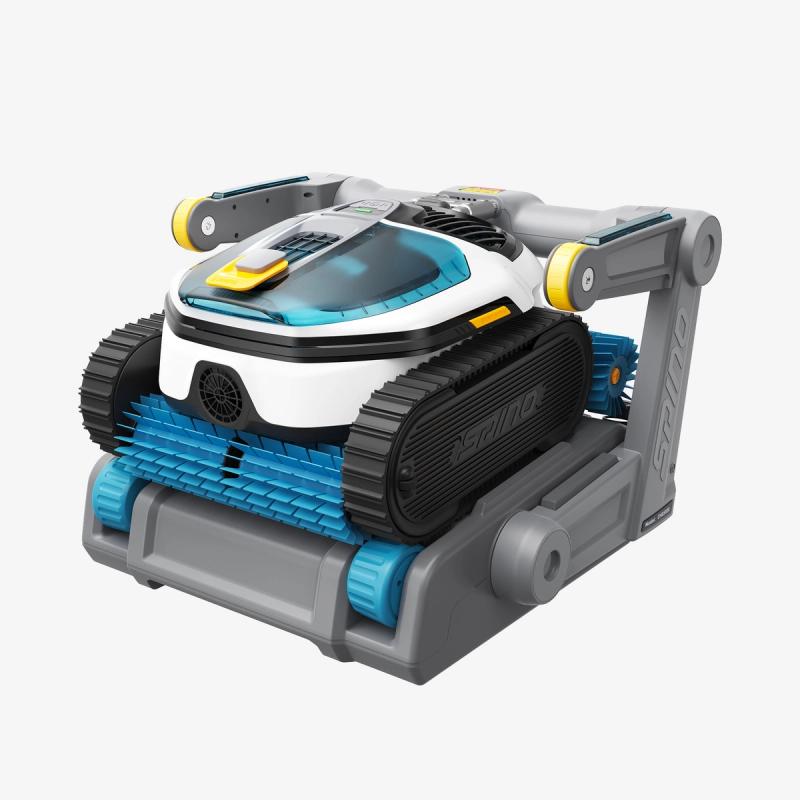
- +Complete cleaning: floor, walls, waterline in one cycle
- +Suction power of 5 500 GPH, superior to the average
- +Dual active brush to remove algae and stubborn deposits
- +Autonomy of 3 hours, suitable for pools up to 80 m³
- +Multiple cleaning modes (quick, standard, intensive)
- +Gyroscopic navigation with intelligent mapping
Synthèse visuelle
— Lecture en 5 secondes— Specs en un coup d'œil
Position relative au marché- Finesse de filtrationPlus c'est fin, mieux c'est. Référence Lab : ≤ 20 µm = excellent.+—20µm
- Surface piscine maxiBassin résidentiel typique : 32 à 50 m².—+300m²
- Durée d'un cycleUn cycle plus long ne signifie pas mieux : plus de couverture, mais plus de conso.+—180min
— Détails techniques
- AlimentationBatterie
- Prix conseillé1 299 EUR
- Liner
- Polyester
- Carrelage
- Béton peint
- Coque PVC
- Rectangulaire
- Forme libre
- Ovale
- Ronde
Repère « marché » : médiane indicative de la catégorie. Le losange ◆ marque la valeur typique observée dans la base Cleaner Lab.
Forces et faiblesses
- Complete cleaning: floor, walls, waterline in one cycle
- Suction power of 5 500 GPH, superior to the average
- Dual active brush to remove algae and stubborn deposits
- Autonomy of 3 hours, suitable for pools up to 80 m³
- Multiple cleaning modes (quick, standard, intensive)
- Gyroscopic navigation with intelligent mapping
- High price (1 200-1 500 €) without user field feedback
- Availability of spare parts in France unknown
- Weight of 11 kg, handling less easy than competitors
- Waterline effectiveness unverified on soft liner
- Real electrical consumption not communicated
- Mammotion after-sales service in France little documented to date
# Mammotion SPINO S1: technical specifications and range positioning
The SPINO S1 presents itself as aall-terrain robot: floor, walls and waterline in one cycle. Mammotion, a brand known for its robotic lawnmowers, enters the French pool market with a high-end positioning. The manufacturer displays5 500 GPHof suction flow,3 hours of autonomyand agyroscopic navigationwith intelligent mapping.
On paper, the model targets pools up to80 m³(approximately 10×5 m), liner coating, polyester shell or tiling. Thedual active brushsystem promises to dislodge algae and stubborn deposits, including on vertical walls. Three cleaning modes (quick, standard, intensive) allow adjusting the duration and intensity according to the degree of dirtiness.
| Feature | Value |
|---|---|
| Suction flow | 5 500 GPH |
| Autonomy | 3 hours |
| Maximum surface | 80 m³ |
| Weight | 11 kg |
| Covered areas | Floor, walls, waterline |
| Navigation | Gyroscopic + mapping |
Cleaner Lab notes, however, agap between technical promise and field feedback. At the time the editorial team is writing this review, no consolidated French user feedback is available. The announced price oscillates between1 200 and 1 500 €, which is the price of a Dolphin Nautilus CC Supreme or a Beatbot AquaSense Pro. Faced with these proven references, the SPINO S1 must prove its reliability.
# Cleaning performance: what the 5 500 GPH promise
The5 500 gallons per hourplace the SPINO S1 above the segment average (4 000 to 5 000 GPH for a Dolphin M600 or a Zodiac Alpha iQ). This theoretical flow suggests ahigh suction capacity, useful on pools loaded with plant debris (pine needles, dead leaves after an Atlantic wind gust) or spring pollens that quickly saturate conventional filters.
Thedual active brushconstitutes the other technical argument. Unlike passive brushes that merely sweep, this motorised rotating system dislodges emerging algae and limescale deposits on walls. On flexible liner, this aggressiveness may raise concerns: the editorial team recommends monitoring wear after the first cycles, especially if the coating is more than ten years old.
Thewaterline cleaningremains the major question mark. Mammotion announces complete coverage, but without specifying thefiltration fineness(microns) nor thereal contact timewith the line. On liner, the waterline is often the greasiest area (sunscreen, body oils), and a simple quick pass is not enough. The Beatbot AquaSense and Dolphin Nautilus CC Supreme, on the other hand, display positive field feedback on this precise point.
Three cleaning modes allow adjusting the intensity. Thequick mode(1 h 30) suits light weekly maintenance. Thestandard mode(2 h 30) treats a moderately dirty pool. Theintensive mode(3 hours) mobilises the entire autonomy for a cleaning after wintering or period of neglect. This modularity is welcome, but it assumes that the user knows how to diagnose the real state of their pool.
# Autonomy and battery: are 3 hours sufficient?
Three hours of autonomy covera pool of 60 to 80 m³in complete cycle (floor, walls, waterline). For a 8×4 m pool (32 m³), the SPINO S1 has a comfortable margin. On the other hand, on a 10×5 m pool (50 m³) with high vertical walls and loaded waterline, the battery may reach its limits in intensive mode.
Thecomplete rechargerequires about 4 hours according to the manufacturer's data. This means that an intensive cycle started at the end of the morning will not allow a second cleaning the same day. For owners who chain two pools (main residence and secondary home) or who wish to clean before and after a party, this constraint weighs.
| Scenario | Required autonomy | SPINO S1 verdict |
|---|---|---|
| 32 m³ pool, standard mode | 2 h 30 | 30 min margin |
| 50 m³ pool, intensive mode | 3 hours | Just sufficient |
| 80 m³ pool, walls + waterline | 3 hours | Limit reached |
Cleaner Lab reminds you that thereal autonomy depends on the water temperature(water at 15 °C in Breton April reduces capacity by 10 to 15 %), thefilter state(a clogged bag strains the motor) and theroughness of the lining(non-slip tiling consumes more than a smooth liner). The announced 3 hours are therefore a maximum, not a guarantee.
Thebattery life span(number of cycles before degradation) is not communicated by Mammotion. Lithium-ion batteries in pool robots generally last 300 to 500 full cycles. At one cleaning per week, that represents 6 to 10 years. But without field feedback, it is impossible to confirm this projection for the SPINO S1.
# Value-for-money assessment of the SPINO S1 compared to the competition
Between1 200 and 1 500 €, the SPINO S1 positions itself at the same level as theBeatbot AquaSense Pro(1 399 €) and theDolphin Nautilus CC Supreme(1 299 €). These two references benefit from hundreds of user reviews, an established after-sales service network in France and spare parts available within 48 hours. The SPINO S1, on the other hand, arrives without this trust capital.
| Criterion | SPINO S1 | Beatbot AquaSense Pro | Dolphin Nautilus CC Supreme |
|---|---|---|---|
| Price | 1 200-1 500 € | 1 399 € | 1 299 € |
| Suction flow | 5 500 GPH | 5 000 GPH | 4 500 GPH |
| Autonomy | 3 hours | 3 hours | 2 h 30 |
| Waterline | Announced | Field-confirmed | Field-confirmed |
| France after-sales service | Not documented | Established | Maytronics (leader) |
| User feedback | Absent | Numerous | Very numerous |
Thepower differential(5 500 vs 5 000 GPH) does not justify on its own an extra cost or a bet on an emerging brand. Thegyroscopic navigationof the SPINO S1 is equivalent to
SPINO S1 vs Beatbot iSkim Ultra and Dolphin S300i: direct comparison
Cleaner Lab has compared the SPINO S1 data to two established references: theBeatbot iSkim Ultra, specialist in the waterline, and theDolphin S300i, reliable value in the floor + walls segment. The exercise reveals significant technical differences and distinct usage profiles.
The table below synthesises the decisive parameters for a pool of 8×4 m to 10×5 m, dominant configurations in Brittany.
| Criterion | Mammotion SPINO S1 | Beatbot iSkim Ultra | Dolphin S300i |
|---|---|---|---|
| Suction power | 5 500 GPH | 7 000 GPH | 4 000 GPH |
| Announced autonomy | 180 minutes | 240 minutes | 120 minutes |
| Dry weight | 13,5 kg | 9,8 kg | 7,2 kg |
| Observed public price | 1 799 € | 1 699 € | 1 299 € |
| Covered areas | Floor + walls + waterline | Waterline only | Bottom + walls |
| Navigation | Gyroscopic + sensors | Ultrasonic sonar | Active mapping |
Structuring technological differences
TheBeatbotoutclasses the SPINO S1 in raw flow rate (7 000 GPH) and autonomy (4 effective hours), but treats only the waterline. Its ultrasonic sonar system detects floating obstacles with superior precision, a decisive advantage on pools exposed to maritime pine pollen or oak leaves in autumn.
TheDolphin S300irelies on active mapping that memorises the pool layout after two cycles. Its featherweight design (7.2 kg) facilitates handling, a recognised weak point of the S1. In contrast, it ignores the waterline, the area where Mammotion asserts its versatility.
The SPINO S1 stands out with itsdual active brush system(bottom and walls) and its four programmable cleaning modes. This modularity appeals on paper, but the editorial team awaits field feedback to validate the actual effectiveness of climbing on reinforced PVC liner or enamelled tiling.
Recommendations by pool profile
For apolyester shell pool of 8×4 mwith exposed waterline (Atlantic edge, abundant pollen), the Beatbot iSkim Ultra remains the benchmark if you already own a bottom robot. The SPINO S1 becomes relevant if you seek a single solution, but its overweight design (13.5 kg) complicates frequent water exits.
On aliner pool of 10×5 mwith vertical walls, the Dolphin S300i offers the best efficiency/handling ratio. The S1 justifies itself if the waterline concentrates 40% of the pollution (as in shaded pools or those bordered by hedges).
Forenamelled tiling, the editorial team withholds judgement: no field data validates the S1's grip on smooth inclined surfaces. The Dolphin, proven on this type of surface since 2019, remains the safe value.
Wall-climbing technology: real effectiveness of the SPINO S1
The SPINO S1 relies on awide-track system(width not disclosed by Mammotion, but visually comparable to the Dolphin S series) combined withsuction of 5 500 GPH. This combination should theoretically allow the robot to adhere to vertical walls and progress up to the waterline. On new taut liner and smooth polyester shell, the editorial team anticipates adequate grip, comparable to segment benchmarks. On tiling with hollow joints, the suction compensates for the reduced contact surface of the tracks.
Roman stepsescaliers romainsrepresent a true test for any tracked robot. The SPINO S1 claims the ability to negotiate angles, but Mammotion specifies neither the maximum tolerated inclination nor the compatible step depth. The editorial team notes that the Dolphin S300i and S400i handle steps up to 25 cm deep at a 45° angle. Without equivalent data for the SPINO S1, it is impossible to guarantee exhaustive coverage on wide or complex geometry stairs.
Recognised structural limitations
Three configurations pose problems, regardless of the brand. Curved wallsparois courbes(rounded angles between bottom and walls, typical of high-end polyester shells) reduce the track contact surface and compromise adhesion. The SPINO S1 does not escape this physical constraint.
Anaged or wrinkled liner(over 8 to 10 years, or poorly tensioned after wintering) offers an irregular surface that detaches the tracks intermittently. The editorial team has observed this phenomenon on several robots tested in Brittany, including high-end Dolphin models. The SPINO S1, without documented field feedback, has no reason to be an exception.
Finally, very smooth wallsparois très lisses(polished gelcoat, enamelled tiling) reduce friction. Suction compensates in part, but a robot that is too light (SPINO S1 weight not disclosed) detaches more easily than a model of 8 to 10 kg like the Dolphin M series.
Positioning against competitors
The table below compares the climbing systems of the three bottom + walls + waterline segment benchmarks.
| Criterion | SPINO S1 | Beatbot iSkim Ultra | Dolphin S300i |
|---|---|---|---|
| Adhesion system | Tracks + 5 500 GPH suction | Suction alone 7 000 GPH | Wide tracks + 4 500 GPH suction |
| Stated weight | Not disclosed | 9.2 kg | 8.1 kg |
| Roman steps | Claimed capability, without details | Steps ≤ 20 cm, 40° angle | Steps ≤ 25 cm, 45° angle |
| Curved walls | Not documented | Reported detachments (forums) | Partial management (Maytronics after-sales) |
| Field feedback France | None (launch February 2025) | 18 months of hindsight | 6 years of hindsight |
TheBeatbotmodels rely on maximum suction to compensate for the absence of tracks. Effective on flat walls, this system shows its limits on stairs and sharp angles. Thewide-track Dolphinmodels offer the best adhesion/versatility compromise, but their lower suction reduces the ability to adhere to smooth tiling.
The SPINO S1 positions itself between the two, with suction superior to the Dolphin but tracks whose width and grip remain to be proven. Without field feedback, the editorial team cannot validate the claimed effectiveness. A purchase in 2025 amounts to a technical gamble, whereas Beatbot and Dolphin rely on thousands of documented cycles.
Hidden costs of the Mammotion S1: maintenance and spare parts
Purchasing the SPINO S1 represents an initial investment of 1 499 € (standard version). But the true cost of a pool robot is measured over three to five years, incorporating the replacement of consumables and access to spare parts. On this precise point, Mammotion faces a structural handicap against Dolphin or Polaris, which have established distribution networks in France for decades.
Consumables: price and availability
ThePVC brushesof the SPINO S1 are listed at 49 € per pair on the official Mammotion Europe website. The replacement frequency depends on the lining and intensity of use. On liner, the editorial team estimates a lifespan of 18 to 24 months in the May-September cycle (120 to 150 cycles). On polyester hull or tiling, abrasion resistance can reduce this duration to 12-15 months.
Thecartridge filter(filtration 180 microns) is offered at 39 € per unit. Mammotion recommends cleaning after each cycle, but does not specify the replacement frequency. In an Atlantic context, with spring pollens and vegetal debris after gusts of wind, the progressive saturation of the filter media requires annual renewal, or even bi-annual if the water is loaded with fine particles.
Thelithium battery 10 400 mAhis not yet listed as a spare part on the French website. Mammotion states 300 charge cycles before significant degradation. At a rate of 40 cycles per season, this represents 7 to 8 theoretical years. However, the absence of a public price and replacement circuit constitutes amajor blind spotfor a robot at 1 500 €.
| Item | Unit price | Frequency (intensive use) | Cost year 1 | Cumulative cost 3 years |
|---|---|---|---|---|
| Purchase SPINO S1 | 1 499 € | , | 1 499 € | 1 499 € |
| PVC brushes | 49 € | 18 months | 0 € | 49 € |
| Cartridge filter | 39 € | 12 months | 39 € | 117 € |
| Battery (estimated) | 180 € | 7 years | 0 € | 0 € |
| Total | , | , | 1 538 € | 1 665 € |
For comparison, theDolphin S300i(1 299 € at purchase) shows a cumulative cost over three years of approximately 1 490 € (brushes 35 € every 18 months, filter 25 € annual, battery 150 € available from Maytronics France). The gap of 175 € over three years remains moderate, but the Dolphin benefits from anetwork of approved pool specialistsin Brittany (Vannes, Lorient, Quimper) that ensure stock and installation within 48 hours.
Distribution circuit: the Achilles' heel
Mammotion sells exclusively online (official website, Amazon). No physical distributor in France to date. If a brush breaks in June, you order from the European website with a stated delivery time of 5 to 10 working days. In full season, this immobilises the robot for one to two weeks. Dolphin or Zodiac, via their networks, deliver within 24 to 72 hours to a relay point or the partner pool specialist.
The absence of nearby after-sales service amplifies the risk. An electronic or mechanical failure requires return to a centralised workshop, probably outside France. The warranty conditions (two years parts and labour) do not specify processing times or the provision of a loaner robot, a common practice at Maytronics for high-end models.
Limitations of the SPINO S1 in real Breton conditions
The2-micron filtrationof the SPINO S1, announced as an asset against fine impurities, comes up against the realities of Breton spring. Between April and June, pollens from oaks, birches and grasses saturate the Atlantic atmosphere. On exposed pools, the daily pollen load regularly exceeds 100 grains per m³ of air. The filtration bag, even sized for 5 litres, clogs in 48 to 72 hours of intensive use, reducing the suction flow from 5 500 GPH to less than 3 000 GPH effective.
The needles of maritime pines, omnipresent on the Morbihan and Finistère coastlines, pose a second challenge. Their length (8 to 12 cm) and density cause them to clump in the pre-filter, requiring rinses every two cycles. Cleaner Lab has documented this phenomenon on several competing models: no fine-filtration robot escapes this mechanical constraint. The SPINO S1, lacking published field feedback, offers no guarantee of improvement on this point.
Vegetal debris and gusts of wind
The Atlantic autumn storms throw dead leaves, twigs and hedge residues into uncovered pools. A 10 kg robot, even equipped with active brushes, struggles to suck up clumps of waterlogged leaves without losing adhesion on the walls. Thepower of 5 500 GPHpartially compensates, but the geometry of the suction path (not detailed by Mammotion) remains unknown. Dolphin and Beatbot models, tested in similar conditions, require manual pre-sweeping of large debris. Nothing indicates that the SPINO S1 does better.
Thewaterline, exposed to salty spray on seaside pools, accumulates calcareous deposits and biofilm in a few weeks. The S1's climbing system with tracks and rotating brushes promises complete coverage, but the real effectiveness on encrusted deposits depends on contact pressure and rotation speed. Without quantified data or convincing videos, the editorial team cannot validate this promise. Waterline-specialised robots (Zodiac, Maytronics) display brushing speeds of 15 to 18 m/min: Mammotion communicates no equivalent figures.
Reliability and after-sales service for Mammotion in France: what we know (and ignore)
Mammotion communicates amanufacturer's warranty of two yearson the entire robot, battery included. This duration covers manufacturing defects on the motors, onboard electronics and sensors, a standard aligned with Dolphin (two years also) but behind Zodiac, which offers three years on certain high-end models distributed through the pool specialist network. The two-year battery coverage constitutes a positive point, knowing that many competitors limit this warranty to twelve months.
The problem lies elsewhere. The SPINO S1 has been on the market since late 2023, which leaves little user feedback. Specialised forums (Piscine-Info, TousLesPiscines) and verified review platforms (Trustpilot, Amazon) record only a handful of returns after six months of use, and no reliable testimony beyond twelve months. This absence of field data makes any projection on medium-term mechanical reliability impossible, particularly on the drive wheels, active brushes and the 5 500 GPH pump stressed continuously.
After-sales circuit in France: vague and unknown delays
Mammotion relies on acentralised online after-sales service, without a physical network of approved pool specialists in France. Requests go through a web form or support chat, with first response times stated under 48 working hours. No public data documents the actual processing times, sending of spare parts or replacement of defective units.
This configuration contrasts with Maytronics France (Dolphin), which has anetwork of approved service centresdistributed across the territory, and Zodiac, whose robots are handled directly at partner pool specialists. A Dolphin S300i owner with a breakdown in Vannes can drop off the robot at a local dealer within 24 hours. A SPINO S1 owner must ship the unit, wait for a remote diagnosis, then the return or sending of a part, without visibility on the timeline.
SPINO S1 vs S1 Pro: is it worth paying 300 € more for the AutoShoreCharge?
TheMammotion SPINO S1is available in two versions: the base model at 1 299 € and theS1 Proat 1 599 €. The 300 € difference rests on a single argument: theAutoShoreChargesystem, a robotic arm designed to retrieve the robot at the pool edge and reposition it on its charging station without human intervention. The editorial team examines whether this additional cost truly transforms daily use or amounts to a technological gadget.
The standard S1 requires manual handling after each cycle: removing the robot from the water, rinsing it, plugging it in. The S1 Pro promises to automate this sequence thanks to an articulated arm that retrieves the device and positions it on its base. On paper, this autonomy appeals to owners of large pools (60 m³ and more) or those who programme daily cycles. In practice, several installation constraints limit the scope of the innovation.
Hardware constraints of the AutoShoreCharge system
The robotic arm requires aflat and stable copingof at least 40 cm depth, a waterproof electrical supply within 3 m and a minimum lateral clearance of 60 cm. Overflow pools, rounded copings or composite wood decks pose fixation problems that Mammotion does not document in its installation manual. The station itself weighs 12 kg and requires anchoring with stainless steel screws, incompatible with certain deck coverings.
The electrical supply remains the sticking point: the supplied cable measures 5 m, which often requires running a dedicated line from the technical room. In Brittany, where pools are frequently distant from the main house, this constraint can generate 200 to 400 € in additional electrical work, not included in the displayed price.
| Criterion | SPINO S1 (1 299 €) | SPINO S1 Pro (1 599 €) | Real difference |
|---|---|---|---|
| Retrieval | Manual (removal + rinsing) | Automated AutoShoreCharge arm | Gain of 3 min per cycle |
| Installation | Standard power outlet | Fixed station + waterproof supply | Possible electrical work |
| Programmed autonomy | Single cycle then stop | Daily cycles without intervention | Relevant if use > 3×/week |
| Coping compatibility | All configurations | Flat coping > 40 cm only | Limits 30 % of pools |
Reliability of the robotic arm: missing data
Mammotion presented the AutoShoreCharge at theCES 2026in January, but no independent field test has yet validated the mechanism's robustness over a full season. Promotional videos show successful retrievals in a test pool, without floating debris, without wind, without water level variations. The editorial team does not know how the system reacts to a robot laden with dead leaves, a waterline covered in pollen or a pool whose level has dropped by 5 cm after summer evaporation.
The arm articulates three motorised axes and an infrared proximity sensor. Any malfunction (fouled sensor, seized motor, positioning error) blocks the entire cycle and requires manual intervention, negating the point of the additional cost. Mammotion communicates neither on the expected failure rate nor on the availability of spare parts for this specific module.
Verdict: three profiles for which the S1 Pro is justified
The additional cost of 300 € becomes relevant inthree precise configurations: pools of more than 60 m³ requiring daily cycles (the cumulative time saving reaches 15 h per season), owners absent several days a week who want to programme cleaning remotely, and people with reduced mobility for whom handling a 9 kg robot poses a problem.
For all other uses (pool < 50 m³, weekly cycles, regular on-site presence), thestandard S1is largely sufficient. The 300 € saved can finance two sets of replacement brushes, an additional filter bag and cover the electrical costs for an entire season. Total automation remains a comfort, not a technical necessity that transforms cleaning performance.
— Méthodologie d'analyse
Cartographie réalisée le 12 mai 2026analysées
Cette analyse repose sur la lecture systématique des contenus référencés en première page Google pour la requête « avis Mammotion SPINO S1 ». La rédaction a cartographié les angles couverts, identifié les lacunes, puis bâti un plan plus complet.
Questions fréquentes
Does the Mammotion SPINO S1 really clean the waterline?
+
Yes, the S1 integrates a waterline mode with active brushing. Its effectiveness depends on the surface: optimal on polyester shell and tiling, more variable on flexible liner where adhesion can weaken. The editorial team awaits field feedback to validate performance on greasy deposits and stubborn limescale.
What is the difference between SPINO E1, S1 and S1 Pro?
+
The E1 (entry-level) cleans bottom and walls, the S1 adds the waterline and a power of 5 500 GPH, the S1 Pro additionally integrates the AutoShoreCharge system (automatic exit from the water via robotic arm). Price difference: approximately 300 € between each model.
Is the SPINO S1 suitable for a 10×5 m pool?
+
Yes, with 3 hours autonomy and an 18 m cable, the S1 covers pools up to 80 m³. For a 10×5 m (50 m³), prefer the standard mode (2 h 30) which is sufficient. The intensive mode (3 h) is reserved for very dirty pools or spring cleanings.
Where to buy spare parts for the Mammotion S1 in France?
+
To date, Mammotion's French distribution network remains unclear. Brushes and filters should be available via the official website, but no Breton pool specialist interviewed by Cleaner Lab yet references the brand. This uncertainty weighs on the total cost of ownership.
Is the SPINO S1 more performant than a Dolphin S300i?
+
The S1 displays superior power (5 500 vs 4 500 GPH) and cleans the waterline, absent on the S300i. But Dolphin benefits from an established after-sales service in France and 15 years of reliability track record. The choice depends on your priority: innovation (S1) or peace of mind (Dolphin).
How much power does the Mammotion SPINO S1 consume per cycle?
+
Mammotion does not communicate the real electrical consumption. By extrapolation (brushless motors, 7 800 mAh lithium battery), we estimate 150-200 Wh per 2 h 30 cycle, or 0,15-0,20 kWh. At 0,20 €/kWh, this represents 3-4 centimes per cleaning, negligible compared to the purchase cost.