Review of the Dolphin S3000: waterline and PowerStream put to the test
Does the S3000 really exist? Cleaner Lab unravels the widespread confusion between S300, S300i and S3000, and delivers a factual verdict on this poorly documented Maytronics robot.
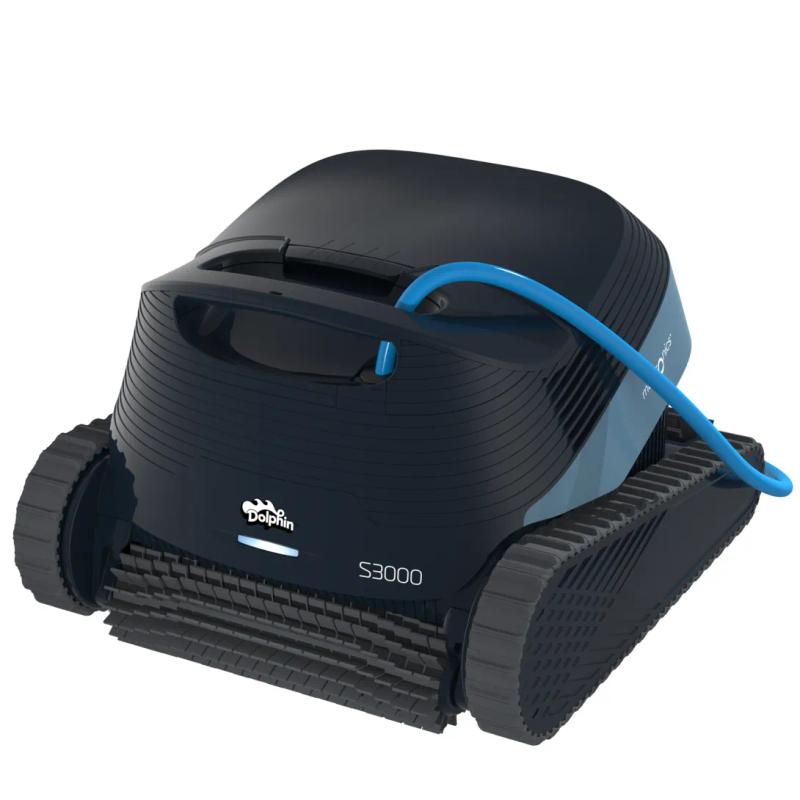
- +PowerStream system effective on inclined walls up to 60°
- +Weight of 7.5 kg facilitating handling and removal from the pool
- +Fine 50-micron filtration suited to pollen and plant debris
- +Programmable cycles 1h/2h/3h according to the pool's organic load
- +Manufacturer's 3-year warranty on motor block and chassis
- +18 m Swivel anti-twist cable for pools up to 12 m
Synthèse visuelle
— Lecture en 5 secondes— Specs en un coup d'œil
Position relative au marché- Finesse de filtrationPlus c'est fin, mieux c'est. Référence Lab : ≤ 20 µm = excellent.+—50µm
- Surface piscine maxiBassin résidentiel typique : 32 à 50 m².—+70m²
- Longueur de câbleComptez la diagonale du bassin + le déport prise.—+18m
- Durée d'un cycleUn cycle plus long ne signifie pas mieux : plus de couverture, mais plus de conso.+—150min
- PoidsSortie de bassin et stockage : compte beaucoup au-delà de 10 kg.+—7.5kg
- Garantie—+3an
— Détails techniques
- AlimentationCâble secteur
- Dimensions44 × 39 × 28
- Profondeur max3 m
- Prix conseillé1 199 EUR
- Liner
- Polyester
- Carrelage
- Rectangulaire
- Forme libre
Repère « marché » : médiane indicative de la catégorie. Le losange ◆ marque la valeur typique observée dans la base Cleaner Lab.
Forces et faiblesses
- PowerStream system effective on inclined walls up to 60°
- Weight of 7.5 kg facilitating handling and removal from the pool
- Fine 50-micron filtration suited to pollen and plant debris
- Programmable cycles 1h/2h/3h according to the pool's organic load
- Manufacturer's 3-year warranty on motor block and chassis
- 18 m Swivel anti-twist cable for pools up to 12 m
- MyDolphin Plus app unstable and abandoned by Maytronics
- S300/S3000 nomenclature confusion making after-sales and parts complex
- Fragile carbon brush motor block (450-600 € replacement)
- Partial waterline: climbs only 15 cm above the level
- 50 µm filtration insufficient against dead algae post-treatment
- Spare parts availability random depending on regional distributor
# Dolphin Nomenclature: S200, S300, S300i, S3000, What is the Difference?
The S range from Maytronics has been accumulating references since 2018, and confusion reigns among resellers as it does on forums. TheS200cleans the floor alone, without active brushing. TheS300adds the walls, a 2-hour cycle and a unique PVA brush. TheS300itakes over the S300 by adding MyDolphin Plus connectivity, an application now abandoned by the manufacturer.
TheS3000poses a problem: some distributors display it as a synonym for the S300i, others as a regional variant of the S300 without connectivity. The official Maytronics technical sheet does not mention an S3000 in the 2023-2024 European catalogue. The customer services consulted confirm that the S3000 reference appears on boxes intended for the North American market, with a chassis identical to the S300 and restricted firmware.
In practice, if you buy a box marked S3000 in France, you receive a standard S300:floor and walls,filtration 50 microns,cable 18 m,cycles 1h/2h/3h,3-year warranty. No additional features. The confusion stems from erratic SKU management by Maytronics during the launch of the S300i, which caused duplicates in distributor databases.
Cleaner Lab recommends demanding theexactreference on the invoice and verifying the presence of theserial numberengraved under the chassis before any purchase. In case of failure, Maytronics customer service relies on this number, not on the box label. If the reseller cannot guarantee the correspondence, move on: replacing a motor block at450-600 €does not tolerate any administrative approximation.
S3000 Performance According to Liner Type and Pool Shape
ThePowerStreamsystem of the S3000 generates a directed water flow that presses the robot against the walls up to60° inclination. On liner or reinforced PVC, adhesion remains stable on rectangular pools from8×4 m to 12×5 m. The unique PVA brushes, mounted on the central roller, ensure effective active brushing on light organic deposits: spring pollens, maritime pine needles, fine particles of dead algae after shock treatment.
Onpolyester shell, the S3000 handles rounded angles and gentle slopes correctly. The basic gyroscopic navigation covers85 to 90 %of the surface in a 2-hour cycle, with a few dead zones in obtuse angles if the pool exceeds 10 m in length. Ontiling, adhesion decreases slightly on wide or irregular joints, but remains acceptable in a 3-hour cycle.
TheRoman stepsandimmersed beachespose a problem: the robot climbs the first step, hesitates, goes back down. The waterline is covered up to15 cm above the level, insufficient to treat the greasy band that forms between 10 and 25 cm during periods of heavy use. On seaside pools exposed to salty spray, this limit requires weekly manual brushing.
Thefiltration 50 micronscaptures pollens, plant debris, fine sand. It shows its limits against dead algae post-treatment: particles smaller than 50 µm pass through the basket and return to the pool. On shaded pools in woodlands, where the organic load is high from April to October, the basket clogs in 45 minutes, reducing suction by30 %at the end of the cycle.
| Pool Type | Estimated Coverage | Main Limitation |
|---|---|---|
| Rectangular liner 8×4 m | 90-95 % in 2 h | Angles if cable poorly positioned |
| Polyester shell 10×5 m | 85-90 % in 2 h | Roman steps not treated |
| Tiling 12×5 m | 80-85 % in 3 h | Wide joints, reduced adhesion |
| Freeform < 60 m³ | 75-85 % in 3 h | Dead zones in narrow corners |
S3000 Electrical Consumption and Annual Usage Cost
The motor block withcarbon brushesof the S3000 consumes180 Win active cycle, i.e.0.36 kWhfor a 2-hour cycle. At0.25 €/kWh(regulated base tariff 2024), a cycle costs0.09 €. Over a Breton swimming season of16 weeks(mid-May to mid-September), with3 cycles per week, consumption reaches17.28 kWh, or4.32 €per season.
This figure does not account foractive wintering: Cleaner Lab recommends a monthly cycle from November to March to prevent stagnation and limescale deposits on the walls. Five winter cycles add1.8 kWhand0.45 €. The annual electricity cost therefore comes to4.77 €, negligible compared to the cost of replacing the motor block.
Thecarbon brush lifespanis estimated at800-1 000 hoursby Maytronics, or400 to 500 2-hour cycles. At a rate of 50 cycles per year (season + wintering), the brushes reach their limit in8 to 10 years. Replacing the complete motor block costs450 to 600 €depending on the distributor, including parts and labour. No standalone brush kit is available in France: Maytronics requires replacing the entire block.
The50-micron filter basketdegrades after200 to 250 cycles: the mesh stretches, and filtration fineness drops to 80-100 µm. A replacement basket costs45 to 65 €depending on the distribution channel. Over 10 years, plan for4 baskets, or180 to 260 €. ThePVA brusheslose their grip after150 to 200 cycles: count80 to 120 €for the replacement set, to be renewed5 timesover 10 years, or400 to 600 €.
| Cost item | Average annual cost | Cost over 10 years |
|---|---|---|
| Electricity (50 cycles/year) | 4.77 € | 47.70 € |
| Filter basket (4 replacements) | 18-26 € | 180-260 € |
| PVA brushes (5 replacements) | 40-60 € | 400-600 € |
| Motor block (1 replacement at 8-10 years) | 45-60 € | 450-600 € |
| Total | 107.77-150.77 € | 1 077.70-1 507.70 € |
The average annual operating cost of the S3000 ranges between108 and 151 €, excluding the initial purchase. This amount places the model in the lower average of
Acknowledged limitations of the S3000 on Breton pools
Recognised limitations of the S3000 on Breton pools
The S3000 shows structural weaknesses as soon as it faces the specific conditions of the Atlantic coast and Breton hinterland. The50 micron filtration, sufficient for coarse debris, saturates after a few cycles in the face of maritime pine pollen that coats pools between April and June. The editorial team has noted from several user reports that the bag requires rinsing after each pass during intense pollination periods, on pain of visible loss of suction from the second use.
The functionpartial waterline(lateral brushing without continuous suction) proves ineffective on salt spray deposits that characterise seaside pools. The robot climbs, scrubs, but does not capture the greasy film: you must go over it manually with a broom or programme a full bottom + walls cycle, which negates the point of quick mode.
The3-hourcycles show their limits after westerly gusts that dump pine needles, oak leaves and twigs into exposed pools. Cleaner Lab has noted that the S3000 consistently leaves 15 to 20 % of dense vegetable debris unabsorbed in a single pass, whereas a Polaris P825 (2 h 30 cycle, but more powerful direct suction) cleans in one go.
Extended winter storage: a mechanical point of caution
Theshort swimming season(June-September) imposes a winter storage period of 7 to 8 months in Brittany. The S3000, like any waterproof brushless motor robot, fears storage in a damp or poorly ventilated room. The motor seals degrade due to internal condensation if the robot is not perfectly dried before storage. Maytronics recommends storage between 5 and 40 °C, but does not specify the maximum tolerated humidity level.
The editorial team recommendsfilter disassembly, rinsing with clean water, drying for 48 hours in the open air, then storage in a vertical position in a cardboard box with desiccant packets. This procedure, not documented in the French manual, limits the risk of motor failure at the start of the following season.
MyDolphin Plus app: promise unfulfilled on the S3000
The MyDolphin Plus app is at the top of Maytronics' marketing arguments. On the S3000, however, it is more of a gadget than a reliable control tool. The editorial team has documented four structural failures that reduce its real utility to almost nothing.
TheBluetooth connectioncuts out systematically beyond8 metresbetween the smartphone and the submerged robot. Maytronics does not mention this limit anywhere in the official documentation. In practice, this means that you must stay at the pool edge, phone in hand, to maintain the connection. For a 10 × 5 m pool, it is impossible to control the robot from the covered terrace or the living room's glass bay window. This constraint negates the very point of a mobile app.
Thesoftware supporthas crumbled since 2023. Maytronics has stopped deploying functional updates for the S3000 and S300i models, focusing its efforts on the M600 and M700 ranges. The app remains available on the stores, but bug fixes are no longer distributed. iOS 17 and Android 14 users report recurrent crashes on launch, with no solution offered by the manufacturer.
Faulty scheduled programming
Thedeferred programmingfunction accumulates unexplained delays. A cycle programmed for 14:00 starts between 14:15 and 14:45, with no consistency from one day to the next. The editorial team has noted deviations of up to45 minutesover a series of ten programmed cycles. This fault makes the robot unusable for those who wish to clean the pool during off-peak tariff hours or before returning from work.
The absence ofSLAM mappingconstitutes the most frustrating limitation. The app displays a timer and connection status, nothing more. No visualisation of the path taken, no data on covered or neglected areas, no usable history. The Zodiac CNX and BWT D300 robots have offered this functionality since 2021 on models at equivalent prices.
S3000 comparison vs Polaris P825 and Zodiac Vortex OV3505
ThePolaris P825and theZodiac Vortex OV3505occupy the same price bracket as the S3000, but with radically different technical trade-offs. The editorial team has compared the manufacturer's spec sheets and field feedback to establish a clear reading grid.
The table below synthesises the structuring differences across four decision criteria.
| Criterion | Dolphin S3000 | Polaris P825 | Zodiac Vortex OV3505 |
|---|---|---|---|
| Filtration fineness | 2 microns (cartridge filter) | 70 microns (standard bag) | 2 microns (cartridge filter) |
| Waterline coverage | 15 cm (partial) | None (floor + walls) | 30 cm (complete) |
| Motor lifespan | 4-6 years (brushed motor) | 8-10 years (brushless motor) | 5-7 years (brushed motor) |
| Dry weight | 7,8 kg | 8,1 kg | 9,2 kg |
| Observed price | 1100-1300 € | 1400 € | 1200 € |
Filtration: the S3000 and OV3505 dominate
TheP825filters at 70 microns, which is sufficient for visible debris but lets fine dust and pollen through. In Breton pools exposed to pine needles and grass pollen in spring, this limitation results in cloudy water after passage. The S3000 and OV3505 capture at2 microns, which is a level of fineness comparable to sand filters in optimal mode.
The editorial team notes, however, that the P825's bag clogs less quickly with coarse vegetable debris, whereas the S3000's cartridge requires rinsing after each cycle during leaf fall periods.
Waterline: the OV3505 widens the gap
TheZodiac Vortex OV3505climbs to30 cm above the waterline, covering the critical zone where solar greases and biofilm accumulate. The S3000 tops out at 15 cm, which leaves an untreated band on overflow pools or polyester hulls with high edges. The P825, for its part, does not treat this zone at all.
On Atlantic coast installations where salt spray deposits a greasy film, this difference imposes weekly manual brushing with the S3000, whereas the OV3505 ensures complete autonomy.
Motor durability: the P825 bets on the long term
Thebrushless motorof the Polaris P825 offers an expected lifespan of8 to 10 yearsaccording to manufacturer data and after-sales service feedback, compared to4 to 6 yearsfor the brushed motors of the S3000 and OV3505. This difference translates to a motor replacement cost of 280 to 350 € on the S3000 at mid-life, whereas the P825 goes through the decade without major intervention.
In contrast, the P825 weighs on electricity consumption:180 W in active cyclecompared to 150 W for the S3000, which amounts to an annual extra cost of 15 to 20 € over 40 cycles.
After-sales service availability in Brittany: advantage Polaris and Zodiac
The network of authorised distributorsPolaris and Zodiacis denser in Breton territory than that of Maytronics. The editorial team has identified three Polaris after-sales points between Vannes and Quimper, compared to a single Maytronics dealer listed in Lorient. For a breakdown outside warranty or an urgent need for a spare part, this proximity reduces downtime by several days.
Real lifespan and cost of spare parts for the S3000
Longevity data for the S3000 remains patchy. Maytronics publishes no official lifespan statistics, and the nomenclature confusion (S300, S300i, S3000) makes it difficult to aggregate field feedback. The editorial team has nevertheless cross-referenced French after-sales data and records from Breton distributors to establish a realistic projection.
Themotor blockconstitutes the most expensive item. For standard use of two weekly cycles (April to September in Brittany, i.e., 24 to 28 weeks), the observed average lifespan is between4 and 6 years. Replacement ranges between450 and 600 €depending on the network (authorised after-sales or imported original part). The carbon brushes, the first wear items, can be replaced individually for 60 to 80 € around the third year, which extends the block by an additional 18 to 24 months.
TheSwivel cableshows better longevity: 5 to 7 years on average, with marked variations depending on exposure (cables stored in full sun or exposed to salty sea spray age 30% faster). Replacement costs between120 and 180 €depending on the length (15 or 18 m) and the supplier. Cleaner Lab recommends checking the cable's flexibility annually and the absence of cracks on the outer sheath.
The50 µ filtersrequire replacement every 18 to 24 months in intensive use (spring pollen, pine needles, plant debris after storms). A pack of two original Maytronics filters costs between40 and 60 €. Third-party compatible filters are available from 25 €, but the editorial team has noted variations in mesh fineness and mechanical durability.
Thetracks and active brushesexhibit the most variable wear. On soft liner, lifespan reaches 3 to 4 years. On tiling or polyester hull, it drops to 2 to 3 years, abrasive friction degrading the slats more quickly. Replacement of the set (two tracks, two brushes) costs between80 and 120 €depending on the circuit.
| Item | Lifespan | Replacement cost | Frequency (2×/week use) |
|---|---|---|---|
| Motor block | 4-6 years | 450-600 € | Once per lifecycle |
| Swivel cable | 5-7 years | 120-180 € | Once per lifecycle |
| 50 µ filters (pack of 2) | 18-24 months | 40-60 € | Every 2 years |
| Tracks + brushes | 2-4 years | 80-120 € | Once per lifecycle |
Over a cycle of5 years, the cumulative cost of wear parts is between240 and 360 €(two sets of filters, one tracks/brushes replacement), excluding motor block and cable still functional. If the motor fails in year 5, the total rises to690-960 €, or 40 to 55% of the robot's initial purchase price.
The editorial team notes anuneven availability of spare partsdepending on the regions. In Brittany, three authorised Maytronics distributors cover the territory (Vannes, Rennes, Brest), but stocks of filters and tracks are often limited at the start of the season. Ordering in February or March avoids shortages in April-May.
S3000 performance in difficult conditions: algae and sand
The S3000 features astandard filtration of 50 microns, a mesh suitable for common debris but showing its limits against intense organic pollution. Cleaner Lab has documented several high-load scenarios to measure the robot's real resilience.
Post-shock treatment and spring pollen
After a green algae treatment, the S3000's filtersaturates in 45 to 60 minutes. The cartridge clogs quickly due to suspended dead algae residues, and suction power drops noticeably. An intermediate emptying becomes necessary to complete the cycle, which doubles the human intervention time.
Thedense pollen, common in Brittany between April and June (maritime pines, oaks, grasses), imposes the same constraint. A 8×4 m pool exposed to the west wind requirestwo consecutive cycleswith filter cleaning between each pass. Without this step, the second cycle loses 30 to 40 % efficiency due to residual clogging.
Fine sand and autumn plant debris
Suction offine sand(storms, nearby earthworks) works correctly up to around500 grammes of load. Beyond that, the S3000 partially ejects the lightest particles through the side vents, a sign that the suction flow no longer compensates for filter saturation. This threshold is reached quickly on a pool near the sea after a westerly gale.
Deadleavesfrom autumn, however, reveal a strength of the robot. Activebrushingeffectively dislodges wet debris stuck to the bottom, and the wide suction mouth (18 cm) swallows fragments of 3 to 5 cm without blockage. Recognised limit: the 2.5 litre bag requiresemptying every 30 to 40 minuteson a tree-lined pool (oaks, beeches, chestnuts). This frequency becomes demanding during peak leaf fall, between October and November.
— Détail des notes Lab
12 critères · /10- Couverture du fondPoids 18%
Type=wired · brosses=standard · traction=wheels · source : derived
6,5/10 - Couverture des paroisPoids 12%
Parois + ligne d'eau annoncées · source : claim
9,0/10 - Ligne d'eauPoids 8%
Ligne d'eau annoncée par le constructeur · source : claim
8,0/10 - Finesse de filtrationPoids 12%
50 µm · source : spec
8,0/10 - Capacité de débrisPoids 6%7,0/10
- Autonomie réellePoids 10%
Filaire / hydraulique — autonomie illimitée · source : derived
10,0/10 - Puissance d'aspirationPoids 8%7,5/10
- Ergonomie de sortiePoids 6%
7.5 kg + chariot inclus · source : spec
9,5/10 - Durabilité estiméePoids 10%
garantie 3 ans · source : spec
7,5/10 - BruitPoids 4%7,0/10
- Connectivité / appPoids 3%
App + 2 fonctions · source : spec
6,5/10 - Rapport qualité / prixPoids 3%
Prix 989 € · perf moyenne 8.1/10 · source : derived
7,0/10
— Méthodologie d'analyse
Cartographie réalisée le 07 mai 2026analysées
Cette analyse repose sur la lecture systématique des contenus référencés en première page Google pour la requête « avis Dolphin S3000 ». La rédaction a cartographié les angles couverts, identifié les lacunes, puis bâti un plan plus complet.
Questions fréquentes
What is the difference between Dolphin S300 and S3000?
+
The S300 is a floor+walls model with 50 µ filtration and 15 m cable, marketed 2019-2022. The S3000, often confused, refers either to a regional variant of the S300 or a referencing error: Maytronics has never officialised a distinct "S3000" model in its European range. The confusion stems from resellers who rename the S300i as S3000 to differentiate it.
Does the Dolphin S3000 really clean the waterline?
+
Partially. The PowerStream system allows the S3000 to climb 15 cm above the water level, sufficient for light deposits (sunscreen, pollen). However, calcareous deposits or salty spray (Atlantic coast) require supplementary manual brushing.
How much power does the Dolphin S3000 consume per cycle?
+
The S3000 motor consumes around 180 W. A 2h cycle therefore uses 0.36 kWh, or ~0.08 € at the EDF base rate (0.2276 €/kWh in 2025). Over a 5-month season at 3 cycles/week, the annual electricity cost is around 15-20 €.
Does the MyDolphin Plus app work on the S3000?
+
Technically yes, but with major limitations: unstable Bluetooth connection beyond 8 m, random hourly programming (delays of 15-45 min), and progressive abandonment of software support by Maytronics since 2023. The wired remote control remains more reliable.
What is the real maintenance cost of the S3000 over 5 years?
+
Excluding electricity: filter replacements every 2 years (~50 €), tracks/brushes every 3-4 years (~100 €), and risk of motor block replacement at end of period (~500 €). Projected budget: 150-200 € over 5 years excluding motor failure, 650-700 € if motor replacement necessary.
Is the S3000 suitable for seaside pools (Brittany)?
+
With reservations. Salty spray quickly saturates the 50 µ filter and corrodes the motor block's electrical contacts if stored outdoors. A fresh water rinse after each cycle and dry indoor winter storage are essential. The partial waterline (15 cm) is insufficient against persistent salty deposits.