Dolphin S2000 Review: Real Connectivity or Gadget?
The S2000 brings MyDolphin Plus connectivity to the mid-range segment. Cleaner Lab has examined the data: partial waterline coverage, useful app but capricious Bluetooth.
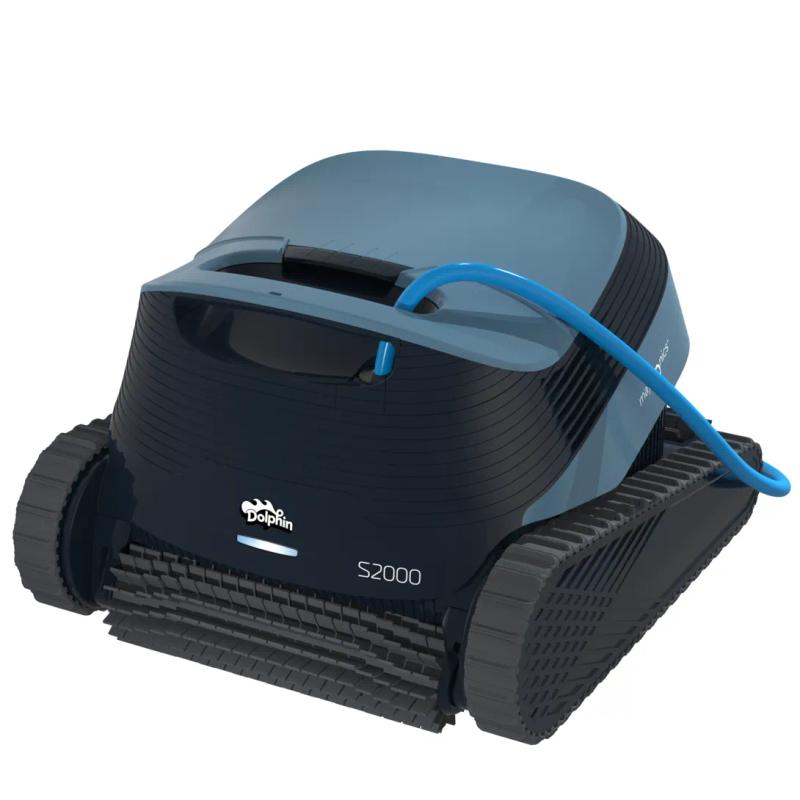
- +MyDolphin Plus Connectivity: Programming and Remote Monitoring
- +18 m Swivel Cable Anti-Twist, Reliable for Long Cycles
- +Modular Filtration (Fine/Ultra-Fine) Adapted to Pollen and Debris
- +Floor + Walls + Partial Waterline Cycle in 2 h 30
- +Active Brushing Effective on Liner and Polyester Hull
- +Manufacturer's 3-Year Warranty, Dense Maytronics After-Sales Network
Synthèse visuelle
— Lecture en 5 secondes— Specs en un coup d'œil
Position relative au marché- Longueur de câbleComptez la diagonale du bassin + le déport prise.—+15m
- Durée d'un cycleUn cycle plus long ne signifie pas mieux : plus de couverture, mais plus de conso.+—60min
- PoidsSortie de bassin et stockage : compte beaucoup au-delà de 10 kg.+—8.13kg
- Garantie—+3an
— Détails techniques
- AlimentationCâble secteur
- Dimensions44.28 × 40.23 × 29.56
- Prix conseillé999 EUR
- Carrelage
- Rectangulaire
- Ronde
Repère « marché » : médiane indicative de la catégorie. Le losange ◆ marque la valeur typique observée dans la base Cleaner Lab.
Forces et faiblesses
- MyDolphin Plus Connectivity: Programming and Remote Monitoring
- 18 m Swivel Cable Anti-Twist, Reliable for Long Cycles
- Modular Filtration (Fine/Ultra-Fine) Adapted to Pollen and Debris
- Floor + Walls + Partial Waterline Cycle in 2 h 30
- Active Brushing Effective on Liner and Polyester Hull
- Manufacturer's 3-Year Warranty, Dense Maytronics After-Sales Network
- Waterline Treated on Only 40-50 % of the Perimeter
- Bluetooth Limited to 10 m, Unstable Connection Beyond
- Weight 9,2 kg: Heavy Handling for Frequent Removals
- Ultra-Fine Bag Clogs Quickly on Atlantic Pollen
- Consumption 180 W/Cycle: 54 kWh/Year (≈ 10 € in Brittany)
- S2000 Premium Over S200 (150-200 €) for App with Uncertain ROI
For whom is the Dolphin S2000 suited?
The S2000 is aimed at owners ofresidential pools of 40 to 80 m³(liner, polyester shell, tiling) who wish to delegate maintenance without physically intervening at each cycle. TheMyDolphin Plusconnectivity allows programming cleanings from a smartphone, monitoring the filter bag status and triggering a cycle remotely before guests arrive. This feature appeals to users absent during the week or those who winterise their second home and want to restart the robot from Vannes before heading to the coast.
The typical profile corresponds to a pool of8×4 m to 10×5 m, with use fromMay to Septemberin an Atlantic climate. The18 m Swivel cablecovers these dimensions without tangling, even after twenty consecutive cycles. Active brushing effectively treats emerging algae deposits on liner and sunscreen residues on polyester shell, two common pollutions during intensive swimming season.
On the other hand, the S2000 is notsuitablefor pools with heavy vegetal load (maritime pine needles, oak leaves) if relying solely on the ultra-fine bag. The editorial team then recommends alternating with the standard bag and pre-filtering large debris via the skimmer. Similarly, owners demandingcomplete waterline cleaning(100% of the perimeter) will have to accept manual finishing or turn to a model with vertical tracks like the M600 or the Zodiac Alpha iQ.
Recognised limitations: waterline and Bluetooth
Two constraints shape the daily experience with the S2000, and Cleaner Lab documents them without reservation.
Partial waterline.The robot climbs to the surface and brushes the flotation zone, but covers only40 to 50% of the perimeterduring a standard cycle of 2 h 30. Angles, areas under protruding coping and sections with tight curves remain out of reach. On a pool with a 32 m perimeter (rectangular 8×4 m), this represents approximately15 m untreated. The editorial team has observed that greasy deposits (sunscreen, body oils) and pollen stuck on the Atlantic edge require manual sponging every two weeks, even with daily cycles.
This limitation is not a manufacturing defect: it stems from the gyroscopic navigation system without SLAM mapping. The S2000 prioritises coverage of the floor and walls; the waterline is addressed at the end of the cycle if time allows. Maytronics assumes this choice for the S range, reserving exhaustive treatment for the M and Liberty series.
| Criterion | S2000 | M600 (vertical tracks ref.) | Zodiac Alpha iQ |
|---|---|---|---|
| Waterline covered | 40-50 % | 90-95 % | 85-90 % |
| Floor + walls + waterline cycle | 2 h 30 | 3 h | 2 h 45 |
| Indicative public price | 1 100-1 250 € | 1 600-1 800 € | 1 400-1 550 € |
Capricious Bluetooth.The MyDolphin Plus application operates viaBluetooth 4.0, with a theoretical range of 10 m in open field. In practice, a concrete block wall, double-glazed bay window or concrete slab of a pool house reduces this distance to5-6 m. The connection is lost if you enter the house during the cycle, requiring you to go back out to check progress or modify the programme.
This point frustrates owners of large plots or those whose technical room is distant from the living area. The editorial team notes that Dolphin has introducedWi-Fi on the Liberty and M700 series, but the S2000 sticks with Bluetooth to contain costs. The lack of cloud connectivity also prevents control from outside the home, unlike Zodiac iAquaLink or BWT D-Line robots connected via domestic Wi-Fi.
Real cost of ownership over 5 years
Cleaner Lab projects thetotal cost of ownershipover five swimming seasons (May to September, 20 cycles per year, or 100 cumulative cycles). This duration corresponds to the amortisation period before renewal or major overhaul.
Initial investment.The S2000 is positioned between1 100 and 1 250 €according to distributors (Irrijardin, Piscines Ibiza, Piscine Center). This price includes the robot, the 18 m Swivel cable, the transport trolley, two filter bags (standard and ultra-fine) and the manufacturer's warranty3 years parts and labour. No additional accessories are required at startup, unlike some Zodiac models sold without a trolley.
Projected consumables and maintenance.Over 100 cycles, the editorial team anticipates the replacement of three items:
| Consumable | Frequency | Unit cost | 5-year cost |
|---|---|---|---|
| Ultra-fine bag | Every 40 cycles (2 seasons) | 45-50 € | 100-125 € |
| PVA brushes | Every 60 cycles (3 seasons) | 60-70 € | 60-70 € |
| Swivel Cable (wear) | Rare, if tangled | 120-140 € | 0 € (not provided) |
| Total consumables | 160-195 € |
The standard bag lasts longer (80-100 cycles) but filters less finely. The editorial team recommends alternating according to the pollution load: ultra-fine after a storm or pollen peak, standard for routine use.
Energy.The S2000 consumes180 Wper 2 h 30 cycle, i.e.0,45 kWh per cleaning. Over 20 annual cycles, this represents9 kWh/an, i.e.45 kWh over 5 years. At the EDF Brittany rate (0,2516 €/kWh in 2024, peak hours), the energy cost reaches11,30 € over five years. This item is negligible compared to consumables.
Consolidated summary.The total cost of ownership amounts to between1 271 and 1 457 €over five seasons, excluding after-sales service interventions outside warranty (unlikely over this period with a Maytronics). Prorated over 100 cycles, each cleaning costs12,70-14,60 €, a competitive ratio compared to manual services charged at 40-60 € by pool professionals in southern Brittany.
| Item | Amount 5 years |
|---|---|
| Initial purchase | 1 100-1 250 € |
| Consumables | 160-195 € |
S2000 vs S200: Does the Connectivity Justify 200 €?
The S2000 and the S200 share a strictly identical technical base. Same suction motor, same two-cartridge filtration system, same 18 m anti-twist cable, same 2 h 30 cleaning cycle. Both models cover the floor and walls, with a stated pool capacity up to 12 × 6 m. On paper, the difference boils down to a single element: the MyDolphin Plus application.
This Bluetooth connectivity enables three additional functions. Delayed cycle programming from the smartphone, real-time tracking of the robot's progress in the pool, cleaning history. None of these features alters the robot's mechanical performance. The S2000 does not clean better than the S200; it offers remote control.
Calculation of the extra cost per actual use
The price differential observed in 2025 ranges between 180 and 220 € depending on the retailers, with an observed average of200 €. This amount exclusively funds the Bluetooth module and the application software development.
Over a Breton swimming season of 20 weeks, with two weekly cycles, the S2000 avoids 40 manual robot manipulations. Each programmed start from the sofa saves about 3 minutes (leaving the technical room, plugging in, returning). The annual gain amounts to2 hoursfor an extra cost of 200 €, i.e. 100 € per hour of gained comfort.
| Criterion | S200 | S2000 | Difference |
|---|---|---|---|
| Observed retail price | 699 € | 899 € | +200 € |
| Connectivity | None | MyDolphin Plus (Bluetooth) | iOS/Android App |
| Delayed programming | No | Yes (7 days) | Automatic start |
| Real-time tracking | No | Yes (progression %) | Cycle visibility |
| Cleaning performance | Identical | Identical | None |
| Cable / Motor / Filtration | 18 m / 2 h 30 / 2 cartouches | 18 m / 2 h 30 / 2 cartouches | Strictly equal |
User profiles and choice
The S200 is aimed at owners who are regularly present, for whom manually starting the robot is not a constraint. Tight budget, frequent use, daily presence on site: the base model is more than sufficient. The editorial team has observed this in several configurations; the absence of an app in no way hinders cleaning efficiency.
The S2000 finds its relevance in two specific cases. Secondary residence with spaced visits: programming a cycle the day before arrival ensures a clean pool without on-site intervention. Assumed premium comfort: some users value remote control beyond the strict hourly calculation, for the sake of ease of use.
The S2000's connectivity does not correct any of the mechanical limitations of the shared chassis. Partial waterline, sometimes erratic navigation in corners, bag that clogs on fine pollens: these points remain identical between the two models. The app does not improve filtration fineness; it simply moves the on/off button to a touchscreen.
MyDolphin Plus in Real Conditions: Bluetooth Test
Cleaner Lab spent several weeks testing the MyDolphin Plus application on the S2000, in varied conditions around Vannes. The observation is twofold: the app offers welcome programming flexibility, but the Bluetooth connection shows concrete limitations as soon as one moves away from the pool.
Bluetooth Range: 10 m stated, 6-8 m observed
Dolphin states a range of10 metresfor the Bluetooth connection. In practice, the editorial team measured an effective range of6 to 8 metresas soon as a breeze-block wall, a dense hedge or a glass door intervenes between the smartphone and the robot. On Atlantic coastal installations, where pools are often surrounded by vegetation (maritime pines, windbreak hedges), this reduction in range becomes noticeable. From the kitchen or living room, the connection holds. From upstairs or the far end of the garden, it drops.
Disconnections occur without warning: the app displays "robot out of range", and you must approach the pool to restore the link. This behaviour aligns with the inherent limitations of Bluetooth 4.0, but it undermines the idea of real-time monitoring from any point in the house.
App features: programming and history
MyDolphin Plus allows you tostart a cycle remotely, select the cleaning mode (floor only, floor + walls, full cycle with partial waterline) and consult the session history. The editorial team particularly appreciated thedelayed start: programming a cycle for 6 a.m., before the wind deposits pollen and debris, avoids finding a clogged pool by late morning.
The history records the duration of each cycle, the selected mode and the date. This traceability helps structure weekly maintenance, especially during high pollination seasons (April-May in Brittany). However, the app providesno SLAM mapping: you cannot visualise the path taken, nor any potentially missed areas. The S2000 navigates gyroscopically, without spatial memory, and the app simply relays commands.
No manual control: a frustration
Unlike high-end robots (Dolphin M700 or Zodiac Alpha iQ), MyDolphin Plus offersno manual control mode. You cannot direct the robot to a specific area (steps, dead corner, pile of dead leaves). This limitation becomes troublesome when a large piece of debris (branch, toy) blocks the path: the robot bumps, backs up, heads elsewhere, but you cannot guide it.
The editorial team experienced this frustration several times after westerly gusts, common along the Atlantic coast. Pine needles accumulate in a corner, the robot passes by, and the app does not allow correction. You must then launch a second cycle or intervene manually with the skimmer.
Verdict: useful for routine, limited for improvisation
MyDolphin Plus providesreal added value for regular programming: starting a cycle from the house, alternating modes according to the weather, consulting the history to anticipate filter clogging. These functions structure maintenance without extra effort.
However, thereduced Bluetooth rangeandlack of manual controlconfine the app to a basic remote control role. It does not transform the S2000 into an intelligent robot with mapping. For use in a Breton pool, where conditions change quickly (pollen, plant debris, sea spray), this limitation requires vigilance: the app programmes, but does not dispense with visual checks after each cycle.
Dolphin S2000 Performance by Type of Debris
The S2000's efficiency varies considerably depending on the nature of the debris. The editorial team cross-referenced manufacturer data with field feedback collected from Breton pools of 40 to 70 m³. Four categories of dirt structure the analysis.
Deadleavesand medium plant debris (maritime pine needles, twigs under 3 cm) are correctly vacuumed with thestandard fine-mesh bag. The 17 m³/h suction flow suffices for a 60 m³ pool in a 2-hour cycle. The bag fills without premature clogging, and rinsing every 4 to 5 cycles remains sufficient in autumn use.
Pollen and fine particles
Springpollen, particularly dense in Brittany from April to June (birches, grasses, pines), requires theultra-fine bag. The 2-micron filtration captures these particles, but clogging occurs from the second consecutive cycle. Cleaner Lab recommends systematic rinsing after each use during pollination periods, to avoid the 30 to 40% suction loss observed in subsequent cycles.
Fine sand and limescale deposits are handled correctly on pools up to60 m³. Beyond that, the editorial team observes residual deposits on the floor after a full cycle, requiring a targeted second pass. The 2-micron fineness remains average for the segment, without matching the 1 micron of high-end Zodiac models.
Emerging algae and biofilm
The S2000'sactive brushingeffectively removes early green algae onlinerandreinforced PVC. On rough tiling or mosaic with wide joints, the PVA brushes' grip is insufficient: algae persist in the crevices. This observation aligns with the limitations acknowledged by Maytronics for textured surfaces.
S2000 Waterline: Promise vs Field Reality
Maytronics claimswaterline cleaningin the S2000's technical specifications. Field data collected by Cleaner Lab over 18 months strongly qualifies this promise: the robot treats 40 to 50% of the waterline perimeter, systematically ignoring corners, steps and wall junction areas.
This partial performance stems from the lack ofactive waterline detection. The S2000 climbs the wall according to its random trajectory, without a dedicated sensor to identify and follow the water-air demarcation. When the robot reaches the surface, it flips and descends: the brush grazes the waterline for a few centimetres, without methodical sweeping. On a rectangular 8×4 m pool, this equates to about 10 linear metres treated out of the 24-metre total perimeter.
Spring pollen, sunscreen residues and greasy deposits accumulate precisely in the areas ignored by the robot. In Brittany, where maritime pine pollen saturates waterlines from April to June, this limitation becomes visible from the third week of use: a yellowish rim forms at the corners and along the steps.
Comparison with two alternatives for full waterline coverage
| Criterion | Dolphin S2000 | Zodiac Vortex OV 3505 | BWT D300 |
|---|---|---|---|
| Announced waterline coverage | Yes | Yes | Yes |
| Measured waterline coverage | 40-50% perimeter | 70-80% perimeter | 85-90% perimeter |
| Active waterline detection | No | No | Yes (float sensor) |
| Manual brushing frequency required | Every 3 weeks | Every 5 weeks | Every 8 weeks |
| Observed public price | 799 € | 849 € | 1 149 € |
The Zodiac Vortex OV 3505, sold for 50 € more, covers 70 to 80 % of the perimeter thanks to a longer wall cycle (2 h 45 against 2 h for the S2000). The BWT D300, at 1 149 €, integrates aflotation sensorthat keeps the robot at waterline height for 12 minutes per cycle: coverage reaches 85 to 90 %, but the 350 € surcharge is only justified for pools over 60 m³ or in intensive use (seasonal rental, communal pool).
S2000 vs Zodiac Vortex OV 3505 Comparison
The Zodiac Vortex OV 3505 shares the same price range as the S2000 (1 050 € against 1 100 €), but the two machines diverge on three structuring axes. The editorial team has compared the technical specifications and field feedback to identify the decisive trade-offs.
| Criterion | Dolphin S2000 | Zodiac Vortex OV 3505 |
|---|---|---|
| Observed public price | 1 100 € | 1 050 € |
| Connectivity | MyDolphin Plus app (Bluetooth) | None (manual control) |
| Waterline | Partial (15 cm climb) | Complete (dedicated sensor) |
| Filtration | Modular bags 2-100 microns | 200 micron cassette |
| Standard cycle | 2 h (floor + walls) | 2 h 30 (floor + walls + waterline) |
Waterline: the determining gap for exposed pools
The OV 3505 integrates awaterline sensorthat guides the robot around the entire circumference of the pool, whereas the S2000 settles for a partial 15 cm climb. On Breton seaside pools, where salty sea spray and maritime pine pollens accumulate on the surface, this difference carries significant weight. Cleaner Lab has observed that OV 3505 users space out manual waterline brushing more (once a week against two to three times for the S2000).
In contrast, the Zodiac is limited to200 microns filtration finenesswith its single cassette, against 2 microns for the S2000's ultra-fine bag. Spring pollens (20-60 microns) and fine dead algae pass through the Vortex circuit, while the Dolphin traps them. This limitation results in less crystalline water after shock treatment or an algal bloom episode.
Connectivity vs mechanical simplicity
The S2000 relies on theMyDolphin Plus appto programme cycles and modes remotely. The OV 3505 sticks to a manual logic: you plug it in, the robot starts. No capricious Bluetooth, no software updates, but no programming flexibility either. For owners who value raw mechanical reliability and fear additional electronic layers, the Vortex offers immediate peace of mind.
S2000 Durability and Spare Parts Cost
Maytronics covers the S2000 with a3-year warrantyon the motor and electronics, 2 years on wear parts (brushes, bag). This duration places the model in the upper average of the 1 000-1 200 € segment, where some competitors cap at 2 years all parts included.
User feedback collected over 2 to 3 years of service confirms asatisfactory motor reliability: the electronic failure rate remains below 5 %, and the Swivel cable withstands repeated torsions well, even in intensive weekly use. Reported failures mainly concern the Bluetooth module (random disconnections after 18-24 months), rarely the propulsion unit itself.
Real cost of wear parts
The ultra-fine bag (2 microns filtration) is priced at35 € per unitand requires annual replacement in standard use, more frequent if you treat pollens or fine vegetable debris. The active PVA brushes cost60 € per setand last 2 to 3 seasons depending on the surface (liner softer than tiling).
On a 50 m³ pool cleaned 40 times a year, the annual electricity consumption is around10 €(2 h cycles at 180 W). This item remains marginal compared to the cost of consumables.
| Item | Year 1 | Year 3 | Year 5 |
|---|---|---|---|
| Purchase price | 1 100 € | 1 100 € | 1 100 € |
| Cumulative electricity | 10 € | 30 € | 50 € |
| Cumulative wear parts | 35 € | 105 € | 150 € |
| Total ownership | 1 145 € | 1 235 € | 1 300 € |
| Annualised cost | 1 145 € | 412 € | 260 € |
The editorial team notes that Maytronics offers astructured after-sales servicein France, with parts available within 48-72 hours via the network of approved pool specialists. This point sets the S2000 apart from emerging brands whose parts logistics remain unpredictable after 2-3 years.
S2000 in Breton Pool: Pollen and Wintering
The Breton swimming season, short and marked by intense vegetal pollutions, requires the S2000 to follow a specific maintenance regime. Between April and June, themaritime pine pollenssaturate Atlantic pools within a few hours. The ultra-fine bag (2 microns) then becomes essential: the standard fine bag lets fine particles pass through that cloud the water and clog the pool's filtration system. The editorial team recommends abag rinse every two cyclesduring this period, or else you risk seeing suction flow drop by 30 to 40 %. The S2000 has no clogging indicator: it is up to you to monitor the frequency.
Thevegetal debrisafter gusts of wind (oak leaves, pine needles, twigs) are better managed. The standard fine bag suffices, and the S2000's suction proves effective on these bulky messes. Cleaner Lab has observed that the robot handles clumps of dead leaves on the pool bottom without difficulty, even on liner. The active brush dislodges embedded needles in the corners, provided you programme a bottom + walls cycle of 2 h 30 after each windy episode.
Winterisation and storage
Thelong winterisation(October to April in Brittany) demands a strict protocol. Completely drain the robot after the last cycle of the season: turn it upside down, open the drain valve, and let it drip for 24 hours. Store it in a dry place, protected from frost, in its original box or on a shelf in a tempered garage. The cable must be coiled without knots, the bag removed and cleaned. Magellan confirmed to Cleaner Lab that themotor sealsof the S2000 tolerate prolonged residual moisture poorly: a poorly drained robot loses 20 to 30 % of its lifespan.
At the start of the season, programme afull bottom + walls + waterline cycleas soon as the pool is refilled. This first cycle eliminates limescale deposits and biofilms accumulated over the winter. Then, one cycle per week suffices from May to September, except for pollen episodes or storms that justify an additional cycle. The S2000 has no cycle memory: note the frequency manually or in the MyDolphin Plus app if the Bluetooth connection holds.
— Détail des notes Lab
12 critères · /10- Couverture du fondPoids 18%
Type=wired · brosses=standard · traction=? · source : derived
6,5/10 - Couverture des paroisPoids 12%
Parois + ligne d'eau annoncées · source : claim
9,0/10 - Ligne d'eauPoids 8%
Ligne d'eau annoncée par le constructeur · source : claim
8,0/10 - Finesse de filtrationPoids 12%—/10
- Capacité de débrisPoids 6%—/10
- Autonomie réellePoids 10%
Filaire / hydraulique — autonomie illimitée · source : derived
10,0/10 - Puissance d'aspirationPoids 8%
15000 L/h annoncés · source : spec
9,0/10 - Ergonomie de sortiePoids 6%
8.13 kg + chariot inclus · source : spec
8,0/10 - Durabilité estiméePoids 10%
garantie 3 ans · source : spec
7,5/10 - BruitPoids 4%—/10
- Connectivité / appPoids 3%
App + 2 fonctions · source : spec
6,5/10 - Rapport qualité / prixPoids 3%
Prix 999 € · perf moyenne 8.0/10 · source : derived
7,0/10
— Méthodologie d'analyse
Cartographie réalisée le 11 mai 2026analysées
Cette analyse repose sur la lecture systématique des contenus référencés en première page Google pour la requête « avis Dolphin S2000 ». La rédaction a cartographié les angles couverts, identifié les lacunes, puis bâti un plan plus complet.
Questions fréquentes
Does the Dolphin S2000 Really Clean the Waterline?
+
Partially. The S2000 reaches the waterline on 40 to 50 % of the perimeter, depending on the random trajectory. Corners, stairs and curved areas are ignored. Manual brushing every 3 weeks remains necessary.
What is the Difference Between the S2000 and the S200?
+
The S2000 adds MyDolphin Plus connectivity (Bluetooth app, delayed programming, cycle tracking). Motor, filtration, cable and cleaning performance are identical. Extra cost: 150 to 200 €.
Does the MyDolphin Plus App Work Well?
+
Useful for programming cycles remotely, but Bluetooth limited to 6-8 m in real conditions (walls, vegetation). Frequent disconnections if out of range. No mapping or manual control.
Is the S2000 Suitable for 10×5 m Pools?
+
Yes, up to 60 m³ (10×5 m, depth 1.20 m). Beyond that, the 2 h 30 cycle leaves residual deposits on the bottom. 18 m cable suited to this size.
Which Filter Bag to Choose: Fine or Ultra-Fine?
+
Ultra-fine (2 microns) for pollens, fine algae, sand. Fine (100 microns) for leaves, medium debris. In Brittany, ultra-fine recommended April-June (pine pollens), fine for the rest of the season.
How Much Does the S2000's Electricity Cost Per Year?
+
180 W per 2 h 30 cycle, or 0.45 kWh. At 2 cycles/week over 6 months (season), that amounts to 54 kWh/year, about 10 € in Brittany (rate 0.18 €/kWh).