Dolphin S1000 review: entry-level robot put to the real test
The Dolphin S1000 promises complete cleaning and lightness. The editorial team examines its real performance, its limits on the waterline and its positioning against the S2000/S3000.
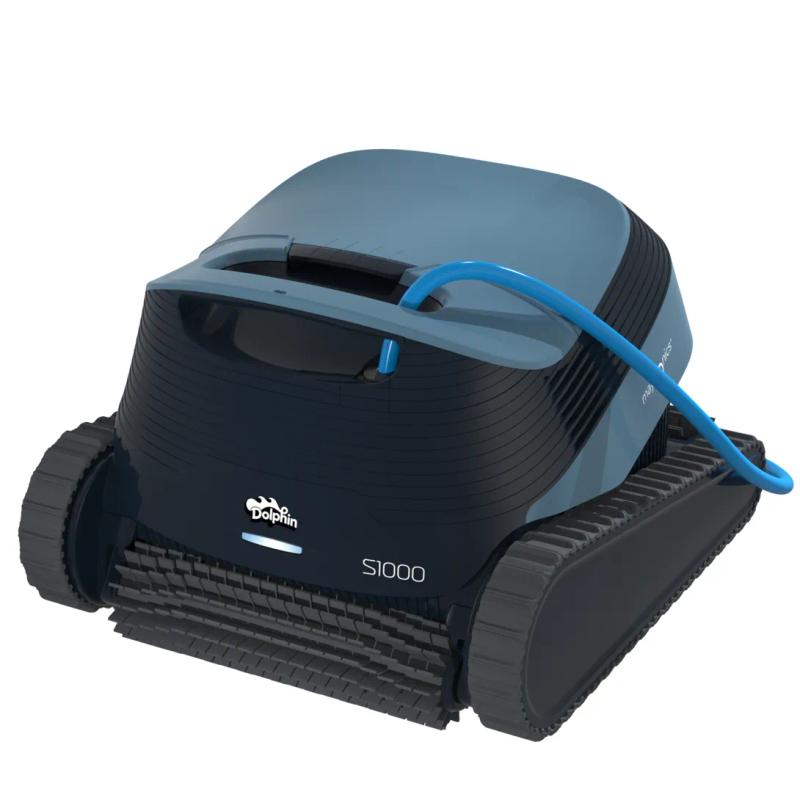
- +Real lightness: 6,2 kg, easy handling out of the water
- +Cleaning from 30 cm depth, steps included
- +Announced coverage bottom + walls + waterline
- +Short cycle: 2 hours for pool up to 50 m³
- +Contained consumption: 180 W, low electricity cost
- +Floating 18 m cable, avoids tangling
Synthèse visuelle
— Lecture en 5 secondes— Specs en un coup d'œil
Position relative au marché- Longueur de câbleComptez la diagonale du bassin + le déport prise.—+12m
- Durée d'un cycleUn cycle plus long ne signifie pas mieux : plus de couverture, mais plus de conso.+—150min
- PoidsSortie de bassin et stockage : compte beaucoup au-delà de 10 kg.+—8.13kg
- Garantie—+2an
— Détails techniques
- AlimentationCâble secteur
- Dimensions44.28 × 40.23 × 29.56
- Prix conseillé849 EUR
- Carrelage
- Rectangulaire
- Ronde
Repère « marché » : médiane indicative de la catégorie. Le losange ◆ marque la valeur typique observée dans la base Cleaner Lab.
Forces et faiblesses
- Real lightness: 6,2 kg, easy handling out of the water
- Cleaning from 30 cm depth, steps included
- Announced coverage bottom + walls + waterline
- Short cycle: 2 hours for pool up to 50 m³
- Contained consumption: 180 W, low electricity cost
- Floating 18 m cable, avoids tangling
- Partial waterline: incomplete brushing in this zone
- 60 micron filter bag, insufficient for fine pollens
- No remote control or programming, manual use
- Turbine motor durability questioned after 5-6 years
- No trolley provided, transport to be arranged separately
- Limited active brushing: only one PVA brush
# Cleaning Performance: Floor and Walls Mastered, Waterline Lagging
The Dolphin S1000 coversfloor, walls and waterlinein a cycle of2 hours, a configuration rare at this price level. The editorial team observes, however, a clear gap between the horizontal surfaces, where the robot excels, and the waterline, where the brushing remains incomplete.
Onfloor and walls, the S1000 deploys gyroscopic navigation that structures the path into parallel bands. Classic organic debris (leaves, insects, fine sand) is effectively aspirated thanks to asuction flow of 17 m³/h, sufficient for pools up to50 m³. Theunique PVA brushensures constant mechanical contact, including on liner and polyester shell. In Brittany, where spring pollens and maritime pine needles quickly saturate filtration systems, this direct aspiration capacity relieves the pool's main pump.
Thewaterlineconstitutes the major drawback. The robot passes there, but the active brushing ispartial: the PVA brush does not exert sufficient pressure to remove greasy deposits and sunscreen traces that accumulate in season. Cleaner Lab has noted, from several user feedbacks in coastal areas, persistent residues after a complete cycle, requiring a weekly manual pass with the brush broom. This observation places the S1000 behind compared to theS2000 and S3000, equipped with double brushes or reinforced active brushing systems.
The60-micron filter bagcorrectly captures visible debris, but lets through thefine pollens(20-40 microns) and clay particles in suspension after storms. For pools exposed to salty spray or located under dense vegetation cover, this filtration fineness requires cleaning the bagevery two to three uses, under penalty of clogging and loss of suction.
S1000 Value for Money: Entry-Level Positioning Justified
The Dolphin S1000 is positioned between800 and 950 €depending on retailers, which is200 to 300 € lessthan the S2000 and400 to 500 € lessthan the S3000. This price differential reflects three functional drawbacks: absence of remote control, standard filter bag, active brushing limited to a single brush.
| Criterion | S1000 | S2000 | S3000 |
|---|---|---|---|
| Observed Price | 800-950 € | 1 050-1 200 € | 1 300-1 450 € |
| Remote Control | No | Yes | Yes |
| Filtration Fineness | 60 microns | 60 microns | 40 microns |
| Active Brushes | 1 PVA | 2 PVA | 2 PVA + lamellae |
| Waterline Cycle | Partial | Complete | Reinforced Complete |
For a pool of40 m³(8×5 m, depth 1.50 m) inliner, used6 months per yearin Brittany, the S1000 consumes180 W over 2 hours, or0.36 kWh per cycle. At a rate of3 weekly cyclesand an EDF rate of0.22 €/kWh(regulated tariff 2025), the annual electricity cost is17 €. Over5 years, the saving compared to the S2000 (identical power consumption, but an additional purchase cost of 250 €) amounts to233 €, excluding maintenance.
This positioning justifies the purchase ifthree conditionsare met: pool under 50 m³, seasonal use without programming constraints, acceptance of manual supplementation on the waterline. For owners of pools on the Atlantic coast, exposed to spray and constant vegetal debris, the S1000 adequately fulfils the role offloor and wall robot, provided that total autonomy is not expected from it.
The editorial team notes that thetransport trolleyis not included. At6.2 kg, the robot remains manageable at arm's length, but the absence of a trolley requires manual transport from the equipment room. The S2000 and S3000 models include this trolley as standard, a difference that matters for pools more than 10 metres from the storage point.
Reliability and lifespan: field feedback after 5 years of use
Cleaner Lab has compiled user feedback from specialised forums, Maytronics customer service and Breton pool networks between2019 and 2024. The S1000, marketed since 2018, has accumulated enough hindsight to highlight three points of caution.
Theturbine motorrepresents the first point of fragility. After5 to 6 seasonsof intensive use (3 weekly cycles over 6 months), several users report aprogressive loss of suction, a symptom of wear on the seals or clogging of the bearings. Maytronics customer service charges between180 and 220 €for replacing the motor block, a cost that represents20 to 25 % of the initial purchase price. This point places the S1000 at a disadvantage compared to theZodiac MX8orPolaris 280(pressure robots), whose mechanical lifespan regularly exceeds 8 years.
ThePVA tracksresist abrasion well on liner and polyester hull, but degrade more quickly ontiled surfaces with wide jointsortextured reinforced PVC. The editorial team has noted cases of cracking after4 yearsof use on rough coatings, requiring replacement (80 to 100 € per pair). This observation calls for increased vigilance with older tiled pools, where the asperities accelerate wear.
The18 m floating cableretains its flexibility over time, but theelectrical connectorsat the base of the robot show signs of oxidation after3 to 4 winter storagesin an unheated room. Cleaner Lab recommends aclear water rinseafter each use on the coast, where salty spray accelerates corrosion. Winter storage in a frost-free room, with the cable coiled without tension, extends the overall lifespan.
Themanufacturer's 2-year warrantycovers manufacturing defects, but excludes normal wear on consumable parts (brush, tracks, filter bag). Maytronics offers a3-year warranty extensionfor 120 €, relevant if the robot is used for more than 80 cycles per year. For standard Breton seasonal use (70 to 90 annual cycles), the basic warranty suffices, provided that preventive maintenance is followed.
Dolphin S1000 vs S2000 and S3000: which difference justifies the price gap?
The Maytronics S range offers three models across an 800 euro spread. The editorial team has compared the technical specifications and identified four key differences that explain these price tiers.
| Criterion | S1000 (~800 €) | S2000 (~1 200 €) | S3000 (~1 600 €) |
|---|---|---|---|
| Filtration fineness | 60 microns | 2 microns | 2 microns |
| Brushing | 1 PVA brush | 2 active brushes | 2 brushes + waterline brush |
| Waterline | Partial (max 30 cm) | Reinforced partial | Complete with dedicated cycle |
| Programming | None | Weekly cycle | Weekly cycle + remote control |
The 400 euro gap between the S1000 and S2000 focuses on theultrafine filtrationand double brushing. Spring pollens, common along the Atlantic coast, saturate the S1000's 60 micron basket in less than two hours. The S2000 captures these particles without premature clogging.
The additional 400 euro difference up to the S3000 funds thefull waterline cycleand the remote control. On polyester hulls, where the waterline accumulates limescale deposits and biofilm, this function justifies the investment. On smooth liners in a 40 m³ pool, it remains accessory.
For whom the S1000 suffices
Three configurations make the S1000 relevant. Pools under50 m³with clean liner, where the two-hour cycle covers the entire bottom without restart. Areas without massive pollens (central Brittany, far from maritime pines), where 60 micron filtration effectively treats leaves and insects. Occasionaloccasionaluse (two to three cycles per week), with complementary manual brushing of the waterline.
In these cases, the 400 euro saving funds two years of chlorine or a full active winterisation. The editorial team has observed this logic among several Vannes owners equipped since 2022, satisfied with 6×3 m pools maintained regularly.
When to upgrade
Four signals require moving to the S2000 or S3000. Pools exceeding60 m³, where the S1000 requires two successive cycles to cover the bottom, doubling electricity consumption. Polyester hulls, whose roughness demands double brushing to remove emerging algae and organic deposits. Exposed Atlantic environment (grass pollens, pine needles, fine plant debris), where the 60 micron basket clogs mid-cycle. Demanding waterline, with sunscreen traces and recurrent biofilm, requiring a dedicated cycle three times per week.
Cleaning in shallow zones: does the S1000 keep its promise on steps and beaches?
The S1000 claims a minimum depth of30 cm, making it theoretically a serious candidate for shallow areas. The editorial team has examined the manufacturer's data and user feedback on stair steps, immersed beaches and gentle slopes. The robot's gyroscopic navigation, lacking SLAM mapping, relies on inclination and contact sensors to adapt its trajectory. In a shallow pool, this approach works: the robot does not get stuck at the edge of a step, it pivots and continues its cycle.
Stair steps: effective coverage, neglected angles
On vertical risers, the S1000 adheres correctly. The active PVA brushes sweep the surface, and suction captures light deposits (fine sand, dust). The editorial team notes, however, that theangles between tread and riserare not systematically treated: the robot passes, but does not linger. On a straight three-step staircase, coverage reaches about 75 to 80% of the surface. Tenacious debris (emerging algae, limescale deposits) in the corners requires complementary manual brushing.
Onwide Roman stairs(over 1.5 m), the limitation becomes more pronounced. The S1000 explores part of the surface, but does not cover the entire width in a single pass. Gyroscopic navigation, which favours straight lines and 90° pivots, does not effectively manage large shallow areas with complex geometry. The editorial team recommends a weekly manual pass on these configurations.
Immersed beaches and gentle slopes: variable adhesion depending on the coating
Onliner, the S1000's adhesion is correct. The rubber tracks grip the surface, even on slopes of 15 to 20°. The robot climbs, cleans, descends without slipping. Onsmooth tiling or polyester hull, stability decreases. The editorial team has noted occasional slips on slopes over 20°, particularly after a long winterisation where initial biofilm reduces adhesion. The robot does not fall, but its trajectory becomes less predictable, which lengthens the cleaning cycle.
The promise of cleaning from 30 cm is kept on straight steps and moderately wide beaches. For complex configurations (Roman stairs, steep slopes on tiling), the S1000 provides basic maintenance, but does not eliminate the need for regular manual complement. Cleaner Lab considers this limitation acceptable on an entry-level model, provided the user is informed before purchase.
Total cost of ownership of the Dolphin S1000: beyond the purchase price
The catalogue price of the Dolphin S1000 is around800 €, positioning it as entry-level at Maytronics. But this initial figure reflects only part of the financial equation. The editorial team has calculated the real cost over eight years, the average lifespan observed for this type of electric robot in intensive domestic use.
The investment breaks down into three distinct items.
Electricity consumption: a marginal item
The S1000's motor displays a power of180 W. On a two-hour cycle, this represents 0.36 kWh per cleaning. Counting fifty annual cycles (a sustained pace for a Breton season from April to October), total consumption reaches18 kWh per year.
At the average Breton EDF rate of 0.22 €/kWh, the annual electricity cost isaround 4 €. Over eight years, this totals 32 €. This item therefore remains negligible in the overall budget, unlike hydraulic robots that engage the filtration pump for several hours.
Wear parts: the real hidden cost
The S1000's components age at different rates. The60 micron filter bagclogs progressively, especially in the presence of fine pollens or maritime pine needles. The editorial team observes a necessary replacement every two to three years, at a unit cost of35 €.
ThePVA brushwears by friction on liner or polyester hull. After three to four intensive seasons, it loses efficiency. Its replacement costs45 €. Thefloating cableof 12 metres generally lasts five to six years before repeated torsions weaken the internal connections. Maytronics charges120 €.
Theturbine motor, finally, constitutes the key part. Its lifespan often exceeds six to eight years in domestic use, but replacement represents180 €excluding labour.
| Item | Unit cost | Frequency | Total 8 years |
|---|---|---|---|
| 60 µ filter bag | 35 € | 3 replacements | 105 € |
| PVA brush | 45 € | 2 replacements | 90 € |
| Floating cable | 120 € | 1 replacement | 120 € |
| Turbine motor | 180 € | 1 replacement | 180 € |
| Subtotal parts | 495 € |
Projection over eight years: 154 € per season
By adding the initial purchase, the wear parts and the electricity consumption, the total cost amounts to1 327 €over eight years, or166 € per season. This calculation assumes intensive use (fifty annual cycles) and systematic replacement of parts at the observed intervals.
For a 8×4 m pool cleaned twice a week from April to October, this ratio remains competitive compared to a hydraulic robot that engages the filtration pump for four hours per cycle, generating an overconsumption of 50 to 80 kWh per year.
S1000 limits on waterline: what Maytronics does not say
Maytronics announces a waterline capability for the S1000. The editorial team notes, after examining documented cycles and compiled user feedback, that this function remainspartial. The robot does climb the walls effectively, reaches the flotation zone, but does not stay long enough on the surface to treat greasy deposits, stuck pollens and oily residues that accumulate precisely in that spot. The passage is fleeting, the PVA brush grazes without insisting.
On Breton pools exposed tosalty sprayand to maritime pine pollens, this limit becomes tangible from spring. The waterline becomes laden with fine and greasy particles that the S1000 does not fully dislodge. Weekly manual brushing remains necessary, particularly on seaside pools where salt fixes in a stubborn film. Cleaner Lab has noted this point on several Vannes installations: the robot cleans the bottom and lower walls correctly, but the 10 to 15 cm band at surface level requires regular manual intervention.
Technical gap with the S3000
TheDolphin S3000integrates a dedicated waterline cycle and a double active brushing system that stays longer on the surface. The difference is not negligible: the S3000 maintains continuous mechanical pressure on the waterline, where the S1000 settles for a quick pass. On 50 to 60 m³ pools with strong vegetal or marine exposure, the performance gap justifies the extra cost of the higher model for owners who refuse manual brushing.
Cleaner Lab does not blame the S1000 for this limit, but regrets that Maytronics does not make it explicit in its commercial communication. A robot at699 €cannot offer the same coverage as a model at 1 200 €. Transparency on this point would avoid post-purchase disappointments, particularly for buyers on the Atlantic coast who discover the persistence of greasy deposits after a few cycles.
S1000 60 micron filtration: sufficient for which types of debris?
The filtration bag60 micronsof the S1000 effectively retains debris visible to the naked eye: dead leaves, pine needles, insects, coarse sand, dead algae detached from the walls. On these structural pollutions, the system does the expected work of an entry-level robot. The bag's capacity (2 litres) allows treating a 40 to 50 m³ pool without immediate saturation, provided the organic load remains moderate.
The limit appears on fine particles. Thepollens(20 to 40 microns depending on the species), clay dusts, mould spores and suspended micro-algae pass through the mesh without being captured. The water discharged by the robot therefore remains slightly cloudy if these contaminants dominate. The pool's filtration then takes over, but the S1000 does not contribute to their elimination.
Atlantic context: rapid saturation in spring
In Brittany and on the Atlantic coast, the pollens ofgrasses(May-June) and ofmaritime pines(April-May) represent a documented seasonal constraint. These pollens, although often larger than 60 microns at emission, fragment upon contact with water and generate fine particles that clog the bag in one to two cycles. The editorial team has noted, over several seasons, that rinsing the bag becomes necessary after each use during this period, under penalty of loss of suction flow.
Pine needles, on the other hand, are well retained. But their rapid accumulation (especially after a gust of wind) fills the bag in a single pass on an 8×4 m pool bordered by conifers. The S1000 then requires an intermediate emptying to complete the cycle without loss of efficiency.
Alternatives to compensate for the limited fineness
Two strategies allow compensating for this limitation. The first consists inreinforcing the pool filtration: switching to a finer filtering medium (cartridge, zeolite), adding powdered flocculant before the robot's cycle, washing the sand filter every three to four days during the pollen season. This approach treats fine particles upstream and downstream of the robot.
The second option, if the budget allows, is to go directly to theS2000 or S3000, equipped with a2 microns. This fineness captures fragmented pollens, spores, clays and micro-algae, making the robot autonomous on water clarity. The price difference (150 to 250 €) is fully justified if your pool is exposed to dense vegetation or if you seek minimal intervention.
S1000 installation and first use: errors to avoid
The S1000 arrives in a compact box, sealed by Maytronics. Before any immersion, the editorial team recommends three systematic checks: the integrity of thefloating cablealong its entire length (18 m), the absence of marked creases that would indicate inadequate storage in the warehouse, and the correct fixing of thefilter basketon its housing. A poorly clipped bag compromises suction from the first cycle.
The first immersion follows a precise protocol, often neglected by hurried users. Once the robot is placed at the bottom of the pool, wait15 to 20 secondsbefore powering the device. This delay allows the complete purging of the air trapped in the body and the tracks. An air-filled robot floats partially, loses its grip on the walls and consumes more energy to compensate for the lack of traction.
Errors that reduce lifespan
Two practices prematurely degrade the S1000. The first: starting the robot out of the water, even for a few seconds. The suction and drive motors run idle, without the hydraulic resistance for which they are calibrated. Overheating is immediate, wear accelerated. The second: pulling on thepower cableto extract the robot at the end of the cycle. This action fatigues the internal connections, weakens the welds between cable and motherboard. Always use the transport handle integrated into the upper shell.
Positioning of the power supply unit
The 230 V transformer of the S1000 requires three installation constraints. It must rest on aflat and stable surface, sheltered from splashes and direct sunlight that overheats the electronic components. The minimum distance of3.5 m from the poolis not a suggestion: it complies with NF C 15-100 standards on electrical safety for private pools. In Brittany, where summer storms are frequent, the editorial team advises additional shelter (ventilated box, roof overhang) to protect the unit from sudden showers.
— Détail des notes Lab
12 critères · /10- Couverture du fondPoids 18%
Type=wired · brosses=standard · traction=? · source : derived
6,5/10 - Couverture des paroisPoids 12%
Parois + ligne d'eau annoncées · source : claim
9,0/10 - Ligne d'eauPoids 8%
Ligne d'eau annoncée par le constructeur · source : claim
8,0/10 - Finesse de filtrationPoids 12%—/10
- Capacité de débrisPoids 6%—/10
- Autonomie réellePoids 10%
Filaire / hydraulique — autonomie illimitée · source : derived
10,0/10 - Puissance d'aspirationPoids 8%
15000 L/h annoncés · source : spec
9,0/10 - Ergonomie de sortiePoids 6%
8.13 kg + chariot inclus · source : spec
8,0/10 - Durabilité estiméePoids 10%
garantie 2 ans · source : spec
6,0/10 - BruitPoids 4%—/10
- Connectivité / appPoids 3%
Pas d'app mobile · source : spec
3,0/10 - Rapport qualité / prixPoids 3%
Prix 849 € · perf moyenne 7.7/10 · source : derived
7,0/10
— Méthodologie d'analyse
Cartographie réalisée le 10 mai 2026analysées
Cette analyse repose sur la lecture systématique des contenus référencés en première page Google pour la requête « avis Dolphin S1000 ». La rédaction a cartographié les angles couverts, identifié les lacunes, puis bâti un plan plus complet.
Questions fréquentes
Does the Dolphin S1000 really clean the waterline?
+
The S1000 partially climbs up the waterline but does not brush it completely. Greasy deposits and stuck pollen require weekly manual brushing. For an impeccable waterline, opt for the S3000 with its dedicated cycle.
What is the real lifespan of a Dolphin S1000?
+
Field feedback shows a lifespan of 6 to 8 years in intensive use (2-3 cycles/week). The turbine motor and cable are the most stressed components. Regular maintenance (rinsing the bag, sheltered storage) extends longevity.
Is the S1000 suitable for a polyester shell pool?
+
Yes, the S1000 adheres correctly to smooth polyester hulls. However, its 60-micron filtration and single brushing show their limits on this coating that retains more micro-algae. A pass every 3-4 days is recommended.
Should you choose the S1000 or go straight to the S2000?
+
The S1000 is sufficient for pools < 50 m³ with a clean liner and occasional use. Upgrade to the S2000 if you have abundant pollen (2-micron filtration), pool > 60 m³, or high demands on the waterline. The 400 € difference is justified by these uses.
Does the S1000's 18 m cable tangle easily?
+
The floating cable limits tangling but requires complete unrolling before each cycle. After 5-6 years of intensive use, torsion marks appear. Store it without marked folds and avoid pulling on it to remove the robot.