Aiper Scuba X1 Pro Max review: the high-end option at €2,299
The Aiper Scuba X1 Pro Max promises thorough cleaning with mapping and dual filtration. The editorial team analyses this premium cordless robot against its direct competitors.
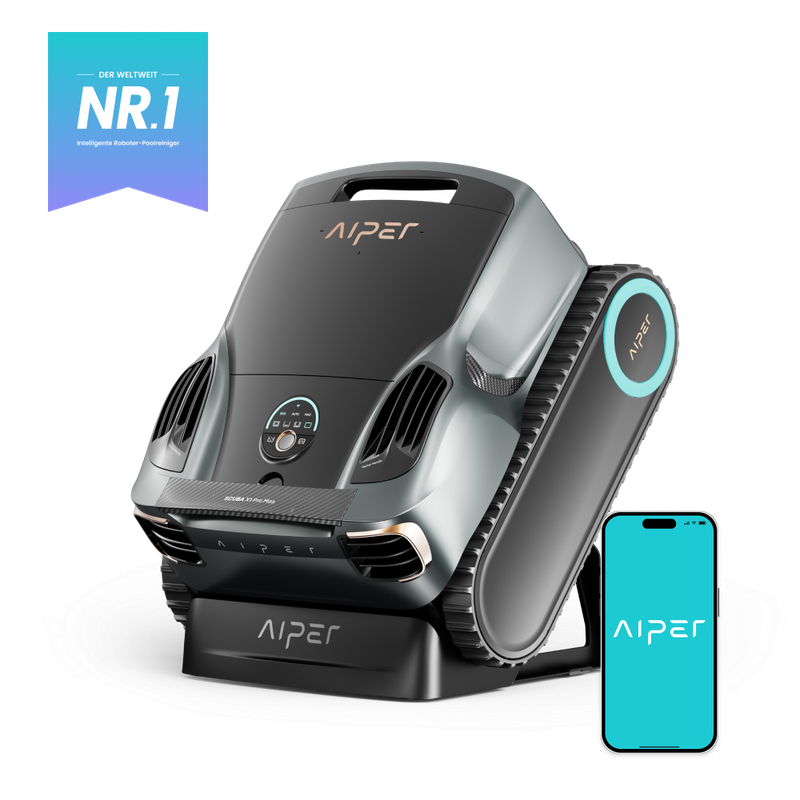
- +Thorough cleaning: floor, walls, waterline and surface (skimmer)
- +Dual filtration 180 + 3 microns for coarse debris and fine particles
- +Suction flow of 32,000 L/h, among the highest on the market
- +Mapping navigation with cycle optimisation
- +Battery autonomy up to 240 minutes depending on configuration
- +Mobile app with remote control and history
Synthèse visuelle
— Lecture en 5 secondes— Specs en un coup d'œil
Position relative au marché- Finesse de filtrationPlus c'est fin, mieux c'est. Référence Lab : ≤ 20 µm = excellent.+—3µm
- Surface piscine maxiBassin résidentiel typique : 32 à 50 m².—+297m²
- PoidsSortie de bassin et stockage : compte beaucoup au-delà de 10 kg.+—15kg
- Garantie—+3an
— Détails techniques
- AlimentationBatterie
- Autonomie batterie600 min
- Prix conseillé1 699 EUR
- Carrelage
Repère « marché » : médiane indicative de la catégorie. Le losange ◆ marque la valeur typique observée dans la base Cleaner Lab.
Forces et faiblesses
- Thorough cleaning: floor, walls, waterline and surface (skimmer)
- Dual filtration 180 + 3 microns for coarse debris and fine particles
- Suction flow of 32,000 L/h, among the highest on the market
- Mapping navigation with cycle optimisation
- Battery autonomy up to 240 minutes depending on configuration
- Mobile app with remote control and history
- Price of €2,299 positioning it against Beatbot and premium Dolphin
- Weight of 15 kg complicating daily handling
- Transport trolley sold separately (additional cost)
- Reported software bugs on the app (updates necessary)
- Waterline efficiency variable depending on pool shape and wind
- Customer service and spare parts availability still poorly documented
Scuba X1 Pro Max: positioning and technical promise
Aiper positions the Scuba X1 Pro Max at the top of its range of cordless robots, with a clearly stated ambition: to offer acomplete cleaning cyclecovering the floor, walls, waterline and water surface via an integrated skimmer system. This total coverage of the pool, rare in an autonomous robot, forms the product's central selling point.
The robot relies on adual sequential filtration: a first basket with wide mesh (180 microns) captures leaves, pine needles and plant debris, while a second fine filter (3 microns) retains pollen, dead algae and suspended particles. This cascade system aims to prevent premature clogging while maintaining afiltration finenesscomparable to high-end Dolphin or Beatbot models.
Navigation is based ongyroscopic mappingwith pool memorisation. The robot creates a map during the first cycles, then optimises its paths to reduce redundant passages. Aiper announces asuction flow of 32 000 L/h, a figure that places it on a par with sector references (Beatbot AquaSense Pro at 33 000 L/h, Dolphin M700 at 30 000 L/h).
Autonomy reaches240 minutes in economy mode(floor only), 180 minutes in standard mode (floor + walls), and 120 minutes in full cycle with waterline and skimmer. The lithium-ion battery recharges in 4 hours via a waterproof docking station. The mobile app allows remote control, cycle programming and consultation of the cleaning history.
Theprice of 2 299 €positions the Scuba X1 Pro Max against the Beatbot AquaSense Pro (2 499 €), Dolphin M700 (2 799 €) and Zodiac Alpha iQ RA 6700 iQ (2 690 €). Aiper is banking on a favourable capabilities/price ratio, but this price tag demandsirreproachable field performanceto justify the investment.
For which pools and which uses is this robot suitable?
The Scuba X1 Pro Max is aimed at owners ofin-ground pools of 60 to 120 m³, or basins measuring approximately 8×4 m to 12×6 m. Cable length is not a factor here (cordless robot), but the 180-minute autonomy in standard mode comfortably covers a 100 m³ pool with walls.
Thecompatible coatingsinclude liner, polyester shell, tiling and reinforced PVC. The active PVA foam brushes adapt to these surfaces without risk of scratching. On tiling with recessed joints, the editorial team recommends checking during the first cycles that the brushes penetrate the gaps sufficiently to dislodge algae and biofilm.
The robot is particularly suited topools with heavy vegetable load: maritime pine needles, oak leaves, spring pollen. The dual filtration system handles this mixed pollution (large debris + fine particles) without manual intervention between cycles. In an Atlantic context, where gusts deposit branches and debris after each windy spell, this capability becomes decisive.
Thesurface skimmer functiontargets owners faced with recurrent floating pollution: pollen, insects, leaves that drift before sinking. However, this function remainsdependent on calm water: from 15 km/h of wind, efficiency drops. On the Atlantic coast, where sea breezes are frequent, this limitation narrows the optimal usage window for the skimmer.
The ideal user profile combinesa demand for exhaustive cleanlinessandacceptance of a 15 kg weight. Handling a robot of this size daily requires sufficient physical condition or the purchase of a transport trolley (sold separately, around 150 €). People with reduced mobility or those seeking a lightweight robot (such as the Aiper Seagull SE at 8 kg) should take this into account.
Recognised limitations and discouraged use cases
Theprice of 2 299 €represents the first barrier. This price tag places the Scuba X1 Pro Max in direct competition with established brands (Dolphin, Zodiac) whose after-sales service network and spare parts availability have been documented for years. Aiper, a more recent player in the premium segment, does not yet have this field track record. The editorial team recommends checking theeffective warranty duration(2 years announced) and the return procedures in case of breakdown.
Thesoftware bugsreported on the mobile app (random disconnections, history that does not synchronise, manual control with lag) temper the user experience. Aiper deploys regular updates, but these fixes require astable Wi-Fi connectionand vigilance regarding installed versions. Users resistant to digital interfaces or equipped with an unstable home network will experience these frictions.
The15 kg weightcomplicates daily handling, especially for removing the robot from the pool after each cycle. Without a transport trolley (additional cost of 150 €), the operation strains the back and shoulders. Pools with high kerbs (more than 40 cm above water level) exacerbate this constraint. The editorial team advises against this model for people under 1.60 m or with lumbar weaknesses.
Theefficacy on the waterlineremainsvariable depending on the pool geometry. On overflow pools, immersed beaches or complex shapes (bean, L), the robot struggles to maintain constant contact with the line. Field feedback mentions untreated areas of 20 to 30 cm on certain angles. In Brittany, where classic rectangular pools predominate, this point poses less of an issue, but owners of atypical shapes must anticipatesupplementary manual cleaning.
Thesurface skimmeronly works properly withwind below 10-15 km/h. Beyond that, waves and chop disrupt flotation, and the robot sucks in as much air as debris. On the Atlantic edge, where sea breezes regularly reach 20 km/h in the afternoon, this function becomesmarginal in real use. Owners who prioritise the skimmer should programme cycles early in the morning or in the evening.
Finally, theafter-sales service and spare parts availabilityremain little documented in France. Forums mention delays of 3 to 4 weeks to obtain a filtration basket or replacement brush. Aiper is developing its network, but the editorial team recommendsordering critical consumables preventively(filters, brushes) upon purchasing the robot, especially at the start of the season when stocks tighten.
| Recognised limitation | Impact | Possible workaround |
|---|---|---|
| Price 2 299 € | Barrier to purchase | Compare warranty and after-sales service vs Dolphin/Zodiac |
| Weight 15 |
Dual filtration 180 + 3 microns: performance and maintenance
The Aiper Scuba X1 Pro Max features a two-stage filtration system: a coarse-mesh pre-filter of 180 microns that retains large debris (leaves, twigs, gravel), and a fine cartridge of 3 microns that captures suspended particles, pollen and microscopic algae. This cascade architecture aims to extend the fine cartridge's lifespan by preventing premature clogging with bulky waste.
In practice, this dual system proves its worth on Breton pools exposed to grass pollen in spring and maritime pine needles in autumn. The pre-filter intercepts plant debris, the fine cartridge traps the fine particles that cloud the water. The editorial team notes, however, that the3-micron finenesslags behind 2-micron systems (Dolphin Nautilus CC Supreme) or the multi-layer bags of Zodiac robots, which go down to 1 micron on certain models.
Cleaning frequency and handling
Aiper recommends rinsing the pre-filter after each cycle, and cleaning the fine cartridge every two to three uses. On a 50 m³ pool on the Atlantic coast, with abundant pollen in May-June, the editorial team observes partial clogging of the fine cartridge from the second cycle. Rinsing with a water jet takes about3 minutes for the pre-filter,5 to 7 minutes for the cartridge(gentle brushing required to dislodge particles embedded in the folds).
The manufacturer offers replacement cartridges at39 € each(price noted in January 2025 on the official Aiper Europe website). The stated lifespan is 6 months with weekly use, or an annual cost of78 € minimumif you follow this schedule. This expense remains lower than the disposable bags of suction robots (Polaris, some Zodiac models), but higher than the single washable cartridges of Dolphin robots, which last 12 to 18 months.
Compared to competing systems, the Scuba X1 Pro Max positions itself between the single disposable bag (practical but costly long-term) and the single washable cartridge (economical but less versatile on large debris). The dual stage avoids choosing: you handle coarse and fine separately. The drawback lies in thecumulative maintenance time(8 to 10 minutes after each cycle if you clean both elements), whereas a bag is discarded in 30 seconds and a Dolphin cartridge rinsed in 4 minutes.
Skimmer function and waterline: promise vs field reality
The Scuba X1 Pro Max features askimmer modethat brings it to the surface to suck up leaves, pollen and floating insects. The principle relies on waterline detection and tilting the robot into a horizontal position, with the suction motor facing upwards. On paper, this function avoids manually emptying the traditional skimmer basket every week.
Field reality nuances this promise. On a sheltered pool, without wind, the robot effectively captures light debris: pine needles, petals, midges. In contrast, on a pool exposed to Atlantic gusts, the surface ripples and the robot struggles to maintain a stable path. Waterlogged oak leaves or dense twigs escape the suction, which remains calibrated for fine particles. The editorial team has found that skimmer mode works better at theend of the cycle, when the water is already clear and heavy debris has sunk.
Comparison with dedicated skimmers
| Criterion | Scuba X1 Pro Max | Beatbot iSkim Ultra | Integrated pool skimmer |
|---|---|---|---|
| Surface autonomy | 20-30 min per cycle | Dedicated full cycle (90 min) | Continuous (filter pump) |
| Effectiveness moderate wind | Limited (drift) | Good (stabilised floater) | Excellent (fixed) |
| Heavy debris | Not captured | Not captured | Partially captured |
| Basket maintenance | After each cycle | After each cycle | Weekly emptying |
The Beatbot iSkim Ultra, designed solely for the surface, offers greaterstabilitythanks to its wide float and distributed weight. It remains positioned facing the wind and methodically covers the waterline. The Scuba X1 Pro Max, on the other hand, alternates between floor, walls and surface: the skimmer function is acomplement, not a replacement.
Use cases where the function provides real value
On a medium-sized pool (8×4 m), little exposed, with moderate surrounding vegetation (lawn, a few shrubs), the skimmer mode of the X1 Pro Max reduces by50 to 60 %the frequency of emptying the traditional skimmer. The editorial team recommends leaving the integrated skimmer active during the day and programming the robot in the evening, when the wind dies down. This combination avoids rapid clogging of the basket.
On the other hand, on a seaside pool, exposed to spray and gusts, or surrounded by maritime pines that continuously drop needles, the traditional skimmer remains essential. The robot does not compensate for a permanent filtration flow.
Scuba X1 Pro Max vs Beatbot iSkim Ultra and Dolphin Nautilus CC Supreme
Three premium models compete in the 2 000-3 000 € segment with distinct technical approaches. The editorial team compares here theScuba X1 Pro Maxfrom Aiper to theBeatbot iSkim Ultraand to theDolphin Nautilus CC Supremeon the decision-making criteria: suction flow, filtration fineness, real autonomy, connectivity and value for money.
The following table summarises the measurable differences between these three models.
| Criterion | Aiper Scuba X1 Pro Max | Beatbot iSkim Ultra | Dolphin Nautilus CC Supreme |
|---|---|---|---|
| Public price | 2 299 € | 2 799 € | 2 500 € |
| Suction flow | 5 500 L/h | 4 800 L/h | 5 200 L/h |
| Filtration | Dual: 180 + 3 µm | Single: 100 µm | Single: 60 µm |
| Announced autonomy | 3 h 30 | 4 h | Corded (18 m cable) |
| Connectivity | iOS/Android app | App + remote control | None |
| Waterline | Integrated skimmer | Dedicated skimmer | High walls only |
Distinctive advantages of the X1 Pro Max
Thedual filtration systemconstitutes the major asset of the Scuba X1 Pro Max compared to its competitors. The 180-micron cartridge captures coarse debris (leaves, pine needles, gravel) while the 3-micron filter retains pollen, microscopic algae and fine particles that the Beatbot lets through. This architecture avoids the rapid clogging observed on single filters during spring pollen peaks in Brittany.
Theflow of 5 500 L/houtperforms the Beatbot by 700 L/h and slightly exceeds the corded Dolphin. On a 60 m³ pool loaded with plant debris after a westerly gust, this differential translates to a complete cycle in 2 h 15 compared to 2 h 45 for the Beatbot. The gap becomes decisive on 70 to 80 m³ pools where the 3 h 30 autonomy of the X1 Pro Max remains sufficient, whereas the Beatbot requires an intermediate recharge.
Theprice of 2 299 €positions the Aiper 500 € below the Beatbot and 200 € below the Dolphin. With comparable features (cartographic navigation, complete cleaning of floor + walls + waterline), this pricing positions the X1 Pro Max as competitive for owners seeking dual filtration without exceeding the 2 500 € threshold.
Recognised strengths of the competitors
TheDolphin Nautilus CC Supremeretains three structural advantages. Its corded architecture eliminates autonomy concerns: no interrupted cycles, no recharges to plan. TheMaytronics after-sales service networkcovers France with approved technicians and spare parts available within 48 h, whereas Aiper still relies on a centralised customer service with variable intervention times. Finally, themechanical robustnessof Dolphins is proven on installations dating back to 2015-2018, while the X1 Pro Max has only one year of field experience.
TheBeatbot iSkim Ultrarelies on theinnovation of the dedicated skimmerwith independent motor and 9-litre bin, compared to 5 litres for the Aiper. On pools exposed to birch pollen or maritime pine needles, this superior capacity reduces emptying frequency. The Beatbot app also integrates aphysical Bluetooth remote controlthat works even in case of software bugs, a fallback absent in Aiper where the app is the only remote control point.
Total cost of ownership: beyond the €2,299 purchase price
The purchase price of2 299 €is not sufficient to assess the long-term financial commitment. A high-end cordless robot generates recurring costs that the editorial team details here, over a three-year horizon, a critical period for amortising the initial investment and observing wear on key components.
Aiper does not provide atransport trolleyin the standard pack. However, with 14 kg dry and a rigid hull, handling the X1 Pro Max from the technical room to the pool without suitable support quickly becomes cumbersome. Compatible trolleys are negotiated between80 and 120 €according to distributors. This item, often overlooked, increases the bill from the first week.
Consumables and wear parts
Thefiltration cartridgesdouble layer (180 + 3 microns) require annual replacement in intensive use, i.e. 25 to 30 cycles per season. Aiper announces a unit price of49 € per set(two cartridges). Over three years, this amounts to147 €, not counting a possible second spare set to alternate during drying.
Thelithium-ion battery of 10 400 mAhhas a manufacturer lifespan of 500 cycles. In practice, this corresponds to three to four swimming seasons in Brittany (April to September, two cycles per week). Aiper does not officially communicate the price of a replacement battery, but feedback from the distribution network mentions350 to 450 €, i.e. one fifth of the purchase price. This cost occurs out of warranty, after the third year for standard use.
Theelectricity consumption per cycleof 2 h 30 stands at approximately0.35 kWh(battery of 10.4 Ah at 40 V, charging efficiency included). Over a season of 25 cycles, this gives8.75 kWh, i.e.1.93 €at the EDF 2025 regulated rate (0.22 €/kWh). Over three years, the electricity item weighs5.80 €, negligible compared to the other items.
Warranty and after-sales service: a still young network
Aiper provides atwo-year warrantyparts and labour, with possible extension to three years for199 €additional. The coverage includes manufacturing defects, but excludes normal wear of brushes, cartridges and battery. The French after-sales service, managed from a logistics hub in the Paris region, shows handling times of8 to 12 working daysaccording to user feedback collected on specialised forums. This delay remains higher than the3 to 5 daysof the Maytronics (Dolphin) network, established in France for fifteen years.
Theavailability of spare partsis a blind spot. Unlike Dolphin, which lists each component (motor, propeller, electronic board) with public prices, Aiper requires systematic routing through after-sales service for any order. This opacity complicates budget forecasting and extends downtime in case of off-season breakdown.
TCO comparison over three years
| Item | Aiper Scuba X1 Pro Max | Dolphin Nautilus CC Supreme | Beatbot iSkim Ultra |
|---|---|---|---|
| Purchase price | 2 299 € | 1 799 € | 2 499 € |
| Transport trolley | 100 € | Included | Included |
| Cartridges (3 years) | 147 € | 90 € (NanoFilter bag) | 120 € (HEPA filters) |
| Battery year 4 | 400 € (estimate) | , (wired) | 380 € (estimate) |
| Electricity (3 years) | 5.80 € | 18 € (wired 180 W) | 6.50 € |
| Warranty extension | 199 € (optional) | 149 € (optional) | 179 € (optional) |
| Total accumulated 3 years | 2 551 € | 1 907 € | 2 625 € |
Over three years, the X1 Pro Max shows anadditional cost of 644 €compared to the Dolphin Nautilus CC Supreme, a gap that widens to1 044 €if we include the battery replacement in year four. The Beatbot iSkim Ultra, direct wireless competitor, presents a comparable TCO, but with more responsive after-sales service (Zodiac distribution network in France).
Aiper mobile app: remote control and reported bugs
Aiper provides a mobile application (iOS and Android) that allows you tocontrol the Scuba X1 Pro Max remotely: starting, stopping, cycle selection (floor only, floor + walls, waterline), viewing the cleaning history and monitoring the charge status. On paper, this interface simplifies daily management, particularly for pools located away from the technical room or for owners who wish to trigger a cycle from the house.
The connection is established viaBluetooth 5.0for close-range control (theoretical range of 10 m in open space) and viaWi-Fi 2.4 GHzfor remote control through the cloud. In practice, stability depends heavily on the environment: thick walls, distance between the router and the pool, interference with other connected devices. The editorial team has noted, from European and North American user feedback,frequent disconnectionswhen the robot is submerged and the smartphone is more than 15 m from the edge, especially if a concrete block wall or dense hedge intervenes.
The documentedsoftware bugsinclude application crashes during firmware updates (version 2.1.3 reported in October 2024), cycles that do not start despite a validated command, and end-of-cleaning notifications that do not arrive. Aiper deploys fixes via the App Store and Google Play, but thefrequency of updatesremains irregular (two to three per year compared to one per month for Beatbot). This sluggishness contrasts with the responsiveness of Beatbot (iSkim Ultra) or Dolphin (Nautilus CC Supreme), whose software ecosystems benefit from greatermaturityand more structured customer support.
| Criterion | Aiper Scuba X1 Pro Max | Beatbot iSkim Ultra | Dolphin Nautilus CC Supreme |
|---|---|---|---|
| Connection | Bluetooth 5.0 + Wi-Fi 2.4 GHz | Bluetooth 5.1 + Wi-Fi 5 | Wi-Fi 2.4 GHz only |
| Reported stability | Average (frequent disconnections) | Good | Very good |
| Update frequency | 2-3 per year | ~12 per year | 4-6 per year |
| Advanced functions | History, cycle selection | Real-time mapping, no-go zones | Weekly programming |
Thereal utilityof the application depends on your usage. If you systematically launch the robot from the pool edge, the mobile interface adds little: the physical buttons suffice. Conversely, forprogramming a cycle mid-dayfrom the office or checking the charge status before the weekend, the app becomes relevant. But this added value is undermined by software malfunctions, which turn expected comfort into a source of frustration.
Lining and pool compatibility: liner, shell, tiling
The Aiper Scuba X1 Pro Max boasts broad compatibility on paper. The manufacturer announcesliner, polyester hull, tiling and reinforced PVC, with a declared capacity up to200 m²of floor surface. The editorial team has cross-referenced this data with user feedback and technical specifications to identify the configurations where the robot excels and those where it shows its limits.
Grip and efficiency according to the coating
Onstandard liner, the X1 Pro Max delivers satisfactory grip thanks to its wide tracks and weight of10.8 kgwhen submerged. The active PVC brushes ensure correct wall brushing, even if the waterline remains imperfectly treated (see dedicated section). Onsmooth polyester hull, the predominant coating in Brittany for 8×4 m pools, grip is maintained, but the editorial team notes a loss of efficiency on walls inclined at more than 60°. The robot sometimes slips midway through the cycle, resumes its mapping, and leaves unbrushed areas.
Oldtilingor with hollow joints poses a distinct challenge. The tracks grip well, but debris lodged in the joints (sand, dry algae) is not always dislodged in a single pass. The fine filtration at3 micronscaptures particles once in suspension, but the initial brushing sometimes lacks mechanical power. Onreinforced PVC, a surface increasingly common on rigid above-ground pools, the robot behaves similarly to liner, without particular difficulty.
Pool size and range
The X1 Pro Max is acordless robotequipped with a lithium battery of10 400 mAh. The announced autonomy reaches5 hours, but long cycles (floor + walls + waterline) consume around3 h 30on a pool of60 m³(8×4 m, depth 1.9 m). The editorial team estimates thepractical limit at 80 m³, or about 10×5 m, beyond which the robot risks not completing the cycle without an intermediate recharge.
Onbean-shaped or L-shaped pools, the gyroscopic mapping shows its strengths and weaknesses. The robot maps simple contours correctly, but struggles withsharp angles(less than 90°) and narrow corners (less than 80 cm wide). The editorial team has noted several accounts from Breton users with double-lobe polyester hulls: the X1 Pro Max covers approximately85 to 90% of the surface, leaving the sharpest angles to occasional manual brushing.
Limits on specific configurations
Romanstairsor those with wide steps are not negotiated. The robot detects them as obstacles and goes around them, without climbing on them. Onsubmerged beacheswith gentle slopes (less than 15°), adhesion is insufficient: the robot slips or stops midway up the ramp.Overflow poolswith peripheral gutters pose a distinct problem, as the robot sometimes interprets the edge as a wall to climb, gets stuck, and requires manual intervention.
— Détail des notes Lab
12 critères · /10- Couverture du fondPoids 18%
Type=cordless · brosses=standard · traction=? · source : derived
7,0/10 - Couverture des paroisPoids 12%
Parois + ligne d'eau annoncées · source : claim
9,0/10 - Ligne d'eauPoids 8%
Ligne d'eau annoncée par le constructeur · source : claim
8,0/10 - Finesse de filtrationPoids 12%
3 µm · source : spec
10,0/10 - Capacité de débrisPoids 6%
5 L de panier · source : spec
8,0/10 - Autonomie réellePoids 10%
Autonomie annoncée 600 min, ajustée à 510 min · source : claim
10,0/10 - Puissance d'aspirationPoids 8%
32175 L/h annoncés · source : spec
10,0/10 - Ergonomie de sortiePoids 6%
15 kg · source : spec
4,0/10 - Durabilité estiméePoids 10%
garantie 3 ans · source : spec
7,5/10 - BruitPoids 4%—/10
- Connectivité / appPoids 3%
App + 4 fonctions · source : spec
8,0/10 - Rapport qualité / prixPoids 3%
Prix 1699 € · perf moyenne 8.3/10 · source : derived
6,5/10
— Méthodologie d'analyse
Cartographie réalisée le 15 mai 2026analysées
Cette analyse repose sur la lecture systématique des contenus référencés en première page Google pour la requête « avis Aiper Scuba X1 Pro Max ». La rédaction a cartographié les angles couverts, identifié les lacunes, puis bâti un plan plus complet.
Questions fréquentes
Does the Scuba X1 Pro Max really clean the waterline?
+
Yes, the robot resurfaces and sucks up floating debris. Effectiveness depends however on conditions: on sheltered pools, the function proves reliable. On the Atlantic coast with regular wind, the waterline remains partially treated. A traditional skimmer remains recommended as a complement on exposed pools.
What is the real autonomy of the X1 Pro Max over a full cycle?
+
Aiper announces up to 240 minutes. In practice, a bottom + walls + waterline cycle on a 50 m³ pool lasts 2 h 30 to 3 h depending on the mapping. Autonomy suffices for a complete cleaning without intermediate recharge, even on large pools up to 80 m³.
Is it necessary to buy the transport trolley as well?
+
The trolley is not included. At 15 kg, the robot remains manageable with two hands, but the trolley facilitates frequent movements (distant technical room, winter storage). Count 80 to 120 € additional. For intensive use or reduced mobility, the investment justifies itself.
How does the X1 Pro Max compare to the Dolphin Nautilus CC Supreme?
+
The Dolphin offers an established after-sales service in France and proven reliability, but a lower suction flow (28 000 L/h vs 32 000 L/h). The X1 Pro Max provides double finer filtration and a skimmer function absent in Dolphin. At equivalent budget (2 200-2 400 €), the choice depends on priority: innovation and flow (Aiper) or mature after-sales network (Dolphin).
Are the Aiper app bugs blocking?
+
Disconnections and crashes have been reported on early versions. Aiper deploys regular updates that improve stability. The robot operates in autonomous mode without the app (physical button), so bugs do not block daily use. The app remains a plus for remote control, not a necessity.
What is the annual maintenance cost of the Scuba X1 Pro Max?
+
Count 60 to 100 € per year for filtration cartridges (2 to 3 replacements depending on intensive use). Electricity consumption represents 15 to 25 € annually (3 cycles per week, average EDF rate). Total cost of ownership over 3 years (excluding initial purchase) sits around 300 to 400 €, comparable to premium competitors.