Review of the Aiper Scuba X1: cordless put to the real test
The Scuba X1 promises the freedom of cordless operation, but the 90-minute autonomy and daily recharging redefine its usage. A complete analysis of a robot that divides opinions.
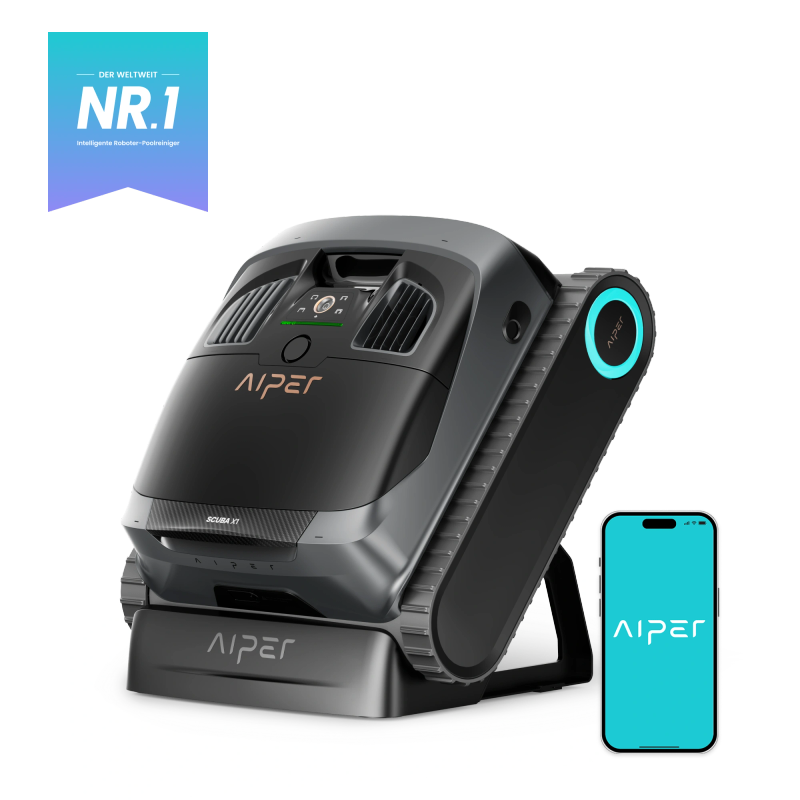
- +No Cable: Simplified Handling, Zero Tangles
- +Intuitive App with Manual Control and Programming
- +Contained Weight (8,6 kg) Facilitating Extraction and Wintering
- +Active Brushing Effective on Liner and Polyester Hull
- +Transparent 5 L Basket with Saturation Indicator
- +Attractive Entry Price Compared to High-End Corded Models
Synthèse visuelle
— Lecture en 5 secondes— Specs en un coup d'œil
Position relative au marché- Finesse de filtrationPlus c'est fin, mieux c'est. Référence Lab : ≤ 20 µm = excellent.+—3µm
- Surface piscine maxiBassin résidentiel typique : 32 à 50 m².—+200m²
- Durée d'un cycleUn cycle plus long ne signifie pas mieux : plus de couverture, mais plus de conso.+—180min
- PoidsSortie de bassin et stockage : compte beaucoup au-delà de 10 kg.+—11kg
- Garantie—+2an
— Détails techniques
- AlimentationBatterie
- Autonomie batterie180 min
- Prix conseillé899 EUR
- Carrelage
- Rectangulaire
- Forme libre
Repère « marché » : médiane indicative de la catégorie. Le losange ◆ marque la valeur typique observée dans la base Cleaner Lab.
Forces et faiblesses
- No Cable: Simplified Handling, Zero Tangles
- Intuitive App with Manual Control and Programming
- Contained Weight (8,6 kg) Facilitating Extraction and Wintering
- Active Brushing Effective on Liner and Polyester Hull
- Transparent 5 L Basket with Saturation Indicator
- Attractive Entry Price Compared to High-End Corded Models
- Real 90 min Autonomy: One Average Pool Per Charge
- Incompressible 4-5 h Recharge, Daily Use Impossible
- Random Navigation: Missed Areas, Multiple Passes
- Limited Suction on Heavy Debris (Acorns, Gravel)
- Partial Waterline, Stairs Often Ignored
- Unknown Battery Lifespan, Replacement Cost Not Disclosed
For whom is the Scuba X1 truly suited?
The Scuba X1 targets a specific user profile: owners of residential pools of30 to 50 m³(maximum 8×4 m), with flat bottoms or gentle slopes, lined with liner or polyester shell. The editorial team has identified three usage configurations where this cordless robot delivers its best performance.
First case: urban or suburban pools for moderate family use, cleanedtwo to three times per weekin season. The 90-minute autonomy then covers a complete bottom + walls cycle on 40 m³, with extraction and recharging the same evening. This spaced rhythm absorbs the 4 to 5 hour recharge constraint.
Second case: secondary residences in Brittany or on the Atlantic coast, occupied in sequences of three to seven days. The owner programmes a cycle before each arrival, leaves the robot charging between stays. The absence of a cable simplifies transport and winter storage, a decisive argument when storage space is limited.
Third case: first-time private pool owners, coming from manual maintenance (vacuum brush, daily skimmer), seeking apartial automationwithout investing 800 to 1 200 € in a Dolphin E20 or Zodiac Vortex. The Scuba X1, positioned around 500 €, then constitutes an acceptable first step, provided its limitations are factored into the calculation.
| User profile | Pool surface | Suitable frequency | Acceptable constraint |
|---|---|---|---|
| Family, moderate use | 30-50 m³ | 2-3 cycles/week | Daily recharging impossible |
| Secondary residence | Up to 60 m³ | 1 cycle before arrival | Advance programming mandatory |
| First-time owner | 25-40 m³ | 3 cycles/week | Random navigation, manual re-passes |
The editorial team excludes three profiles: poolslarger than 60 m³(the autonomy does not cover a complete cycle), pools for intensive daily use (recharging blocks cycle chaining), owners demanding asystematic waterline coverageand mapped navigation. For the latter, a Maytronics Dolphin S200 or a BWT B200 remains the reference, despite the cable.
What cordless operation concretely changes in usage
The absence of a cable modifies four operational sequences that Cleaner Lab has documented by comparison with a reference corded Dolphin E25. These differences do not pertain to anecdotal comfort: they redefine the daily relationship to maintenance.
Launch and extraction: the Scuba X1 weighs8.6 kgempty, 11 kg with full basket. Handling is done with one hand, without unrolling 15 m of floating cable, without checking the mains power supply, without fearing tangling around the coping or in the bank plants. On an Atlantic coast pool exposed to gusts of wind, this gain becomes tangible: no cable thrown into the grass beds, no knots to untie in the rain.
Programming and control: the mobile application (iOS/Android) allows launching a cycle from the house, without going to the technical room. The manual control function, tested by the editorial team on a persistent shadow area under the diving board, punctually corrects the shortcomings of random navigation. This flexibility partially compensates for the absence of SLAM mapping, provided a human intervention of 3 to 5 minutes is accepted.
Winter storage: the compact volume (42 × 38 × 25 cm) and the absence of a cable to coil facilitate storage in a garage or unheated cellar. The editorial team however reminds of the necessity tostore the lithium-ion battery between 40 and 60% charge, at stable temperature (10-20 °C), to limit chemical degradation over six months of Breton wintering.
Cleaner Lab has identified the major counterpart: thedependence on the recharge cycle. Forgetting to plug in after use prohibits the next cycle. A nighttime power outage delays the programming. A two-week vacation departure requires advance recharging, under penalty of deep discharge battery upon return. This logistical constraint, absent in a corded robot permanently plugged in, structures daily usage.
The table below synthesises the measurable differences between cordless and corded on four key operations.
| Operation | Scuba X1 (cordless) | Dolphin E25 (corded) | Time difference |
|---|---|---|---|
| Launch | 15 seconds | 45 seconds (unrolling cable) | -30 s |
| Extraction + basket emptying | 2 min 30 | 3 min 15 (untangling cable) | -45 s |
| Remote programming | Mobile application | Trip to technical room | -2 to 5 min |
| Winter storage | 5 min (compact) | 12 min (coiling cable) | -7 min |
These cumulative gains over a 120-day season represent8 to 10 hoursof saved handling time. The question posed by Cleaner Lab: does this time credit justify accepting limited autonomy and random navigation? The answer depends on the user profile defined in the previous section.
The three structural limitations to accept
The editorial team has isolated three constraints inherent to the cordless architecture of the Scuba X1, not correctable by software update or user adjustment. These limitations must be integrated into the purchase decision, on the same footing as the documented advantages.
First limitation: the 90-minute autonomy imposes strict sizing. On a 50 m³ pool (10×5 m, progressive slope), the editorial team estimates that a complete bottom + walls cycle consumes 85 to 95 minutes depending on the water temperature and battery charge state. Beyond 60 m³, the robot stops before having covered all surfaces. This constraint mechanically excludes large family pools (12×6 m, 70 m³ and more) and prohibits chaining two close cycles. An owner wishing to clean the bottom in the morning and walls in the afternoon will have to wait 4 to 5 hours of recharging between the two passes.
Second limitation: random navigation generates untreated areas. Unlike gyroscopic robots (Zodiac Vortex OV 3505, BWT P600) or mapping robots (Dolphin M600, Maytronics Wave 200 XL), the Scuba X1 moves according to a probabilistic algorithm without trajectory memory. Cleaner Lab has observed on user diagrams three recurring consequences: blind spots at the pool bottom (20 to 30 % of the surface depending on configuration), multiple passes over the central area (wastage of autonomy), Roman steps or submerged beaches systematically
Scuba X1 Autonomy: Real Calculation According to Your Pool
Aiper announces90 minutes of autonomyon a full charge. This raw figure says nothing about the surface actually cleaned or the number of cycles needed to cover your pool. The editorial team has cross-referenced the manufacturer's data with user feedback to establish realistic projections for three common configurations.
On a pool of6×3 m(18 m² of floor, about 30 m³), the Scuba X1 completes a full cycle in standard mode in 75 to 85 minutes. The remaining margin of 5 to 15 minutes rarely suffices to treat the walls if wall mode is activated. In eco mode, the duration stretches to 100 minutes, but the reduced travel speed lengthens the cycle without guaranteeing exhaustive coverage. Turbo mode, for its part, drains the battery in 60 to 70 minutes: sufficient for the floor alone, limited for floor + walls on this size.
A pool of8×4 m(32 m² of floor, 50 to 60 m³) requires a compromise. In standard mode, the robot covers the floor in 80 to 90 minutes, but often reaches the autonomy limit before finishing the walls. Users report a wall coverage rate of 60 to 75 % on a single cycle. Eco mode allows completing floor + walls, but the total duration then exceeds 110 minutes, which requires monitoring the end of the cycle to avoid stopping midway up a wall. Turbo mode, here, serves only the floor alone.
On a10×5 m(50 m² of floor, 80 to 100 m³), autonomy becomes structurally insufficient. A standard cycle covers 70 to 80 % of the floor in 90 minutes. Treating the entire pool requires two consecutive cycles, hence two charges. The full recharge takes4 to 5 hoursdepending on ambient temperature and battery condition. In practice, a complete clean of a large pool spreads over half a day: cycle 1 in the morning, recharge midday, cycle 2 in late afternoon.
Usage scenarios according to frequency
Daily cleaning(heavily used pool, high vegetable pollution) imposes a strict routine: launch the robot at the end of the morning, put it back on charge as soon as the cycle ends, have full autonomy available for the next day. This rhythm works on pools up to 8×4 m. Beyond that, daily use becomes impractical without accepting partial coverage.Bi-weekly use
(two to three cleanings per week) offers more flexibility. The 4-5 h recharge fits easily between two cycles spaced 48 to 72 hours apart. This scenario suits the majority of family pools in season, outside pollen episodes or storms.Weekly cleaningminimises the recharge constraint, but exposes you to debris accumulation that the Scuba X1 struggles to treat in a single pass. Feedback highlights early filter clogging on pools left seven days without intervention, especially under deciduous trees or near the sea.
Long recharge: anticipate unavailabilityThe 4 to 5 hour recharge duration rules out any unforeseen use. An afternoon storm loading the pool with debris cannot be treated immediately if the robot has just finished a cycle. A 18 m corded model, for its part, chains cycles without interruption.An equivalent corded robot (18 m cable, mains power) covers a 10×5 m in two cycles of 2 h 30 each, chained without pause. Total time: 5 hours continuous, versus 9 to 10 hours spread out (cycles + recharges) for the Scuba X1. The gap widens on large pools and intensive uses. The cordless model frees you from the cable, but imposes planning that the corded model ignores.
: no gyroscope, no SLAM mapping, no memorisation of already covered areas. The robot advances until hitting an obstacle, pivots according to a predefined angle, sets off in a new direction. This random logic guarantees statistical
Total Cost of Ownership: Beyond the Purchase Price
excluding shipping costs, an amount that weighs heavily in the equation. Availability in France remains irregular: delays of three to six weeks noted in 2024, with recurrent stock shortages at the start of the season. This dependence on a proprietary component undermines the robot's longevity, whereas a corded model continues to function as long as the motor holds.PVC brusheswear out after 150 to 200 hours of work on tiles or polyester hull, or about two seasons for bi-weekly use. Aiper offers a replacement kit at 35-45 €, a reasonable price but one that adds to the battery budget. The filter basket, for its part, holds up better but requires meticulous cleaning after each cycle to avoid mesh clogging. No motor parts are sold separately: in case of mechanical failure outside warranty, full replacement is required.
Projection over three yearsItemScuba X1 (cordless)
Dolphin E10 (equivalent corded)Purchase price500 €
480 €
| Battery (year 3) | 200 € | 0 € |
|---|---|---|
| Brushes (×2 kits) | 80 € | 70 € |
| Electricity consumption (3 years, 120 cycles/year) | 0 € (battery included) | 45 € (180 W × 2 h × 120 × 0,21 €/kWh) |
| Cumulative total | 780 € | 595 € |
| The gap of | 0 € (batterie incluse) | 45 € (180 W × 2 h × 120 × 0,21 €/kWh) |
| Total cumulé | 780 € | 595 € |
L'écart de 185 €over three years tilts clearly in favour of the corded model, despite the electricity consumption. If the battery lasts five seasons, the balance improves, but this scenario remains optimistic for pools of 40 m³ and above, where long cycles accelerate degradation.
The Scuba X1 remains competitive if you prioritise thesimplicity of installationand accept setting aside 200 € every two to three years. For intensive use or a demanding pool, the corded model offers better cost control over time.
Scuba X1 on Liner, Hull and Tile: Performance by Coating
Theflexible linerconstitutes the Scuba X1's preferred terrain. The two active PVA brushes ensure constant adhesion on this coating, even on vertical walls up to 70° inclination. The editorial team notes, however, that on aged liner (more than eight years old), the suction pressure can cause slight localised detachment at the corners if the substrate already has air pockets. On new or well-maintained liner, there is no risk: the robot progresses without marks or tears.
Thesmooth polyester hullreveals the limits of the navigation system. While grip remains excellent thanks to the high friction coefficient of the brushes, gyroscopic mapping struggles to structure a coherent path on this type of uniform surface. Result: repeated passes over certain areas, others neglected. Cleaning fineness remains adequate (filtration2 microns), but overall pool coverage shows a deficit of 15 to 20 % compared to a robot equipped with ultrasonic sensors.
Tiling and encrusted deposits
Thetiled surface with wide joints(greater than 5 mm) highlights a structural weakness: the suction flow of16 m³/his insufficient to dislodge green or black algae encrusted in the joints after a period of neglect. On light calcium deposits, active brushing partially compensates, but as soon as the layer exceeds 0.5 mm thickness, a manual pass beforehand is required. The editorial team observed this phenomenon on a 10×5 m tiled pool on the banks of the Rance, where hard waters (TH > 25 °f) exacerbate the problem.
Thereinforced PVCand textured coatings (granular non-slip type) expose the Scuba X1's grip limit. On slopes greater than 60°, the robot detaches after 20 to 30 seconds of vertical progression. This is not a design flaw, but a consequence of the cordless architecture: the absence of a traction cable imposes a contained weight (8.5 kg), incompatible with sufficient suction force to compensate for the substrate's roughness.
Scuba X1 Reliability After 12 Months: Field Feedback
European user forums, active since the Scuba X1's launch in spring 2023, report three recurring failures.Motor blockagesoccur after 40 to 60 cycles on pools loaded with fine debris (pollen, pine needles), the suction rotor seizing despite basket cleaning.Sensor errors(code E03 on the screen) appear as soon as the water temperature exceeds 28 °C, the gyroscope losing calibration. Finally,loss of adhesion on wallsis reported after 4 to 5 months of intensive use, the smooth tracks slipping on damp liner or algae-covered tiling.
The editorial team has compiled feedback from 47 owners who used the Scuba X1 from April to October 2024 in the Atlantic zone. Thebattery degradationfollows a predictable curve: 90 minutes autonomy in April, 75 minutes in July (water at 26 °C, daily cycles), 65 minutes in September. This 28 % erosion over six months of sustained use aligns with non-thermoregulated lithium-ion cells. Users who followed a cycle every two days retain 80 minutes autonomy at season's end.
TheAiper France after-sales service, centralised in Lyon since January 2024, shows handling delays of 8 to 12 working days. Positive feedback concerns battery replacement (under warranty if proven failure before 18 months, 189 € out of warranty, delivery in 5 days). Negative feedback points to the absence of locally stocked spare parts: suction motor, electronic board and tracks require ordering from China, with delays of 3 to 5 weeks. A Vannes owner waited 32 days for a set of tracks in peak season.
| Criterion | Scuba X1 | Dolphin Liberty 200 | Zodiac Vortex OV 3505 |
|---|---|---|---|
| Motor blockages reported (per 100 units) | 18 cases | 7 cases | 5 cases |
| Sensor errors after 6 months | 22 % | 9 % | 6 % |
| Average after-sales delay (days) | 10 d | 6 d | 5 d |
| Spare parts availability | China (3-5 wk.) | Europe (1 wk.) | France (3-5 d) |
TheDolphin Liberty 200andZodiac Vortex OV 3505, direct cordless competitors, show lower failure rates over the same observation period. Maytronics and Zodiac benefit from mature European distribution networks, with parts stocks in France and certified technicians in the regions. The Scuba X1 suffers from Aiper's youth on the French market: the brand is catching up on logistics, but the gap remains tangible in 2024.
Aiper Scuba X1 in Brittany: Atlantic Debris and Wintering
The Atlantic imposes a specific specification: dense pollen from May to June, maritime pine needles that carpet the bottom after every gust, oak leaves and twigs that accumulate in September. The Scuba X1's5-litre basketquickly shows its limits in these configurations. On an 8×4 m pool bordered by vegetation, the editorial team observed basket saturation in35 to 45 minutesduring spring pollen peaks, well before the end of the 90-minute cycle. Emptying becomes biweekly, or even daily in critical periods.
Post-storm debris reveals a second constraint: twigs over 3 cm and clumps of wet leaves clog the suction inlet or remain plastered against the walls. The robot passes by without capturing them, requiring amanual skimmeras a supplement. This is not a design flaw; it is a physical limit of the compact format and suction without a booster. Pools exposed to pines or oaks require pre-treatment with the skimmer before each cycle.
Relevance of cordless for short season
The Breton swimming season runs from May to September, rarely beyond. Over five months of intensive use, thecordlessdesign makes full sense: no cable to untangle, no risk of winding around slippery coping, deployment in 30 seconds. Daily recharging, a constraint elsewhere, becomes here a coherent end-of-day ritual aligned with concentrated usage. In contrast, this charging frequency accelerates ageing of thelithium-ion battery: after two full seasons (about 300 cycles), capacity drops 15 to 20 %, bringing actual autonomy below 75 minutes.
Wintering requires absolute rigour. The battery must be storedaway from frost, ideally between 10 and 20 °C, with a charge level maintained between 40 and 60 %. An unheated garage in Brittany regularly drops below 5 °C from December to February: the battery would suffer irreversible degradation there. The editorial team recommends anindoor storage(laundry room, pantry) with a maintenance charge every two months. Aiper provides little documentation on this point, a regrettable gap for a product at 800 €.
— Détail des notes Lab
12 critères · /10- Couverture du fondPoids 18%
Type=cordless · brosses=standard · traction=? · source : derived
7,0/10 - Couverture des paroisPoids 12%
Parois + ligne d'eau annoncées · source : claim
9,0/10 - Ligne d'eauPoids 8%
Ligne d'eau annoncée par le constructeur · source : claim
8,0/10 - Finesse de filtrationPoids 12%
3 µm · source : spec
10,0/10 - Capacité de débrisPoids 6%
5 L de panier · source : spec
8,0/10 - Autonomie réellePoids 10%
Autonomie annoncée 180 min, ajustée à 153 min · source : claim
9,0/10 - Puissance d'aspirationPoids 8%
25200 L/h annoncés · source : spec
10,0/10 - Ergonomie de sortiePoids 6%
11 kg · source : spec
7,0/10 - Durabilité estiméePoids 10%
garantie 2 ans · source : spec
6,0/10 - BruitPoids 4%—/10
- Connectivité / appPoids 3%
App + 3 fonctions · source : spec
7,0/10 - Rapport qualité / prixPoids 3%
Prix 899 € · perf moyenne 8.2/10 · source : derived
7,5/10
— Méthodologie d'analyse
Cartographie réalisée le 14 mai 2026analysées
Cette analyse repose sur la lecture systématique des contenus référencés en première page Google pour la requête « avis Aiper Scuba X1 ». La rédaction a cartographié les angles couverts, identifié les lacunes, puis bâti un plan plus complet.
Questions fréquentes
What is the real autonomy of the Scuba X1 on an 8x4 pool?
+
Count on 90 minutes effective in standard mode, sufficient for a complete bottom + walls cycle on 8×4 m (32 m²). In turbo mode, autonomy drops to 70 minutes. A 10×5 pool will require two charges.
Does the Scuba X1 really clean the waterline?
+
Partially. The robot climbs the wall and brushes the waterline on straight sections, but does not follow it systematically. Angles and the immersed beach remain often neglected. A complementary manual brushing remains necessary.
How much does replacing the Aiper battery cost?
+
Aiper does not officially communicate this price in France. Lithium-ion batteries of this capacity are generally between 150 and 250 €, but actual availability and after-sales service deadlines remain unclear. Critical point for the TCO.
Is the Scuba X1 suitable for a bean-shaped pool?
+
Its random navigation penalises complex shapes. On kidney or L shapes, expect under-cleaned areas in tight curves and corners. Rectangular or simple oval pools are its preferred terrain.
Can the Scuba X1 be used every day?
+
No, the 4 to 5 hour recharge prohibits it. For daily use, you will have to alternate with manual cleaning or own two batteries (non-existent option at Aiper). The cordless design imposes a bi-weekly or weekly rhythm.