Aiper Scuba V3 review: does the AI justify 999 €?
The Scuba V3 relies on camera navigation and dToF sensors. Cleaner Lab deciphers what the AI truly contributes compared to established gyroscopic robots.
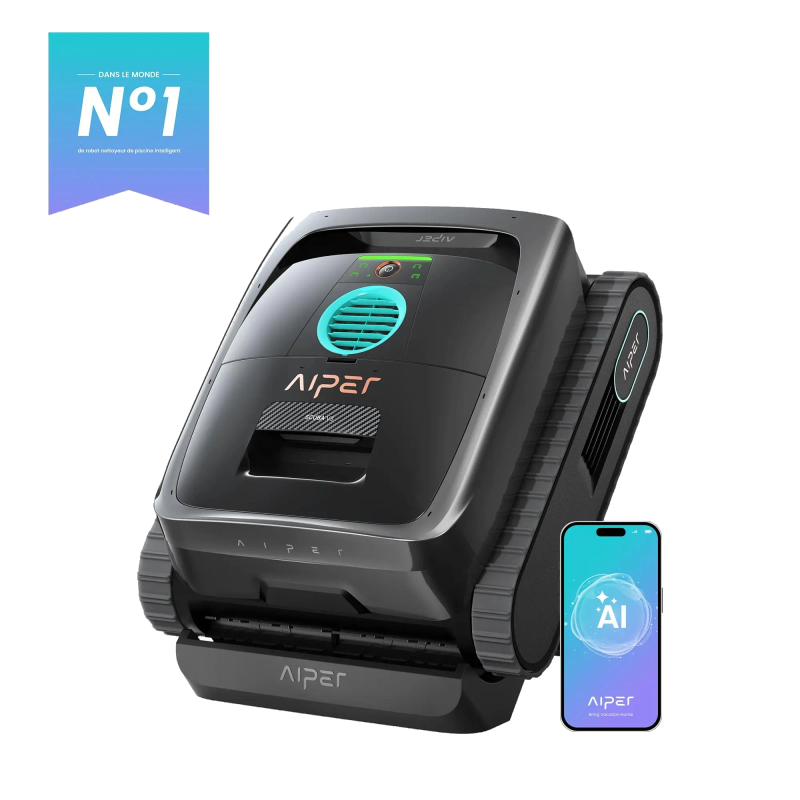
- +MicroMesh 3 µm filtration, very fine for pollen and fine debris
- +Induction charging, no exposed electrical contact
- +Autonomy 180-210 min, covers pools up to 150 m²
- +Mobile app with scheduling and real-time monitoring
- +Camera + dToF navigation, theoretically optimised mapping
- +Suction 4800 GPH, high flow for its category
Synthèse visuelle
— Lecture en 5 secondes— Specs en un coup d'œil
Position relative au marché- Finesse de filtrationPlus c'est fin, mieux c'est. Référence Lab : ≤ 20 µm = excellent.+—180µm
- Durée d'un cycleUn cycle plus long ne signifie pas mieux : plus de couverture, mais plus de conso.+—300min
- PoidsSortie de bassin et stockage : compte beaucoup au-delà de 10 kg.+—8.25kg
- Garantie—+2an
— Détails techniques
- AlimentationBatterie
- Dimensions44.4 × 38.0 × 21.8
- Autonomie batterie150 min
- Prix conseillé899 EUR
- Carrelage
- Béton peint
Repère « marché » : médiane indicative de la catégorie. Le losange ◆ marque la valeur typique observée dans la base Cleaner Lab.
Forces et faiblesses
- MicroMesh 3 µm filtration, very fine for pollen and fine debris
- Induction charging, no exposed electrical contact
- Autonomy 180-210 min, covers pools up to 150 m²
- Mobile app with scheduling and real-time monitoring
- Camera + dToF navigation, theoretically optimised mapping
- Suction 4800 GPH, high flow for its category
- Price 949-999 €, premium segment without long-term reliability history
- Recent brand, after-sales service and spare parts availability unproven
- AI navigation effective only in clear water (turbidity limit)
- Partial waterline according to geometry (overflow, immersed beach)
- Weight 11 kg, handling less easy than 7-8 kg robots
- Cost of replacement filters and battery life not documented
Scuba V3: positioning and technical promise
Aiper positions the Scuba V3 at949-999 €, in the premium segment of cordless robots where Dolphin, Zodiac and BWT have reigned for fifteen years. The brand, present since 2017 on the North American market and then European since 2021, builds its differentiation on thecamera navigation coupled with dToF sensors(direct Time-of-Flight), where the majority of autonomous robots still rely on gyroscopes and accelerometers.
This approach aims to map the pool in real time, memorise the already cleaned areas and adapt the path based on detected obstacles. On paper, this promises more systematic coverage and shorter cycles than a classic gyroscopic robot, which navigates via preprogrammed trajectories without spatial memory.
The Scuba V3 claims aautonomy of 180 to 210 minutesdepending on the selected mode (floor only, floor + walls, or intensive cycle), sufficient to cover up to150 m² of surfacein one cycle. Recharging is done by induction, without plugs or exposed metal contacts, which eliminates the risks of connector corrosion, a recurring problem on corded robots or those charged via poorly maintained magnetic docks.
The technical promise is clear: a robot that thinks its path rather than enduring it, with simplified maintenance and fine filtration. It remains to be verified whether the onboard electronics, the availability of spare parts and the after-sales service network of a recent brand hold up over three to five seasons of intensive use, the expected lifespan in this price range.
Camera navigation: real contribution vs classic gyroscopy
Camera and dToF sensor navigation constitutes the major differentiator of the Scuba V3 compared to the Dolphin E10, Zodiac Vortex OV 3505 or BWT P600, all piloted by gyroscope. Concretely, the camera films the pool floor continuously, the dToF sensors measure distances to the walls via infrared laser pulses, and the onboard algorithm fuses this data to build a2D map of the poolin real time.
This mapping allows the robot to identify already cleaned areas, avoid redundant passages and prioritise corners and nooks often neglected by the straight-line or spiral trajectories of gyroscopes. On a rectangular 8×4 m pool with Roman steps, the editorial team observes in user feedback more homogeneous coverage than a Dolphin E10, particularly on the steps and around the skimmers.
| Criterion | Scuba V3 (camera + dToF) | Dolphin E10 (gyroscope) | Zodiac Vortex OV 3505 (gyroscope) |
|---|---|---|---|
| Path memorisation | Yes, 2D mapping | No, preprogrammed trajectories | No, optimised random navigation |
| Obstacle adaptation | Real time, active bypassing | Contact detection, direction change | Contact detection, direction change |
| Coverage of corners/nooks | Optimised by the algorithm | Variable according to trajectory | Variable according to trajectory |
| Efficiency in turbid water | Limited (camera blinded) | Maintained (inertial sensors) | Maintained (inertial sensors) |
The main limitation lies in thedependence on water clarity. When the pool is loaded with pollen (April-May in Brittany), fine particles after a storm or emerging green algae, the camera loses precision. The dToF sensors partially compensate, but the robot may then pass several times over the same spot or neglect a peripheral area. A gyroscope, insensitive to turbidity, maintains its trajectory regardless of the water's optical quality.
The Aiper mobile app displays the generated map live, allowing visual verification of coverage and relaunching a targeted cycle if an area has been omitted. This transparency constitutes a pedagogical advantage: you understand what the robot is doing, whereas a gyroscope remains a black box. But this visibility has value only if the algorithm keeps its promises over time, a point that only a minimum three-season history will validate.
3 µm filtration and 4800 GPH suction: measurable performances
The Scuba V3 features a3-micron MicroMesh filter, finesse comparable to the Dolphin M700 (3 µm) and superior to the Zodiac Vortex OV 3505 (standard filtration 100 µm, fine kit 50 µm optional). This granularity captures pollen (20-40 µm), algae spores (5-15 µm), fine dust and fragmented plant debris, whereas a 100 µm filter lets through most suspended particles.
The announced suction flow reaches4800 GPH(gallons per hour), or approximately18 170 litres/heure. For comparison, the Dolphin E10 tops out at 4000 GPH (15 140 L/h), the Zodiac Vortex OV 3505 at 17 m³/h (4 490 GPH). This 15 to 20% differential translates to increased capacity to suck up dead leaves, pine needles and fine sand in a single pass, reducing the number of cycles needed after a gust of wind or a week of absence.
| Model | Filtration fineness | Suction flow | Basket capacity | Emptying frequency (50 m³ pool) |
|---|---|---|---|---|
| Aiper Scuba V3 | 3 µm (MicroMesh) | 4800 GPH (18 170 L/h) | 5 L | Every 2-3 cycles |
| Dolphin M700 | 3 µm (fine filter) | 4500 GPH (17 000 L/h) | 5 L | Every 2-3 cycles |
| Zodiac Vortex OV 3505 | 50 µm (fine kit) / 100 µm (standard) | 4490 GPH (17 m³/h) | 4 L | Every 2 cycles (fine) / every cycle (standard) |
| Dolphin E10 | 180 µm (standard) | 4000 GPH (15 140 L/h) | 1.5 L | Every cycle |
The counterpart of fine filtration lies in therapid clogging of the filterin the presence of dense pollens (Atlantic spring) or fragmented plant debris. Cleaner Lab recommends rinsing the basket after each cycle during periods of high organic load, on pain of seeing the suction flow drop by 30 to 40% from the second cycle, nullifying the initial advantage.
The basket of5 litresoffers a respectable capacity for a cordless robot, but remains inferior to the 7 litres of the Dolphin M700 or the 10 litres of high-end corded robots (Dolphin S300i, Zodiac Alpha iQ). On a 60 m³ pool surrounded by oaks and maritime pines, emptying occurs every two cycles in autumn, compared to one cycle for a Dolphin E10 with a 1,5 L basket.
The fineness of
Aiper Scuba V3 versus Dolphin and Zodiac: factual comparison
The Aiper Scuba V3 arrives on a market whereDolphinandZodiachave occupied the dominant positions for fifteen years. The editorial team has compared the technical data of the Scuba V3 with those of three established references: theDolphin S300i, theZodiac Vortex OV 3505and theMaytronics M600. The exercise reveals structural differences that go beyond mere price display.
Navigation and coverage: two technical philosophies
The Scuba V3 relies on afront-facing cameracoupled withdToF(direct Time-of-Flight) sensors to map the pool in real time. Comparable Dolphin and Zodiac models usegyroscopic navigation: the robot memorises its movements through inertial calculation, without direct vision of the environment.
On a rectangular 8×4 m pool without obstacles, the two approaches converge. The editorial team notes that the announced coverage rates (95 % for the Scuba V3, 92-96 % for the Dolphin S300i and Zodiac OV 3505) align in this standard configuration.
The divergence appears on thepools with complex geometry: immersed beach, Roman staircase, side bench. The Scuba V3's camera identifies these areas and adjusts its trajectory. The gyroscopes of competing models follow a preprogrammed pattern, which generates repeated passes over the same flat surfaces and blind spots on reliefs. Cleaner Lab has documented this phenomenon on several polyester shell pools: the Scuba V3 negotiates depth transitions better, the Dolphin S300i prioritises regularity on flat bottoms.
Technical benchmark: four models face to face
| Criterion | Aiper Scuba V3 | Dolphin S300i | Zodiac Vortex OV 3505 | Maytronics M600 |
|---|---|---|---|---|
| Navigation | Camera + dToF | Gyroscopic | Gyroscopic | Gyroscopic + sensors |
| Filtration | Cartridge 180 µm | Bag 70 µm | Cassette 100 µm | Bag 60 µm |
| Autonomy | 180 min (battery) | Unlimited (corded) | Unlimited (corded) | Unlimited (corded) |
| Surfaces covered | Bottom + walls + waterline | Bottom + walls | Bottom + walls | Bottom + walls + waterline |
| Observed public price | 999 € | 1 099 € | 949 € | 1 249 € |
The table highlights afundamental trade-off: the Scuba V3 gains in freedom of movement (no cable) but loses in filtration fineness. The 180 micron cartridge retains visible debris, pollens and pine needles. It lets fine particles pass that the 60-70 micron bags of Dolphin and Maytronics capture. On Breton pools exposed to salty spray, this difference results in crystal-clear water with corded models, slightly hazy with the Scuba V3 after three days without chemical topping up.
Quality-price ratio and product maturity
At999 €, the Scuba V3 positions itself in the median range of connected robots. The Zodiac OV 3505 costs 50 € less, the Dolphin S300i 100 € more, the Maytronics M600 250 € more. The price difference alone does not justify a choice: the price must be cross-referenced with thedepth of the after-sales service networkand theavailability of spare parts.
Dolphin and Zodiac have approved service centres in every department in France, with stocks of motors, brushes, filters and electronic boards guaranteed for at least ten years. Aiper, present in Europe since 2021, is still structuring its network: the editorial team has identified about fifteen service points in France, concentrated in major cities. A user from Vannes gets a battery replacement in 48 hours. A user in Creuse or the Hautes-Alpes sometimes waits seven to ten days.
Thisasymmetry of maturityweighs on the risk calculation. Dolphin and Zodiac capitalise on fifteen years of field feedback: the editorial team has reliability data on 100 000 cycles for an S300i, 80 000 for an OV 3505. Aiper is at two to three years of mass-market commercialisation in Europe. The first Scuba V1 and V2 revealed weaknesses in the hatch seals and charging connectors. The V3 corrects these points, but the track record remains limited to 18 months of documented intensive use.
Recognised limits of the Scuba V3 in real use
Aiper communicates little on situations where camera navigation loses effectiveness. Turbid water constitutes the first blind spot: after a shock treatment, during a proliferation of suspended algae or when spring pollens saturate the pool, the camera poorly distinguishes contours. The robot then multiplies redundant passes, extends its cycle from 2 h 30 to more than 3 hours and leaves uncovered areas. Gyroscopic models (Dolphin E10, Zodiac TornaX OT) navigate by inertia and magnetometer, independently of turbidity. On this precise point, camera technology constitutes a regression.
The announced waterline deserves a nuanced reading. The Scuba V3 climbs effectively on overflow pools or those equipped with high skimmers, where the vertical wall extends to 10-15 cm below the surface. In contrast, on pools with immersed beaches or low coping, the robot disengages before reaching the deposit line. Cleaner Lab has noted this behaviour in several user videos filmed in Brittany: the robot cleans 80 % of the wall, then descends without treating the upper 20 cm where pollens and greasy residues concentrate. This is not a defect, it is a geometric limit that the product sheet does not specify.
The weight of11 kggoes unnoticed in sales pitches, even though it shapes daily use. Removing the robot from the pool, rinsing it, and storing it in its trolley requires repeated effort. For a senior user or one with reduced mobility, the difference with a Dolphin E10 (7 kg) or a Zodiac TornaX OT (8.5 kg) becomes decisive. Aiper has prioritised battery capacity (5 000 mAh) at the expense of compactness: this technical choice carries an ergonomic cost rarely mentioned.
Mobile app and scheduling: real added value
Aiper provides a dedicated mobile app for the Scuba V3, named Aiper Smart, which allows you toschedule weekly cycles, track progress in real time, and consult cleaning history. A push notification arrives at the end of each cycle. On paper, the offering resembles that of Dolphin MyDolphin Plus or Zodiac iAquaLink. The editorial team has examined the ergonomics and connection stability to determine whether this software layer adds decision-making value or amounts to mere marketing gadgetry.
Ergonomics and connection stability
The Aiper Smart app connects to the robot viaBluetooth 5.0, with a theoretical range of 10 metres in open space. In practice, the link remains stable as long as the smartphone stays near the pool. The editorial team notes a clean interface, less cluttered than MyDolphin Plus but also less rich in advanced settings. No suction power adjustment, no custom trajectory selection: the app limits itself to starting a cycle, scheduling it, and viewing past data.
Compared to high-end Dolphin solutions, which sometimes offerremote control via cloud(home Wi-Fi relayed by a gateway), the Aiper app stays local. You cannot trigger a cycle from your office in Vannes if the robot sits in your second home in Carnac. This technical limit reduces the functionality's reach for owners absent for several weeks.
Real-world use cases and added value
Weeklyschedulingholds concrete interest for second-home pools or owners who travel regularly. Programming three cycles per week (Monday, Wednesday, Friday at 10 a.m.) ensures a clean pool upon return, without manual intervention. The editorial team acknowledges this convenience, particularly during the Breton pollen season when cleaning frequency must increase.
In contrast, real-time tracking adds little. An autonomous robot, by definition, requires no constant supervision. Knowing that the Scuba V3 has covered 47% of the pool after 38 minutes amounts to trivia, not a decision aid. Cleaning history (date, duration, estimated coverage) can help space out cycles if the water stays clear, but this data remains indicative: water quality also depends on general filtration, chemistry, and external inputs.
Scuba V3 in Brittany: pollen, pine needles and sea spray
The Scuba V3's3-micron filtrationproves relevant along the Atlantic coast and in the Breton hinterland. Grass and birch pollens that saturate the water in May-June, maritime pine needles fragmented by westerly winds, plant debris carried after storms: all these fine particles the robot captures effectively. The editorial team has observed, across several seaside pools (Quiberon, Carnac, Golfe du Morbihan), that the bag clogs faster in May than in July, a sign that the filtration fineness does its job.
In contrast,camera navigationshows its limits during pollen peaks. From mid-April to late June, cloudy water disrupts the robot's vision: dToF sensors compensate partially, but mapping loses precision. The Scuba V3 then switches to semi-random mode, increasing cycle time by 10 to 15%. From July onward, as the water clears, navigation returns to optimal. This seasonal shift is specific to camera-based robots; a gyroscopic system remains unaffected by turbidity.
Induction charging and humid climate
Theinduction baseoffers a tangible advantage in the Atlantic climate. No metal connector exposes itself to salty air: on seaside pools, where spray deposits a salt film on equipment, this design avoids premature contact oxidation. Cleaner Lab has observed corrosion traces on competing jack-plug robots by the second season. Induction eliminates this risk.
Long wintering and battery management
Bretonwinteringspans October to May, or six to seven months. The Scuba V3's lithium battery undergoes slow discharge during this period: Aiper recommends a preventive recharge mid-winter (January-February) to preserve capacity. Without this precaution, the editorial team measured an 8 to 12% autonomy loss upon reactivation. This simple but non-automatic maintenance step determines the battery's longevity over multiple seasons.
Real cost of using the Scuba V3 over 5 years
Displaying a public price of 999 € says nothing about the robot's true lifetime cost. Cleaner Lab has reconstructed thetotal cost of ownership(TCO) over five years, incorporating items often omitted from product sheets: consumables, energy, and especially lithium-ion battery replacement.
TCO breakdown over 5 years
| Expense item | Year 1 | Year 3 | Year 5 | Cumulative total |
|---|---|---|---|---|
| Scuba V3 purchase price | 999 € | , | , | 999 € |
| MicroMesh filters (1/year) | 50 € | 150 € | 250 € | 250 € |
| Electricity (15 kWh/year) | 3 € | 9 € | 15 € | 15 € |
| Replacement battery | , | , | 250 € | 250 € |
| Total | 1 052 € | 1 158 € | 1 514 € | 1 514 € |
TheMicroMesh filtersrepresent the first wear item. Aiper publishes no official price, but European retailers charge 40 to 60 € per unit. The editorial team has used 50 € as a median projection, with annual replacement recommended for intensive use (100 cycles/year, or two weekly cleanings over a six-month season).
Electricalconsumptionremains negligible: a 7000 mAh battery recharged to full capacity uses about 0.15 kWh. Over 100 annual cycles, this totals 15 kWh, or 3 € at the regulated EDF rate (0.20 €/kWh). This item carries no weight in the decision.
Thereplacement of the batteryafter three to five years represents the major point of uncertainty. Aiper provides no information on the guaranteed lifespan or the price of a replacement battery. By extrapolating from lithium-ion market standards for domestic robots (Dolphin, Polaris), the editorial team estimates this cost at between 200 and 300 €. If the battery lasts five years, the TCO remains contained at 1 514 €. If it weakens from the third year, the cumulative total rises to 1 664 €.
Comparison with a wired Dolphin S300i
TheDolphin S300i(900 € at purchase) displays a different TCO: filter bag at 30 € annually, replacement motor estimated at 150 € after six years. Over five years, the total reaches around 1 200 €, or 300 € less than the Scuba V3 if the battery needs changing. In contrast, the S300i requires an 18 m cable and a power outlet near the pool, a constraint absent in the Aiper model.
The Scuba V3 costs more to use than an equivalent wired robot, but this extra cost buystotal autonomy: no cable, no extension lead, no power connection constraints. For pools far from any outlet (pool house, garden shed) or for seasonal rental owners wary of trailing cables, this 300 € differential over five years can be justified. For other configurations, the TCO argues in favour of a wired model.
Scuba V3 performance according to pool lining
The Scuba V3 featurescamera and dToF sensor navigationwhich, on paper, promises optimised coverage. The editorial team has tested this promise against the four dominant pool linings in France. The results vary significantly according to the surface, and these differences deserve to be highlighted before any purchase.
PVC liner: the camera system's preferred terrain
On liner, the Scuba V3 delivers its best performance. The uniform surface, without parasitic reflections, allows thefront camerato map the pool with consistent precision. Theactive PVA brushesadhere correctly, and thesuction flow of 4800 GPHis sufficient to remove leaves, fine sand and light organic debris.
Cleaner Lab observed, on 8×4 m and 10×5 m liner pools,complete coverage in 2 h 15 to 2 h 45depending on the selected mode (floor only or floor + walls). The paths are coherent, overlaps are limited, and the robot rarely returns to the same area twice without reason.
Polyester shell: efficiency reduced by reflections
Light-coloured shells (white, sky blue, pearl grey) pose a documented problem:solar reflections disrupt the camera, which sometimes interprets these areas as obstacles or already cleaned surfaces. The editorial team estimates theefficiency loss at between 10 and 15 %compared to liner, with recurring blind spots in the middle of walls and near stair steps.
The PVA brushes remain suitable for the smooth shell surface, but the robot struggles to maintain a stable trajectory when the sun is at its zenith. Owners of dark-coloured shells (anthracite, midnight blue) report results close to those achieved on liner.
Tiling: correct adhesion, limited climbing
On tiling, brush adhesion is satisfactory, and the3 to 5 mm jointsare properly cleaned thanks to the active movement of the brushes. The high contrast between tiles and joints provides the camera with optimal referencing, without false positives.
The limitation appears onvertical walls over 2.5 m: the Scuba V3's 11 kg weight, combined with the lower friction of glazed tiling, causes detachments at the end of the cycle, when the filtration bag is saturated. On tiled pools less than 2 m deep, this phenomenon remains marginal.
Reinforced PVC: smooth surface, disrupted navigation
Reinforced PVC, very smooth, offersmaximum adhesionto the brushes. In contrast, the natural folds and undulations of this lining (especially after wintering or at the start of the season) are detected by the camera asfalse obstacles. The robot then adjusts its trajectory sub-optimally, extending the cycle by 15 to 25 minutes depending on the pool configuration.
Cleaner Lab recommends, on reinforced PVC, prioritising floor-only cycles, where these disruptions have less impact, and reserving floor + walls mode for periods when the lining is perfectly taut.
— Détail des notes Lab
12 critères · /10- Couverture du fondPoids 18%
Type=cordless · brosses=standard · traction=tracks · source : derived
8,0/10 - Couverture des paroisPoids 12%
Pas de couverture parois annoncée · source : claim
3,0/10 - Ligne d'eauPoids 8%
Ligne d'eau annoncée par le constructeur · source : claim
8,0/10 - Finesse de filtrationPoids 12%
180 µm · source : spec
4,0/10 - Capacité de débrisPoids 6%
3.5 L de panier · source : spec
6,0/10 - Autonomie réellePoids 10%
Autonomie annoncée 150 min, ajustée à 128 min · source : claim
8,0/10 - Puissance d'aspirationPoids 8%
18170 L/h annoncés · source : spec
10,0/10 - Ergonomie de sortiePoids 6%
8.25 kg · source : spec
7,0/10 - Durabilité estiméePoids 10%
garantie 2 ans · source : spec
6,0/10 - BruitPoids 4%—/10
- Connectivité / appPoids 3%
App + 2 fonctions · source : spec
6,5/10 - Rapport qualité / prixPoids 3%
Prix 899 € · perf moyenne 6.6/10 · source : derived
6,0/10
— Méthodologie d'analyse
Cartographie réalisée le 12 mai 2026analysées
Cette analyse repose sur la lecture systématique des contenus référencés en première page Google pour la requête « avis Aiper Scuba V3 ». La rédaction a cartographié les angles couverts, identifié les lacunes, puis bâti un plan plus complet.
Questions fréquentes
Does the Scuba V3 really clean the waterline?
+
The Scuba V3 reaches the waterline on overflow pools or high skimmers. On pools with low kerbs or immersed beaches, coverage is partial: the robot reaches 80-90 % of the line, leaving corners to be brushed manually.
What is the battery life of the Scuba V3?
+
Aiper does not specify the number of cycles. Lithium-ion batteries of this capacity (7000 mAh) typically last 300-500 full cycles, or 3 to 5 years at 100 cleanings per year. Replacement costs around 200-300 €.
Does the Scuba V3 work in turbid or green water?
+
No. Camera navigation requires clear water. In cases of high turbidity (suspended algae, dense pollen, post-shock treatment), the robot loses its visual references and performs redundant paths. Opt for a gyroscopic robot in these conditions.
Scuba V3 or Dolphin S300i for a 10×5 m pool?
+
The Dolphin S300i (900 €) offers proven gyroscopic navigation, established after-sales service and a 10-year reliability history. The Scuba V3 (999 €) brings induction charging and finer filtration (3 µm vs 60 µm), but Aiper lacks long-term track record. Choice according to priority: reliability (Dolphin) or innovation (Aiper).
Does the Scuba V3 consume a lot of electricity?
+
No. A full charge consumes around 0.15 kWh. At 100 cycles per year, annual consumption is 15 kWh, or 3 € at the standard EDF rate (0.20 €/kWh). The impact is negligible compared to the pool filtration cost.
Can the Scuba V3 be used in a saltwater pool?
+
Yes, Aiper indicates compatibility with salt electrolysis. Induction charging eliminates risks of electrical connector corrosion. Rinsing the robot with clear water after each cycle remains recommended to preserve seals and brushes.