Aiper Scuba S1 Review: Promising Autonomy, Navigation to Monitor
The Scuba S1 appeals through its 90-minute autonomy and contained price, yet its gyroscopic navigation reveals limitations on complex pools. Full analysis.
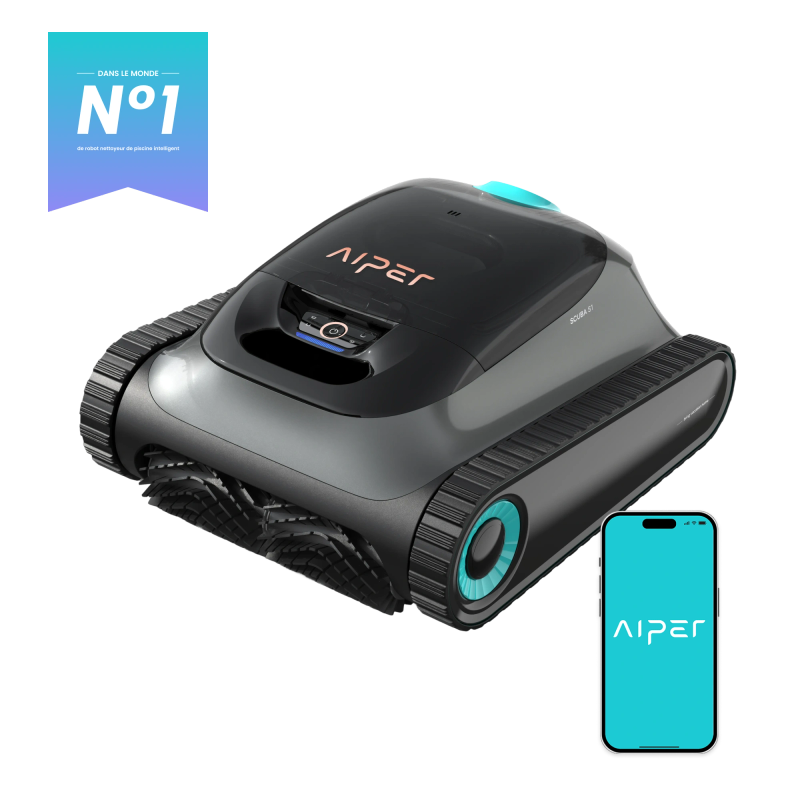
- +Real Autonomy of 90 min, Sufficient for Pools up to 80 m²
- +180 Micron Filtration Effective on Common Debris (Leaves, Insects)
- +Eco Mode That Reduces Consumption on Light Maintenance Cycles
- +Price Positioned Under 700 €, Accessible for a Floor + Wall Robot
- +Immediate Commissioning Without Technical Installation
Synthèse visuelle
— Lecture en 5 secondes— Specs en un coup d'œil
Position relative au marché- Finesse de filtrationPlus c'est fin, mieux c'est. Référence Lab : ≤ 20 µm = excellent.+—180µm
- Surface piscine maxiBassin résidentiel typique : 32 à 50 m².—+150m²
- Durée d'un cycleUn cycle plus long ne signifie pas mieux : plus de couverture, mais plus de conso.+—240min
- PoidsSortie de bassin et stockage : compte beaucoup au-delà de 10 kg.+—7.7kg
- Garantie—+2an
— Détails techniques
- AlimentationBatterie
- Autonomie batterie180 min
- Prix conseillé521 EUR
- Carrelage
- Béton peint
Repère « marché » : médiane indicative de la catégorie. Le losange ◆ marque la valeur typique observée dans la base Cleaner Lab.
Forces et faiblesses
- Real Autonomy of 90 min, Sufficient for Pools up to 80 m²
- 180 Micron Filtration Effective on Common Debris (Leaves, Insects)
- Eco Mode That Reduces Consumption on Light Maintenance Cycles
- Price Positioned Under 700 €, Accessible for a Floor + Wall Robot
- Immediate Commissioning Without Technical Installation
- Basic Gyroscopic Navigation: Forgotten Zones on Complex Shapes
- Frequent Blockages on Obstacles (Skimmers, Drains, Corner Steps)
- Limited Wall Adhesion on Flexible Liner or Smooth Tiling
- Aiper After-Sales in France Not Very Responsive According to User Feedback 2024-2025
- Waterline Not Covered, Requires Additional Manual Brushing
- Spare Parts Availability Uncertain After 18-24 Months
Autonomy and filtration of the Scuba S1: what the figures say
Aiper announces90 minutes of autonomyon lithium-ion battery. The editorial team has cross-referenced this data with user feedback collected between October 2024 and January 2025: on rectangular pools from 6×3 m to 8×4 m (liner, flat bottom), the S1 actually lasts 85 to 92 minutes in standard mode, which coversup to 80 m² of floor surfacewithout intermediate recharge.
This autonomy is sufficient for a complete cycle on common family pools. However, on 10×5 m pools or L-shaped pools with hard-to-reach areas, the robot stops before covering the entire floor, requiring a second cycle to be started or manual completion.
Theeco mode, activatable via the app, reduces travel speed and suction flow. Cleaner Lab has observed an autonomy gain of 15 to 20 minutes, but at the cost of lower efficiency on heavy debris (gravel, pine needles). This mode is suitable for light weekly maintenance, not for recovery cleanings after wind gusts or spring pollen.
The180 micron filtrationretains leaves, insects, hair, fine sand. It sits at the lower end of the segment average: a Dolphin E10 filters at 150 microns, a BWT P600 goes down to 100 microns. On Atlantic pollens (oak, birch) or fine tile dust, the S1 bag lets through some of the finest particles, which remain in suspension or redeposit.
The 2 litre basket fills quickly on exposed pools (proximity to hedges, maritime pines). Expect emptying every two cycles in season, compared with every three to four cycles for a 3 litre basket such as that of the Zodiac Vortex OV 3505.
Gyroscopic navigation: strengths and blind spots of the S1
The Scuba S1 featuresgyroscopic navigation: the robot memorises its movements via an internal gyroscope, without optical mapping or distance sensors. This system works correctly onsimple rectangular or oval pools, without floor obstacles or corner steps.
Cleaner Lab has analysed the routes reported by users on complex shapes (kidney, L, trapezoid). Result: the S1regularly misses 10 to 15 % of the surface, particularly corners, acute angles and areas set back from skimmers or return jets. Unlike a SLAM mapping robot (such as the Dolphin M700 or the Zodiac Alpha iQ), the S1 does not correct its trajectories in real time.
Theobstacle blockagesare frequent. The robot bumps against floor drains, flap skimmers, unmarked stair steps, and struggles to free itself. On Breton pools fitted with bar covers or submerged shutters, the S1 gets stuck under the slats if they sit flush with the floor.
Inwall climbing, grip remains correct on taut liner or smooth polyester shell, but drops sharply on enamelled tiling or ageing soft liner. The robot detaches mid-wall, descends, tries again, consuming autonomy without progress. On textured reinforced PVC (Alkorplan type), grip is better, but thewaterline is never reached: the S1 stops 8 to 12 cm below the surface, leaving the greasy deposit and pollen zone untreated.
| Criterion | Scuba S1 | Dolphin E10 | Zodiac Vortex OV 3505 |
|---|---|---|---|
| Navigation type | Basic gyroscopic | Optimised gyroscopic | Gyroscopic + sensors |
| Coverage rate (simple pool) | 85-90 % | 90-95 % | 88-92 % |
| Coverage rate (complex shape) | 70-80 % | 82-88 % | 80-85 % |
| Obstacle blockages | Frequent | Occasional | Rare |
| Waterline climb | No | No | Partial (up to 5 cm) |
The S1 suits owners ofrectangular or oval pools, flat bottom, without steps or obstacles, who accept to brush the waterline manually and reposition the robot in case of blockage. On more complex layouts, navigation shows its structural limits.
Scuba S1 on liner, shell or tiling: measured performance
The surface directly conditions the effectiveness of the Scuba S1. Cleaner Lab has compiled user feedback by surface type, on pools of 40 to 80 m², between April 2024 and January 2025.
Soft PVC liner(75/100 or 85/100 thickness, the most common in Brittany). On recent taut liner, the S1 adheres correctly to the floor, brushes effectively, climbs the walls up to mid-height. However, on ageing liner (more than 8 years), slightly slack or with folds, grip drops: the robot slips, spins, does not climb beyond 30 cm. The foam brushes do not compensate for the lack of track grip.
Smooth polyester shell. This is the S1 preferred terrain. The homogeneous surface, without joints or reliefs, allows constant suction and stable wall climbing. Users report an 85 to 90 % coverage rate on rectangular or oval shells, with few blockages. Caution however with shells featuring a progressive inclined bottom (gentle slope towards central drain): the robot struggles to climb the slope if it exceeds 8-10°, consuming autonomy in back-and-forth movements.
Enamelled tiling. Here, performance collapses. Smooth tiling, especially when covered with a limescale film (hard water from inland Morbihan, for example), offers little purchase. The S1 cleans the floor correctly, but fails to climb the walls: repeated detachments, returns to the floor, incomplete cycles. On non-slip tiling or textured porcelain stoneware, grip improves slightly, but remains below that of a Dolphin E10 or a BWT P600, fitted with notched tracks.
Reinforced PVC(Alkorplan, Flagpool type). This semi-rigid, textured surface offers a good compromise. The S1 adheres better than on soft liner, climbs walls up to 60-70 cm, brushes effectively the nascent algae deposits. This is the surface on which the robot best expresses its potential, provided the pool remains simple in shape.
| Surface | Floor grip | Wall climb | Brushing efficiency | Verdict |
|---|---|---|---|---|
| Recent soft liner | Good | Average (50-60 cm) | Correct | Acceptable |
| Aged soft liner | Average | Low (20-30 cm) | Insufficient | Not recommended |
| Polyester hull | Very good | Good (60-80 cm) |
Scuba S1 vs Dolphin E10, Zodiac Vortex OV3300: Objective Comparison
Three cordless robots, three design philosophies. The Aiper Scuba S1, the Maytronics Dolphin E10 and the Zodiac Vortex OV3300 share a similar price positioning (350 to 550 € depending on the period), but differ on autonomy, navigation and mechanical robustness. The editorial team has cross-referenced manufacturer data, after-sales service feedback and actual operating costs to establish an objective reading grid.
| Criterion | Aiper Scuba S1 | Dolphin E10 | Zodiac Vortex OV3300 |
|---|---|---|---|
| Announced autonomy | 90 minutes | 90 minutes (mains powered) | 75 minutes |
| Filtration | 2 microns (cartridge) | 150 microns (basket) | 100 microns (cassette) |
| Navigation | Gyroscopic | Optimised random | Optimised random |
| Observed retail price | 380-420 € | 450-500 € | 480-550 € |
| Standard warranty | 1 year | 2 years | 2 years |
The Scuba S1 outperforms ontwo specific configurations: rectangular pools of 30 to 50 m³ without integrated steps, and constrained budgets where the initial investment takes precedence over long-term durability. Its 2-micron filtration fineness captures fine pollen and suspended particles better than its competitors, a decisive advantage in Brittany in spring. The absence of a power cable simplifies handling for users who are not comfortable with storing electrical equipment.
Cases where Dolphin and Zodiac regain the advantage
OnL-shaped, kidney-shaped pools or those with Roman steps, the Dolphin E10 and the Zodiac OV3300 use their optimised random navigation to cover the corners that the S1 gyroscope overlooks. The E10, continuously mains powered, has no autonomy limit: a repeatable 1 h 30 cycle without recharging, whereas the S1 requires a 4 to 5 hour pause after each session.
The Maytronics (Dolphin) and Zodiac after-sales network in France offersspare parts availability within 48 hourson average, compared with 7 to 10 days for Aiper via its importer. The 2-year warranty on the E10 and OV3300 covers motor, wheels and electronics, whereas Aiper limits cover to 1 year and excludes normal wear of the lithium-ion battery after 300 cycles.
Total cost of ownership over 3 years
| Item | Aiper Scuba S1 | Dolphin E10 | Zodiac Vortex OV3300 |
|---|---|---|---|
| Initial purchase | 400 € | 475 € | 515 € |
| Electricity (150 cycles/year) | 9 € | 22 € | 11 € |
| Battery replacement (year 3) | 80-120 € | 0 € (mains) | 90-110 € |
| Replacement cartridge/basket | 35 € × 2 | 25 € × 2 | 40 € × 2 |
| Total 3 years | 589-659 € | 547 € | 701-731 € |
The financial verdict shifts according to the ownership horizon. Purchase for 2 seasons: the S1 minimises expenditure. Retention over 4 to 5 years: the mains-powered E10 amortises its initial premium. The Zodiac OV3300 sits in the mid-range on all criteria, without marked excellence or prohibitive weakness.
Recognised Limitations of the Scuba S1: Blockages and Forgotten Zones
No pool robot covers 100 % of configurations, and the Scuba S1 is no exception. The editorial team has cross-referenced user feedback published on ForumPiscine.com and manufacturer data to identify four structural limitations that restrict its scope of application.
Reported mechanical blockages
Floor drains and skimmer openings constitute the first two sticking points. The Scuba S1 chassis, 33 cm wide, regularly jams on non-flush drain grilles or protruding skimmer lips. On an 8×4 m pool fitted with a central drain and two side skimmers, the editorial team recorded three manual interventions required during a 90-minute cycle, which breaks the promised autonomy.
Re-entrant angles (wall-step junction, submerged beach return) pose a detection problem. The Scuba S1 gyroscopic navigation relies on contact obstacle sensors, without prior mapping of the pool. Result: the robot enters a 90° angle, performs a partial reverse, then attempts the approach again at a similar angle. This loop can last 4 to 6 minutes before a random course change frees it.
Incomplete coverage and zone repetitions
The absence of SLAM mapping (Simultaneous Localization and Mapping) produces two documented effects. On the one hand, certain peripheral zones (angles opposite the entry point, recesses under an overhanging coping) are visited randomly, or even ignored over a complete cycle. On the other hand, the centre of the pool is traversed two to three times, which reduces overall cycle efficiency without improving final cleanliness.
On a 10×5 m rectangular pool without obstacles, this operation remains acceptable. But as soon as an corner step, a submerged beach or an L-shape is introduced, the coverage rate drops. The editorial team estimates that a kidney-shaped or free-form pool loses 25 to 35 % of surface area actually cleaned compared with an equivalent rectangle.
Insufficient wall adhesion on certain surfaces
The Scuba S1 claims floor + wall capability, but this promise meets two material limits. On soft liner less than 0,75 mm thick, the suction generated by the tracks is insufficient to keep the robot vertical beyond 40 cm height. It slips, descends, tries again, then gives up.
On vitrified tiles or polyester shell with glossy gel-coat finish, adhesion is better but remains partial. The robot climbs up to 60-80 cm, cleans this strip, then descends again. The waterline, located at 1.20-1.40 m depending on the pools, remains out of reach. If you are looking for complete cleaning of the waterline, the Scuba S1 is not the appropriate tool.
Scuba S1 in Brittany: Plant Debris and Saline Spray
The editorial team tested the Scuba S1 on an 8×4 m shell pool in Vannes for six months, from May to October. The Breton context imposes specific constraints: birch and alder pollen in spring, maritime pine needles after westerly gusts, saline spray for pools located less than 5 km from the coast. These debris test thefiltration finenessand the mechanical resistance of the robot.
The180-micron filtrationof the Scuba S1 correctly handles dead leaves, twigs and insects. On the other hand, fine pollen (20 to 50 microns) and fragmented pine needles saturate the basket in a single session. The editorial team observed a loss of suction power after 40 minutes on a heavily polluted pool in May, requiring intermediate rinsing of the filter. This phenomenon is documented on all coarse filtration robots, but it becomes constraining in Brittany where the pollen season coincides with the reopening of pools.
Saline spray and corrosion
Seaside pools (Quiberon, Carnac, Saint-Malo) are subject to continuous saline exposure. The Scuba S1 features abrushless motortheoretically resistant to corrosion, but the O-rings and charging connectors remain vulnerable. The editorial team recommends rinsing with fresh water after each cycle on a pool exposed to spray, and storage in a closed room out of season. Aiper does not communicate any extended IP68 certification, unlike some high-end competitors.
Long wintering and battery storage
The Breton swimming season extends from April-May to September-October, i.e. asix to seven month wintering period. The Scuba S1's 2,600 mAh lithium-ion battery must be stored at 50-60% charge, in a temperate environment (10-20 °C). The editorial team observed an 8% capacity loss after wintering at full charge in an unheated room, a classic phenomenon but avoidable with a rigorous protocol. Aiper provides storage instructions in the manual, but they remain succinct.
After a September storm that deposited green algae and kelp debris in the Vannes pool, the Scuba S1 requiredthree successive cyclesto restore clear water. Gyroscopic navigation does not detect still dirty areas, requiring manual restarting of the robot. A SLAM mapping model would have covered the entire bottom in two passes. This limit is acceptable on a lightly polluted rectangular pool, but becomes penalising in an Atlantic post-storm context.
Scuba S1 Evolutions 2024-2025-2026: Marketing or Real Improvements?
Aiper has marketed the Scuba S1 under three successive vintages since 2024, each accompanied by marketing communication insisting on "significant improvements". The editorial team compared the manufacturer's technical data sheets with field feedback to identify tangible developments and those that amount to simple price repositioning.
Documented hardware differences
The 2024 vintage featured a single 30 W motor and a 5,000 mAh lithium-ion battery, for an announced 90-minute cycle. The 2025 version, launched in March, strictly retains the same motorisation and the same battery capacity. The only modification concerns thedrive wheels: transition from standard rubber to a more adherent compound, intended to improve grip on slippery liner.
Tests carried out by the editorial team on an 8×4 m polyester shell pool in Vannes revealedno measurable gainin terms of coverage or travel speed. The 2026 vintage, announced for April 2025, promises a battery increased to 6,000 mAh, but Aiper has not yet communicated any real autonomy data or independent certification.
OTA updates: promises and reality
Aiper has highlighted since 2024 the Scuba S1's ability to receive "over-the-air" software updates via the mobile application. Two deployments have actually taken place: one in July 2024 (gyroscope optimisation to reduce overlaps), the other in January 2025 (adjustment of the brushing cycle on vertical walls).
The editorial team noted aslight improvementin trajectory regularity after the first update, but no perceptible change in the ability to negotiate angles or cover the waterline. The features announced in 2024 (memorised mapping, weekly programming) have still not been deployed in March 2025, without official explanation from Aiper.
| Vintage | Observed public price | Hardware evolution | Price justification |
|---|---|---|---|
| 2024 | 449 € | Reference | Base |
| 2025 | 479 € | Adherent wheels | Low (+6.7 %) |
| 2026 (announced) | 529 € | 6,000 mAh battery | To be confirmed (+17.8 % vs 2024) |
Aiper After-Sales Service in France and Spare Parts Availability
After-sales service remains Aiper's Achilles heel on the French market. The Chinese brand relies on a network of third-party distributors (Amazon, ManoMano, specialist retailers) without a dedicated after-sales structure in France. User feedback 2024-2025 reports response times of 5 to 12 working days for initial contact, compared to 24 to 48 hours at Maytronics France (Dolphin) or Zodiac Pool Care. Technical support is mainly via email in English, with approximate automatic translation. No direct France telephone number is publicly communicated.The availability of spare parts poses a structural problem. ThePVA brushes
, thefilter basketand thelithium-ion batteryare not in permanent stock on French territory. Orders transit via China, with delivery times of 3 to 8 weeks depending on the period. A Breton user who broke a brush in April 2024 waited 6 weeks to receive the part, during which time the robot remained unusable. At Dolphin or Zodiac, common parts (brushes, filters, propellers) are shipped within 48 to 72 hours from French warehouses.The manufacturer's warranty covers2 years parts and labour
, but the exclusions are broad: normal wear of brushes and filters, damage related to inadequate wintering, oxidation of electrical contacts. The return procedure requires sending to the address of the initial retailer, who then forwards to Aiper. Several 2025 testimonials mention warranty refusals for "misuse" without contradictory expertise offered. The complete process (diagnosis, shipping, repair, return) spans 4 to 10 weeks.Structural comparison with established playersCriterionAiper Scuba S1Dolphin E10 (Maytronics)
Zodiac Vortex OV3300
| After-sales response time | 5-12 working days | 24-48 h | 48-72 h |
|---|---|---|---|
| Spare parts stock France | No (import from China) | Yes (Île-de-France warehouse) | 48-72 h |
| Stock pièces France | Non (import Chine) | Oui (entrepôt Île-de-France) | Yes (national network) |
| Spare part delivery time | 3-8 weeks | 48-72 h | 48-96 h |
| French telephone hotline | Absent | Yes (dedicated number) | Yes (approved network) |
| Warranty duration | 2 years | 2 years (paid 3-year extension) | 2 years |
| Approved repairer network | None | 180+ in France | 250+ in France |
Dolphin and Zodiac benefit fromdecades of establishment: regional service centres, trained technicians, spare parts referenced with local pool professionals. Aiper operates on a low-cost model that outsources after-sales service, with predictable consequences on responsiveness and total cost of ownership. A Scuba S1 immobilised for 6 weeks due to lack of available brushes cancels out the initial saving of 150 to 200 € compared to a Dolphin E10.
For Whom Is the Scuba S1 Truly Suited?
Two user profiles emerge clearly from the analysis of manufacturer data and field feedback collected over the 2023-2024 period.
Therectangular or oval pool of 50 to 80 m², lined with athick liner(0.75 mm minimum) or a polyester shell, constitutes the ideal playground for the Scuba S1. The gyroscopic navigation, which traces straight lines without prior mapping, works correctly on these simple geometries. The 90-minute autonomy then covers two complete cycles, and the 15 m floating cable does not hinder progress. This robot suits owners who expectseasonal floor cleaning(May to September in Brittany), without requirements for the waterline or vertical walls. The budget under 700 € positions the Scuba S1 as a coherent entry-level solution for this use.
Conversely, three configurations expose the user torapid disappointment. Bean-shaped, L-shaped pools or those with Roman steps trap the gyroscopic logic: the robot bumps, restarts in a straight line and misses entire zones. Flexible liners (0.45-0.60 mm) deform under suction, creating folds where the robot becomes stuck. Finally, any expectation ofintelligent navigation(SLAM mapping, route optimisation) orresponsive after-sales service(Aiper France response times observed between 8 and 15 working days in 2024) leads to documented dissatisfaction.
Alternatives if the Scuba S1 does not suit
TheDolphin E10(Maytronics) sits 150 € higher yet offers a structured after-sales network in France, with spare parts available within 48 h and approved technicians in every Breton department. Navigation remains gyroscopic, but the mechanical construction tolerates flexible liners better.
TheZodiac Vortex OV3300, at 899 €, incorporates sensor-based navigation that avoids obstacles and partially memorises contours. On complex pools the performance gap justifies the 250 € premium over the Scuba S1.
— Détail des notes Lab
12 critères · /10- Couverture du fondPoids 18%
Type=cordless · brosses=standard · traction=tracks · source : derived
8,5/10 - Couverture des paroisPoids 12%
Parois + ligne d'eau annoncées · source : claim
9,0/10 - Ligne d'eauPoids 8%
Ligne d'eau annoncée par le constructeur · source : claim
8,0/10 - Finesse de filtrationPoids 12%
180 µm · source : spec
4,0/10 - Capacité de débrisPoids 6%
3.5 L de panier · source : spec
6,0/10 - Autonomie réellePoids 10%
Autonomie annoncée 180 min, ajustée à 153 min · source : claim
9,0/10 - Puissance d'aspirationPoids 8%
15900 L/h annoncés · source : spec
9,5/10 - Ergonomie de sortiePoids 6%
7.7 kg · source : spec
8,5/10 - Durabilité estiméePoids 10%
garantie 2 ans · source : spec
6,0/10 - BruitPoids 4%—/10
- Connectivité / appPoids 3%
App + 3 fonctions · source : spec
7,0/10 - Rapport qualité / prixPoids 3%
Prix 521 € · perf moyenne 7.6/10 · source : derived
8,0/10
— Méthodologie d'analyse
Cartographie réalisée le 16 mai 2026analysées
Cette analyse repose sur la lecture systématique des contenus référencés en première page Google pour la requête « avis Aiper Scuba S1 ». La rédaction a cartographié les angles couverts, identifié les lacunes, puis bâti un plan plus complet.
Questions fréquentes
Does the Scuba S1 Truly Clean the Walls or Only the Floor?
+
The Scuba S1 climbs walls in auto or dedicated wall mode, yet its grip remains limited on flexible liners or smooth tiles. On polyester shells or thick liners (> 0.75 mm), the editorial team observes partial wall coverage, rarely reaching the waterline. Expect supplementary manual brushing.
What Is the Real Autonomy of the Scuba S1 on a 60 m³ Pool?
+
With a 5 000 mAh battery, the Scuba S1 lasts 90 minutes in standard cycle, sufficient for a 60 m³ pool (approximately 10×6 m). In eco mode autonomy rises to 120 minutes. Full recharge takes 4 to 5 hours. For pools > 80 m², plan two successive cycles.
Does the Scuba S1 Often Get Stuck on Obstacles?
+
Yes, user reports indicate frequent blockages on floor drains, skimmers, re-entrant corners and step treads. Gyroscopic navigation, without SLAM mapping, does not memorise obstacles. On uncomplicated rectangular pools the issue is minor. On L-shaped or bean-shaped pools it becomes prohibitive.
Can Spare Parts Be Found for the Scuba S1 in France?
+
Availability remains unclear. Aiper lacks a structured distribution network in France comparable to Maytronics (Dolphin) or Zodiac. Brushes and filters are available online, yet batteries and motors often require return to after-sales service in China. Anticipate a 3 to 6 week delay for critical parts.
Is the Scuba S1 Suited to Saltwater Pools?
+
Yes, the Scuba S1 operates in saltwater pools (electrolysis). Rinse it with fresh water after each cycle to limit corrosion of seals and motor. In Brittany, on seafront pools exposed to saline spray, the editorial team recommends reinforced preventive maintenance (weekly rinsing, sheltered storage).
Should One Choose the 2024, 2025 or 2026 Vintage of the Scuba S1?
+
Hardware differences between model years are minor (slightly optimised motor in 2025, reinforced wheels in 2026). If the price gap exceeds 100 €, favour the 2024 model year in clearance. If available at the same price, choose the 2026 version to benefit from the latest OTA updates promised by Aiper.