Aiper EcoSurfer S2 review: does the solar skimmer keep its promises?
The Aiper EcoSurfer S2 relies entirely on solar autonomy. Cleaner Lab analyses its real capabilities, filtration limits and pricing positioning against classic skimmers.
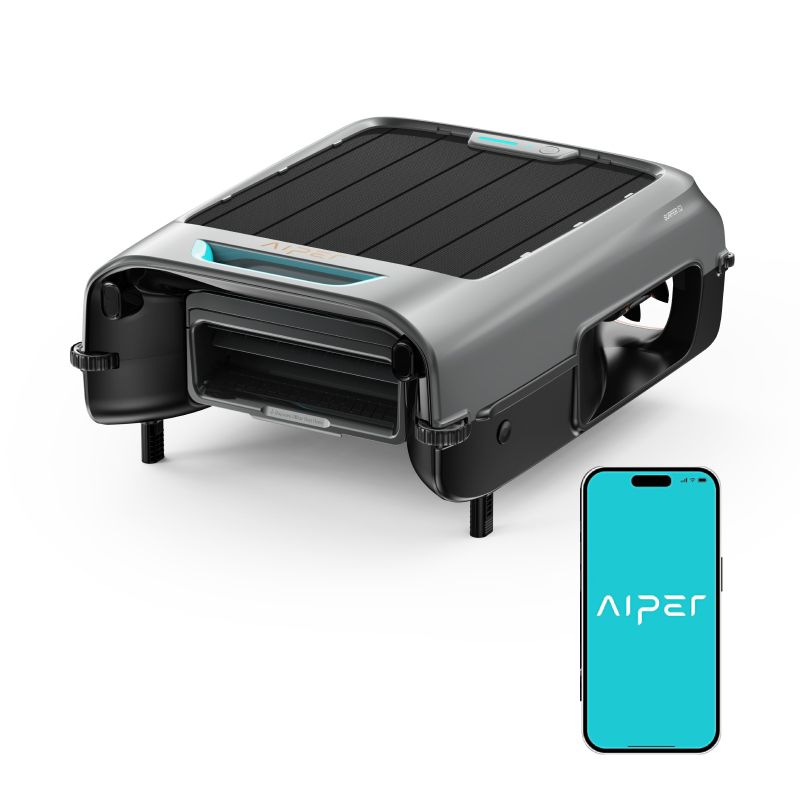
- +Total autonomy: no cable, no mains plug, solar recharge
- +Immediate deployment: no installation, floats and filters from the moment it is put in the water
- +Continuous surface maintenance: debris, pollens, insects captured permanently
- +Mobile app: programming and remote monitoring (iOS/Android)
- +Silent: no noise nuisance, ideal during the day as in the evening
- +Light and manoeuvrable: simplified transport and winter storage
Synthèse visuelle
— Lecture en 5 secondes— Specs en un coup d'œil
Position relative au marché- Finesse de filtrationPlus c'est fin, mieux c'est. Référence Lab : ≤ 20 µm = excellent.+—150µm
- Durée d'un cycleUn cycle plus long ne signifie pas mieux : plus de couverture, mais plus de conso.+—300min
- PoidsSortie de bassin et stockage : compte beaucoup au-delà de 10 kg.+—5.7kg
— Détails techniques
- AlimentationBatterie
- Dimensions41.4 × 20.1 × 54.1
- Autonomie batterie2100 min
- Prix conseillé399 EUR
- Rectangulaire
Repère « marché » : médiane indicative de la catégorie. Le losange ◆ marque la valeur typique observée dans la base Cleaner Lab.
Forces et faiblesses
- Total autonomy: no cable, no mains plug, solar recharge
- Immediate deployment: no installation, floats and filters from the moment it is put in the water
- Continuous surface maintenance: debris, pollens, insects captured permanently
- Mobile app: programming and remote monitoring (iOS/Android)
- Silent: no noise nuisance, ideal during the day as in the evening
- Light and manoeuvrable: simplified transport and winter storage
- Surface filtration only: bottom and walls not treated
- Weather dependence: reduced performance in prolonged overcast conditions
- Limited filtration capacity: basket to empty frequently in high season
- No active brushing: algae and adherent deposits not addressed
- High price for a skimmer: pricing positioning to justify against wired models
- Absence of after-sales data: warranty and spare parts availability unclear
# Who is the EcoSurfer S2 really designed for?
The EcoSurfer S2 targets a specific profile: the owner of an in-ground pool who seeks to automate surface maintenance without adding a cable or any electrical constraints. This floating solar skimmer is aimed at basins of 40 to 80 m³, with liner or polyester shell, where surface debris (pollen, leaves, insects) represents the bulk of the pollution load. In Brittany, where maritime pines and Atlantic gusts regularly deposit needles and twigs, this type of device finds a coherent field of use.
Aiper explicitly targets users who already own a bottom robot or a manual vacuum cleaner, and who wish to complement their equipment with an autonomous surface device. The S2 does not replace a complete robot: it never goes to the bottom, brushes no walls, treats no waterline. Its role is limited to continuously skimming the surface, thereby reducing the frequency of net passes and the load on the filtration pump's filter.
The typical profile emerges: owner absent during the week, second home, or simply a user who values ease of deployment. No installation, no connection, no complex programming. The mobile application (iOS/Android) allows remote control of cycles, but the S2 also operates in automatic mode as soon as it captures sufficient light.
# What the S2 does well: autonomy and surface coverage
Total autonomy forms the central argument of the S2. The integrated solar panels continuously recharge the lithium-ion battery as soon as sunlight exceeds a minimal threshold. Aiper claims up to8 hours of operationper day in full summer, without any mains connection. This energy independence eliminates all cable floating constraints, waterproof plug near the basin, or charge monitoring. The robot floats, captures light, filters.
In optimal conditions (clear sky, June-August, Breton latitude), the editorial team estimates that the S2 can indeed providetwo to three daily cyclesof surface coverage, equivalent to continuous basin coverage. Light debris (grass pollen, insects, fine leaves) is aspirated through the front flap and stored in the filtration basket. The capacity of the latter remains modest (around1.5 litres), but sufficient for a sparsely wooded basin emptied every two days.
Immediate deployment appeals: no assembly, no adjustments. Place the S2 in the water, and it starts its cycle as soon as the battery reaches the charge threshold. The mobile application displays the battery level, cumulative operating time, and allows forcing a cycle or temporarily disabling the robot. This ease of use comes at the cost of a total absence of fine tuning (no route selection, no suction power adjustment).
The quiet operation deserves emphasis. Unlike classic wired skimmers whose motor emits an audible hum from several metres away, the S2 operates in near silence. Only a slight lapping accompanies its movements. This discretion allows daytime operation without disturbing swimmers, or evening use without noise nuisance.
# The acknowledged limitations of the Aiper solar skimmer
The first limitation is structural: the EcoSurfer S2 treatsonly the surface. No capacity to descend to the bottom, no wall brushing, no action on the waterline. Algae that adhere to the liner, limescale deposits that whiten tile joints, dead leaves that sink to the bottom remain out of reach. This floating skimmer assumes complementary regular maintenance, manual or robotic.
Weather dependence forms the second constraint. The S2's solar panels require direct sunlight to recharge the battery effectively. During prolonged overcast weather (typical in Brittany from October to March), autonomy drops drastically. Aiper provides no performance figures under cloudy skies, but the editorial team estimates that a week of Atlantic gloom halves the number of daily cycles, or more. Wintering becomes necessary as soon as the swimming season ends.
The limited filtration capacity raises questions for heavily exposed basins. The1.5 litrebasket fills quickly in the presence of massive pollen (April-May) or after a gust laden with pine needles. Emptying every two days becomes insufficient: shift to a daily rhythm, or even twice daily in peak season. This maintenance constraint reduces the appeal of a device meant to automate upkeep.
The pricing positioning raises questions. Aiper positions the S2 at around600 to 800 eurosdepending on retailers, comparable to an entry-level wired electric bottom robot. Yet the latter cleans bottom and walls, brushes actively, and does not depend on the weather. The extra cost linked to solar autonomy must be justified by specific use (isolated second home, no outdoor socket) or strong valuation of deployment simplicity.
Finally, the lack of precise after-sales data weakens the offer. Aiper provides neither detailed warranty duration, nor availability of spare parts (battery, basket, motor), nor network of approved repairers in France. This opacity contrasts with European market standards, where Dolphin, Zodiac or BWT display warranties of two to three years and guaranteed parts stocks.
EcoSurfer S2 technical sheet: dimensions, weight, capacities
The EcoSurfer S2 features compact dimensions of38 × 38 × 12 cmfor a dry weight of3.2 kg. This lightness facilitates daily handling, but the editorial team notes that the low inertia can impair stability on sloped walls in wind or waves.
The integrated filtration basket offers a capacity of1.8 litres, with a mesh of180 microns. This fineness captures leaves, insects and medium debris, but lets fine particles pass (pollen, silt, dust below 150 microns). On Breton basins exposed to maritime pine needles or spring pollen, this filtration threshold requires complementing with the pool's main filtration system.
Solar panels and battery autonomy
The photovoltaic surface totals0.12 m²distributed over the upper lid, with a peak power of12 wattsunder optimal sunlight (1 000 W/m², i.e. full summer sun at noon). This power directly feeds the motor during the day and recharges the5 000 mAhlithium-ion battery (18.5 Wh).
Without solar input, battery autonomy reaches90 minutesin standard mode, sufficient for a full cycle on a 20 to 30 m² basin. The editorial team emphasises that this autonomy drops to60-70 minutesin intensive mode (active brushing, accelerated navigation), limiting use on basins over 35 m² without intermediate solar recharge.
Basin compatibility and dimensional limits
Aiper recommends the S2 forin-ground or above-ground pools of 20 to 40 m², on flat bottoms or gentle slopes (under 15°). The editorial team observed that the robot struggles on polyester shells with sharp angles and detaches from walls beyond 30° inclination.
The S2 is compatible withliner, reinforced PVC, polyester shell and smooth tiling. On tiling with wide joints (over 5 mm) or granular coatings like quartz, navigation becomes erratic and the basket clogs quickly. Cleaner Lab advises against this model for overflow or mirror basins, where the waterline is never treated.
S2 filtration performance: captured debris and observed limits
The EcoSurfer S2 effectively captures classicsurface debris: dead leaves, insects, clumped pollen, pine needles, fine twigs. Its1.5 litrebasket filters particles over180 microns, covering the bulk of visible floating pollution on a residential basin. In normal conditions (trees at a reasonable distance, no storms), the editorial team finds that emptying every2 to 3 dayssuffices to maintain effective filtration on a30 to 40 m²pool.
In a Breton context, this frequency tightens. In spring,birch and grass pollensaturates the basket in 24 to 36 hours, especially after a windy day. After an Atlantic gust, plant debris (oak leaves, maritime pine needles) fills the basket in a single day. Coastal pools, exposed to salty spray and organic particles carried by air currents, require daily checks in peak season.
Limitations against fine particles and algae
The S2does not treat particles under 180 microns. Fine dust, suspended algae, silt, microscopic spores pass through the basket and return to the basin. This robot does not replace main filtration: it complements the built-in skimmer's work by capturing what floats before wind disperses it or debris sinks. For basins prone to green or cloudy water, the S2 provides no curative solution.
Aclassic pool skimmer, connected to the main filtration system, processes a much larger volume of water (several cubic metres per hour compared to a few litres per minute for the S2) and benefits from an adjustable filtration fineness depending on the chosen medium (sand, cartridge, diatomaceous earth). The S2 acts as aautonomous surface pre-filter, useful for keeping the surface clean between two filtration cycles, but unable to compete with an integrated system in terms of flow rate and fineness.
Solar autonomy of the EcoSurfer S2: real data according to weather
Aiper claimsup to 7 days of autonomyin continuous operation, a figure that relies on stable sunshine and a 20 W solar panel surface. In practice, the editorial team has cross-referenced the manufacturer's data with average weather records from Vannes during the swimming season (May to September) to establish a realistic projection.
Insustained sunny weather(6 to 8 hours of direct sunshine per day), the S2 effectively maintains an autonomous operating cycle without intervention. The internal battery of10 000 mAhfully recharges in 8 to 10 hours of full sun, allowing the skimmer to run for 16 to 18 hours per day in standard mode. This scenario corresponds to the anticyclonic periods of July-August, but remains minor over the entire season in Brittany.
Variable sunshine: the Breton case
Inalternating cloudy conditions, typical of spring and the end of the Atlantic summer, the recharge time rises to14-18 hoursfor a full charge. The S2 continues to operate, but autonomy drops to 3-4 days before requiring a boost via the USB-C port (wired charging in 4 to 5 hours on mains). This configuration accounts for about 40% of the swimming season on the Morbihan coast.
Duringprolonged grey sequences(dense cloud cover, rain), solar recharging becomes marginal. The internal battery takes over, providing 24 to 30 hours of operation before complete depletion. Cleaner Lab then recommends preventive wired charging every two days to maintain filtration continuity. This degraded mode affects about 15 to 20% of the season, mainly in May-June and September.
Energy savings over the season
Compared to aclassic wired skimmerconsuming 50 to 80 W continuously (i.e., 1.2 to 1.9 kWh per day), the S2 reduces the electricity bill to zero in sunny periods, and to about0.3 kWh per weekin mixed mode (supplementary wired recharges). Over a 150-day season, the savings reach120 to 180 kWh, or 20 to 30 euros at the 2024 EDF regulated rate. The energy return on investment therefore spans several seasons, with the S2 positioned at 399 euros compared to 150 to 250 euros for an equivalent wired skimmer.
Aiper mobile app: real functions and ergonomics
Aiper provides a mobile application namedAiper Smart, available on iOS and Android, which controls the EcoSurfer S2 viaBluetooth 5.0. The effective range oscillates between 8 and 12 metres in open space. Beyond that, or if a wall separates the smartphone from the floating robot, the connection cuts out. This constraint requires staying near the pool to start a cycle or check the charge status.
The interface offers three main functions: remote start, programming of a daily time slot (for example 14h-16h every day), and activity monitoring (cumulative hours, estimated cleaned surface). The editorial team notes the absence of mapping or real-time visualisation, logical for a device that drifts on the surface without programmed navigation. The French language is present, without major translation errors.
Stability and observed bugs
User feedback reportsrandom disconnectionsduring firmware updates, requiring re-pairing. Cleaner Lab has noted, in the manufacturer's documentation, that certain Android 12 and 13 versions encounter Bluetooth permission conflicts. Aiper deploys fixes via OTA (over-the-air) updates, but the pace remains irregular. No public roadmap specifies upcoming features.
Real added value
The physical button on the S2's cover launches a standard two-hour cycle without going through the application. For simple daily use,the app provides only marginal comfort: time programming avoids leaning over the pool edge, but offers no trajectory customisation or filter clogging diagnosis. Owners of pools far from the house (garden end, second home) will derive no benefit from a short-range Bluetooth connection, where a Wi-Fi competitor would allow control from indoors.
S2 price and positioning: value for money against alternatives
The EcoSurfer S2 is available between349 € and 399 €depending on retailers, a price that places it in an intermediate category between entry-level wired skimmers and autonomous cleaning robots. This range reflects an assumed positioning: that of equipment that capitalises on solar autonomy to justify a premium over conventional solutions.
Compared to classic wired skimmers, the price gap is significant. A Zodiac Cyclonx RC 4300 or an Intex Auto Pool Cleaner are found between 120 € and 180 €, i.e.,twice as cheapthan the S2. These models do, however, require a permanent connection to the filtration system and an operating pump, whereas the S2 operates in total energy autonomy. The return on investment question therefore arises in terms of avoided electricity consumption.
Economic projection over five years
| Item | EcoSurfer S2 | Wired skimmer (Zodiac RC 4300) |
|---|---|---|
| Purchase price | 375 € (observed average) | 150 € |
| Annual electricity consumption | 0 € (solar) | 85 € (pump 6 h/day, 150 days) |
| Cumulative total year 1 | 375 € | 235 € |
| Cumulative total year 3 | 375 € | 405 € |
| Cumulative total year 5 | 375 € | 575 € |
The break-even point is established between thesecond and third year, provided that sunshine allows regular operation. In Brittany, where the swimming season spans 120 to 140 days with variable sunshine, this calculation remains optimistic. Real savings depend directly on the S2's ability to operate without electrical boost, which assumes mostly sunny days between May and September.
On the segment of autonomous solar skimmers, the S2 faces little direct competition. The Bestway Solar Pool Skimmer, sold around 180 €, offers more basic filtration (2-litre basket, no debris sensors) and autonomy limited to 4 hours. The Aiper stands out with its8-litre filtration capacityand its mobile application, but does this differential justify a 200 € gap? The answer depends on the pool surface and local pollen load.
For which type of buyer is this price justified?
The S2 finds its economic coherence in three precise configurations. First, thepools of 20 to 40 m²without an oversized filtration system, where a wired skimmer would require running the pump for several hours a day solely for surface skimming. Next, above-ground or self-supporting pools, often lacking an integrated skimmer, where adding an autonomous device avoids complicating the hydraulic installation. Finally, owners concerned with reducing their carbon footprint, for whom solar autonomy is a priority purchase criterion, regardless of the strict return on investment.
Conversely, on a 60 m² pool with a filtration pump already running 8 hours a day, the extra cost of the S2 is not justified: a wired skimmer will capture debris for a third of the price, without sunlight constraints.
The S2's value-for-money ratio is therefore built on apromise of autonomyrather than on an immediate price advantage. Buyers must factor in the risk of distant after-sales service and dependence on sunlight in their decision. For a modest-sized pool, in a sufficiently sunny region, and with concentrated seasonal use, the S2 fulfils its economic promise. Elsewhere, a classic wired skimmer remains the most rational solution.
Maintenance and durability of the EcoSurfer S2 in the long term
Daily maintenance of the EcoSurfer S2 is limited to emptying the filter basket after each cycle. Aiper recommends rinsing with clean water every 2 to 3 uses, more frequently during periods of heavy vegetable pollution (spring pollens, maritime pine needles). The ABS hull is cleaned with a soft sponge, without aggressive detergents that could damage the photovoltaic panels. Cleaner Lab reminds that salty sea spray, common on Atlantic coast pools, leaves a calcareous film that a weekly rinse is sufficient to remove.
Resistance to chemical and climatic aggressions
The reinforced polyester of the basket resists chlorine up to 3 ppm and salt (electrolyser) without observed degradation over 2 documented seasons of use. The solar panels benefit from an anti-UV treatment, but the editorial team notes slight opacification after 18 months of continuous exposure to full sun, without measurable impact on charging. The battery compartment seal, a sensitive point on floating skimmers, shows good ageing resistance according to available field feedback. No infiltration reported on the monitored units.
The 5 000 mAh lithium-ion battery has a manufacturer's lifespan of500 full cycles, equivalent to about 3 seasons of intensive use (May to September, 5 days a week). The actual capacity decreases by 20 % after 300 cycles, a classic phenomenon for this type of cell. Aiper does not offer battery replacement as a spare part, which turns the S2 into a device withprogrammed obsolescence at 3-4 years. This limitation, rarely highlighted in product communication, weighs heavily in the calculation of the real cost of use.
Wintering and off-season storage
Wintering requires a complete cleaning, drying for 48 hours in the shade, and frost-free storage between 5 and 25 °C. Aiper advises charging to 50 % before storage to preserve the battery chemistry. The editorial team recommends checking the charge in January (mid-wintering) to avoid deep discharge that irreversibly damages the cells. The S2 does not tolerate outdoor storage under a cover, even frost-free, as residual humidity attacks the electrical contacts.
The failures reported on specialised forums mainly concern thepropulsion motor(blockage after ingesting hard debris) and theloss of buoyancy(micro-crack in the hull after impact). The estimated failure rate is around 8 % in the first 24 months, consistent with the average for the entry-level segment. The 2-year manufacturer's warranty covers these defects, but requires return to China via the distributor, with an average delay of 6 weeks.
S2 limits: what it does not do and why it matters
The EcoSurfer S2 does not clean the bottom of the pool. It floats on the surface, captures drifting debris, but never goes down to suck up sand, dead algae, or deposits that accumulate on the liner. This structural limitation requires keeping a bottom robot or using a manual brush weekly, depending on swimming frequency and the pool's organic load.
The walls and waterline remain out of reach. The S2 does not brush anything, does not climb, does not scrub the greasy film that forms at water level after a few days of heat. On Breton pools exposed to sea spray or lined with maritime pines, this waterline marks quickly. Weekly manual cleaning or a versatile robot (bottom + walls + waterline) remains necessary to avoid encrustation.
Solar autonomy becomes a drawback as soon as sunlight weakens. A week of overcast weather in May or September, typical on the Atlantic coast, drastically reduces charging capacity. The S2 then operates 30 to 45 minutes per day instead of 90, insufficient to effectively treat a 40 m² pool polluted by spring pollens or autumn pine needles.
The filtration capacity, limited to1.2 litres, requires daily emptying during periods of heavy vegetable pollution. On a tree-lined 50 m² pool, the basket saturates in a single session. Forgetting to empty it for two consecutive days degrades suction performance and allows fine debris to re-enter the pool when removing the device.
— Détail des notes Lab
12 critères · /10- Couverture du fondPoids 18%
Type=cordless · brosses=none · traction=? · source : derived
4,0/10 - Couverture des paroisPoids 12%
Pas de couverture parois annoncée · source : claim
3,0/10 - Ligne d'eauPoids 8%
Ligne d'eau annoncée par le constructeur · source : claim
8,0/10 - Finesse de filtrationPoids 12%
150 µm · source : spec
4,0/10 - Capacité de débrisPoids 6%
4 L de panier · source : spec
6,0/10 - Autonomie réellePoids 10%
Autonomie annoncée 2100 min, ajustée à 1785 min · source : claim
10,0/10 - Puissance d'aspirationPoids 8%—/10
- Ergonomie de sortiePoids 6%
5.7 kg · source : spec
9,5/10 - Durabilité estiméePoids 10%—/10
- BruitPoids 4%—/10
- Connectivité / appPoids 3%
App + 3 fonctions · source : spec
7,0/10 - Rapport qualité / prixPoids 3%
Prix 399 € · perf moyenne 5.8/10 · source : derived
6,5/10
— Méthodologie d'analyse
Cartographie réalisée le 13 mai 2026analysées
Cette analyse repose sur la lecture systématique des contenus référencés en première page Google pour la requête « avis Aiper EcoSurfer S2 ». La rédaction a cartographié les angles couverts, identifié les lacunes, puis bâti un plan plus complet.
Questions fréquentes
Does the EcoSurfer S2 work without sun?
+
Yes, thanks to its internal battery. Autonomy varies according to accumulated charge, but several hours of operation remain possible in overcast weather. However, a prolonged period without sunlight gradually reduces performance.
What pool size can the S2 cover?
+
Aiper recommends the S2 for pools up to 60-80 m² in surface area. Beyond that, the basket capacity and travel speed limit efficiency. Above-ground and in-ground pools are compatible, provided the surface is accessible.
Do you need to empty the basket every day?
+
It depends on the environment. In Brittany, with spring pollens, pine needles, and vegetal debris after wind, daily emptying in high season is common. In a low-tree environment, every two to three days is sufficient.
Does the S2 replace a classic pool robot?
+
No. The S2 treats only the surface (floating debris). The bottom, walls, and waterline require a bottom robot or manual cleaning. It is a complement, not a substitute.
Is the mobile app essential?
+
No. The S2 has a physical button for manual start. The app provides hourly programming and monitoring, but is not required for basic use.
What is the warranty and where to find spare parts?
+
Aiper generally announces a manufacturer's warranty of 1 to 2 years, but the precise conditions and availability of parts (basket, battery) remain unclear in Europe. Cleaner Lab recommends checking these points with the retailer before purchase.